

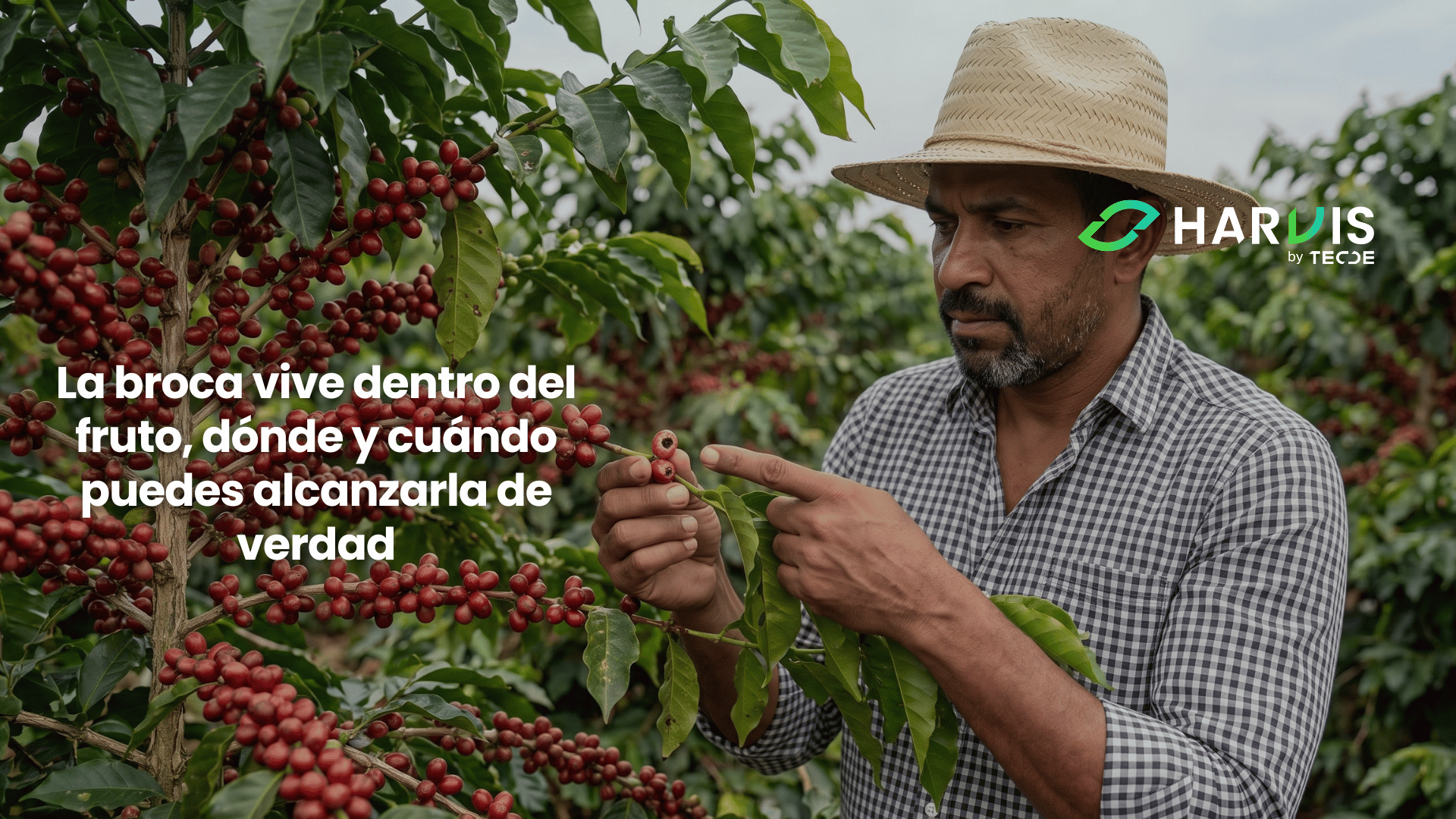
A single infested fruit left on the ground managed to infest, on average, 590 healthy fruits from the tree during the following year. Not 590 fruits across the entire hectare, but 590 starting from just one, measured in a trial that placed controlled amounts of infested fruits on the ground and followed what happened above for four years. That number alone rearranges the priorities of borer management, because it means that the insect you are targeting is not primarily in the canopy; it is in the coffee that no one picked.
There is no single application against the borer that solves the problem; there is a sequence of inexpensive operations that, when done at the right moment, reduce the population that starts the next cycle. What follows is where each of those operations is and what each yields.
An insect that is only within your reach for a few hours a day
The female borer drills into the fruit, settles in the seed, and there she eats, reproduces, and dies. Inside, she is protected from any product you apply by spraying, from the sun, from the rain, and from most of her natural enemies. That hidden life is what makes her so difficult to manage and explains why so many well-executed applications yield disappointing results; the product arrived, but it did not reach where the insect was.
The only time the borer is truly exposed is during the dispersal flight, when the already fertilized female leaves the old fruit and seeks a new one to infest. During that journey, she is vulnerable to chemical and biological control. Everything else in the cycle occurs outside your reach.
This flight also has a schedule. Studies of flight patterns with traps placed at different heights record low activity during the day and night with a marked peak between noon and four in the afternoon, and studies on mass emergence find that the highest number of captures concentrates between two and four in the afternoon in shaded lots and between three and five in fully exposed lots. The practical takeaway is uncomfortable for the habit of applying early in the morning, because a spray made at seven in the morning leaves a residue that, as we will see, loses almost all its activity before the target population starts to fly.
From this comes the first operational rule of this blog. Against the borer, the timing of the application is not a logistical detail that adjusts according to personnel availability; it is part of the method, and getting it wrong turns a complete application into an expense without measurable effect.
The coffee left on the ground is the borer's farm
The trial that opened this blog deserves to be looked at in full, because it is one of the few that quantify a mechanism that everyone intuits. Zero, one, five, ten, fifteen, and twenty infested fruits were placed on the ground of young coffee plantations in four locations situated between 1,218 and 1,700 meters above sea level, and the infestation of the trees was followed for four years covering an El Niño event, a La Niña event, a neutral year, and a transition.
The infested fruits on the ground functioned as a borer reservoir for an average of 140 days, with a deviation of just over eight days. That single data point already explains why infestation reappears in lots where applications were done well; the reservoir continued emitting insects for almost five months after harvest.
The magnitude of the effect changed with the climate in a way that is worth keeping in mind. In a neutral year, an infested fruit on the ground produced on average 590 infested fruits in the trees at 1,218 meters; in the La Niña year, that figure dropped to 151, and in the El Niño year, it rose to 959. Keep that range in mind, because it comes back two sections later when we calculate the cost of a revisit.
Altitude, for its part, drastically changed the size of the problem. Under the El Niño scenario, infestation reached values of 82 percent at 1,218 meters, 42 percent at 1,381, 24 percent at 1,470, and just 5.6 percent at 1,700 meters. In terms of farms, this means that two producers with the same collection discipline face problems of different scales depending on where their lots are, and that in the lower areas, revisiting stops being a recommended good practice to become the operation that sustains all management.
This connects directly with the degree days from the previous blog. At lower altitudes, there is more heat accumulated per day, the borer's cycle completes faster, and more generations fit into the same time window. Temperature is not a decorative meteorological data point; it is the clock that defines how many times your pest reproduces between one harvest and the next.
Timely harvest, the cheapest application you will make this year
With those numbers in hand, the calculation for revisiting becomes self-evident. If an infested fruit on the ground can generate between 150 and 950 infested fruits depending on the climatic year, then every fruit your crew collects from the ground and from the tree after the main harvest is preventing damage measured in hundreds of fruits, not just one. No product application has that relationship between cost and what it prevents.
The management literature consistently confirms this. Timely harvest and the collection of ripe and overripe fruits left on the ground or on the plant are efficient strategies for reducing pest populations, and under the conditions of Colombian coffee farming, collecting the fruits left by pickers is crucial for management. The same literature warns that the viability of this practice depends on resources, the availability of pickers, and their skill, which is exactly the type of restriction that is managed with a farm decision and not with a product.
The economic point is that this work competes with other uses of the same labor force, and that is where the price of the grain comes into play. When the price received rises, each saved fruit is worth more, and revisiting is paid for with fewer fruits collected; when the price drops, the same collection day needs to prevent more damage to justify itself, and the threshold you calculated last year stops being useful. As we already addressed in our blog When climate and market change, reflections from Colombian coffee farming, which you can read here, the internal price and the exchange rate move in cycles that do not depend on your farm but that completely change the profitability of each task; the borer threshold is one of the places where that movement translates into a concrete decision about how many revisiting days you authorize this year.
Knowing which lot the borer is in, not which one it was in
Could you today point out, on a map of your farm, the three lots where the infestation has been rising for the past two months, and say when the last reading of each was? In most operations, that information exists in a scattered form, in notebooks from different people and in the memory of the foreman, and that is why applications are ordered for the entire farm when the problem is concentrated in a fraction. Harvis helps you keep track of borer monitoring by lot and by date, to compare each reading against the threshold you defined, to record the revisits and applications with responsible parties and doses, and to see the trend of each lot instead of an average of the farm that hides exactly what you need to see. Write to us, and we will set up that record based on the lot structure you already manage.

Beauveria bassiana, what can be asked of it and under what conditions
The most used entomopathogenic fungus against the borer works, and it works within limits that almost never appear on the label. It is worth knowing them with numbers, because the difference between a realistic expectation and an inflated expectation is what decides whether the producer abandons the tool after the first campaign.
Field trials with the commercial strain GHA report a mortality of 12 to 15 percent in the founding females collected one to three days after spraying, and 9 to 10 percent in those collected ten days later, yielding 20 to 25 percent mortality per application. The accumulated mortality with multiple sprays stabilizes between 50 and 60 percent. That is the realistic ceiling of the tool applied alone, and it is a respectable ceiling for a product that leaves no residue and does not select for resistance, as long as it is not asked to play the role of a curative.
The residue has a short life that conditions the entire operation. Spray residues infected between 30 and 40 percent of the borers seeking fruit captured one day after application, and that activity fell below 11 percent after two days. The main cause is radiation. Unprotected conidia become practically inactive with sixty minutes of direct sunlight or with twenty seconds of ultraviolet light at 302 nanometers, and formulations with ten percent humic acid have managed to increase spore persistence to 87 percent seven days after application.
From this come three operational rules that are worth more than any dose adjustment. Apply when the sun is not shining directly, preferably in the afternoon or on cloudy days, because half of the product is lost before finding an insect. Apply early in the development of the fruit and in the early stages of the attack, not when the infestation is already established. And plan repetitions, because a single spray with a residue that lasts two days cannot cover a dispersal flight that extends over weeks.
Parasitoids and traps, what each contributes and what they do not
The most useful evidence from recent years comes from a validated sustainable management program on an experimental Colombian coffee farm, which compared the years 2023 and 2024 against the historical series from 2012 to 2022, when management was mainly based on synthetic chemical insecticides. The program combined hotspot mapping with geographic information systems, targeted release of parasitoids, and application of the fungus triggered when infestation reached the threshold.
The results are concrete. Field infestation dropped from a historical average of 3.3 percent to 1.7 percent, remaining below the action threshold of 2 percent that the program had set. Notice that detail, because it is exactly the mechanism we explained in the previous blog; the action threshold was set below the level of damage, so that the intervention could prevent the problem instead of just confirming it.
Regarding parasitoids, the numbers allow us to separate what each one does. Prorops nasuta reduced the number of developmental stages of the borer inside the fruit by 32.1 percent, going from 10.9 individuals per un-parasitized fruit to 7.0 in parasitized fruits, while parasitism by Phymastichus coffea reached peaks of 70 percent. The flight activity of the pest decreased markedly compared to the historical average. And the economic closure, which is what practically decides adoption, showed a 26 percent increase in net income per hectare and a marginal return rate of 18.06.
The other path, slower and cheaper, is the conservation of the natural enemies that already live on your farm. A recent study evaluated twenty-four Colombian coffee farms over two consecutive years, measuring infestation, damage, and abundance and diversity of predators and parasitoids with sweeping nets, beating samples, and baits for predatory ants, and found that altitude, shade, and management practices shape both infestation and the community of natural enemies. The practical implication is that decisions about shade and undergrowth management are not unrelated to borer management; they are part of it.
Regarding traps, it is important to be precise to avoid selling what is not. Traps with attractants serve to detect the start of flight, measure its intensity, and decide when to intensify sampling or schedule an application, and that biological calendar function is valuable. Expecting mass trapping to replace revisiting and control is where the tool disappoints.
A lot, a revisit, and a four-week account
All of the above can be tested in a single lot and in one campaign, without buying equipment.
Choose the lowest altitude lot on your farm, which, as we saw, is where the cycle runs faster and where the signal will appear first. At the end of the main harvest, divide that lot into two comparable parts and do a complete revisit on one of them, collecting the fruits from the ground and those left on the plant, while the other remains with your usual management. Note the days it took for the revisit, which is the data you will later need for the calculation.
In the following weeks, sample the two parts with the same unit, the same number of trees, and the same day of the week, following the standardized sampling method that evaluates thirty trees per hectare. Record the daily average temperature from a regional climate source and accumulate degree days, which, as we saw in the previous blog, is enough to anticipate what stage the population is in.
After two or three months, you will have the only comparison that matters, the infestation of the revisited part against that of the non-revisited part, with the cost of the revisit written alongside. Multiply the difference in infested fruits by the price you received and compare it against the days you invested. That number is yours, corresponds to your altitude and climatic year, and is worth more than any general recommendation, including this blog's.
Collecting is also controlling
Borer management has been discussed for decades as a problem of what to apply, and the evidence has been pointing out for just as long that it is primarily a problem of what to collect and when. The insect spends its life in a place you cannot reach, flies for a few hours a day for a few weeks, and replenishes itself from a reservoir that is on the ground of your lot and continues emitting borers for almost five months. A program that organizes those three realities over time achieves what no product can achieve alone.
What you can do starting Monday fits into five decisions. Treat the revisit as the first operation of the program and not as an optional cleanup, because a fruit on the ground can cost you hundreds of fruits from the tree depending on the climatic year. Move the application time to the afternoon or cloudy days, since the residue of the fungus loses almost all its activity with one hour of direct sunlight, and the pest flies precisely during the hours of highest radiation. Ask Beauveria bassiana for what it yields, between twenty and twenty-five percent mortality per application and a cumulative ceiling close to sixty, and plan repetitions instead of waiting for a single hit. Set your action threshold below the damage level you calculated, as the program that reduced infestation from 3.3 to 1.7 percent did, and trigger intervention when sampling crosses it, not when the date suggests it. And start with the lowest lot on your farm, where the cycle runs faster and where any improvement is noticed sooner. The producer who finishes the campaign with the revisit account done knows how much each day yields; the one who did not will continue discussing input prices without knowing if they are needed.
Do you want to set up borer monitoring by lot and keep track of what each revisit yields? Write to us via WhatsApp or schedule a demo, and we will show you how Harvis turns your rounds and tasks into a series you can consult when it comes time to decide.
Consulted references
- Coffee Berry Borer (Hypothenemus hampei) Emergence from Ground Fruits Across Varying Altitudes and Climate Cycles, and the Effect on Coffee Tree Infestation. (2021). Insects, MDPI. https://www.ncbi.nlm.nih.gov/pmc/articles/PMC8121740/
- CTAHR, University of Hawai'i. Coffee Berry Borer Management. https://www.ctahr.hawaii.edu/site/cbbmanage.aspx
- Vertical and temporal flight patterns of coffee berry borer (Coleoptera, Curculionidae) in Hawaii. (2024). Environmental Entomology, Oxford Academic. https://doi.org/10.1093/ee/nvae051
- Effect of Microclimate on the Mass Emergence of Hypothenemus hampei in Coffee Grown under Shade of Trees and in Full Sun Exposure. (2024). PMC. https://www.ncbi.nlm.nih.gov/pmc/articles/PMC10888701/
- Ecology and management of the coffee berry borer (Hypothenemus hampei), the potential of biological control. (2024). BioControl, Springer. https://link.springer.com/article/10.1007/s10526-024-10253-6
- Efficacy of Beauveria bassiana strain GHA spray applications against coffee berry borer Hypothenemus hampei. Biological Control / ScienceDirect. https://www.sciencedirect.com/science/article/abs/pii/S1049964421000578
- Photoprotection of Beauveria bassiana, testing simple formulations for control of the coffee berry borer. International Journal of Pest Management, Taylor & Francis. https://www.tandfonline.com/doi/abs/10.1080/096708700415490
- Validation of a Sustainable Pest Management Program to Control Coffee Berry Borer. (2026). Insects, MDPI. https://doi.org/10.3390/insects17020181
- Coffee berry borer infestations and natural enemy communities shaped by altitude, shade, and management practices. (2026). Agriculture, Ecosystems and Environment / ScienceDirect. https://www.sciencedirect.com/science/article/pii/S0167880925004761
- Evaluación de un método de muestreo para broca del café. Cenicafé, 56(3). https://biblioteca.cenicafe.org/bitstream/10778/150/1/arc056(03)237-249.pdf
- Establishing an Integrated Pest Management Program for Coffee Berry Borer in Hawaii and Puerto Rico Coffee Agroecosystems, Achievements and Challenges. (2023). Insects, MDPI. https://doi.org/10.3390/insects14070603
- Economic Benefits from Managing Coffee Berry Borer (Hypothenemus hampei) in Hawaii. PMC. https://www.ncbi.nlm.nih.gov/pmc/articles/PMC10143774/
- Threshold-Driven Integrated Management of the Coffee Berry Borer, Insights from Bifurcation Analysis. (2026). Agriculture, MDPI. https://doi.org/10.3390/agriculture16090982
- Field Efficacy of Spinetoram for the Management of Coffee Berry Borer (Hypothenemus hampei). PMC. https://www.ncbi.nlm.nih.gov/pmc/articles/PMC10058456/
- Quantifying movement of the coffee berry borer at the interface between coffee plantations and adjacent land uses. (2024). Frontiers in Sustainable Food Systems. https://www.frontiersin.org/journals/sustainable-food-systems/articles/10.3389/fsufs.2024.1356650/full
- CTAHR, University of Hawai'i. Recomendaciones para el manejo integrado de plagas de la broca del café. https://www.ctahr.hawaii.edu/oc/freepubs/pdf/ip-33spanish.pdf