

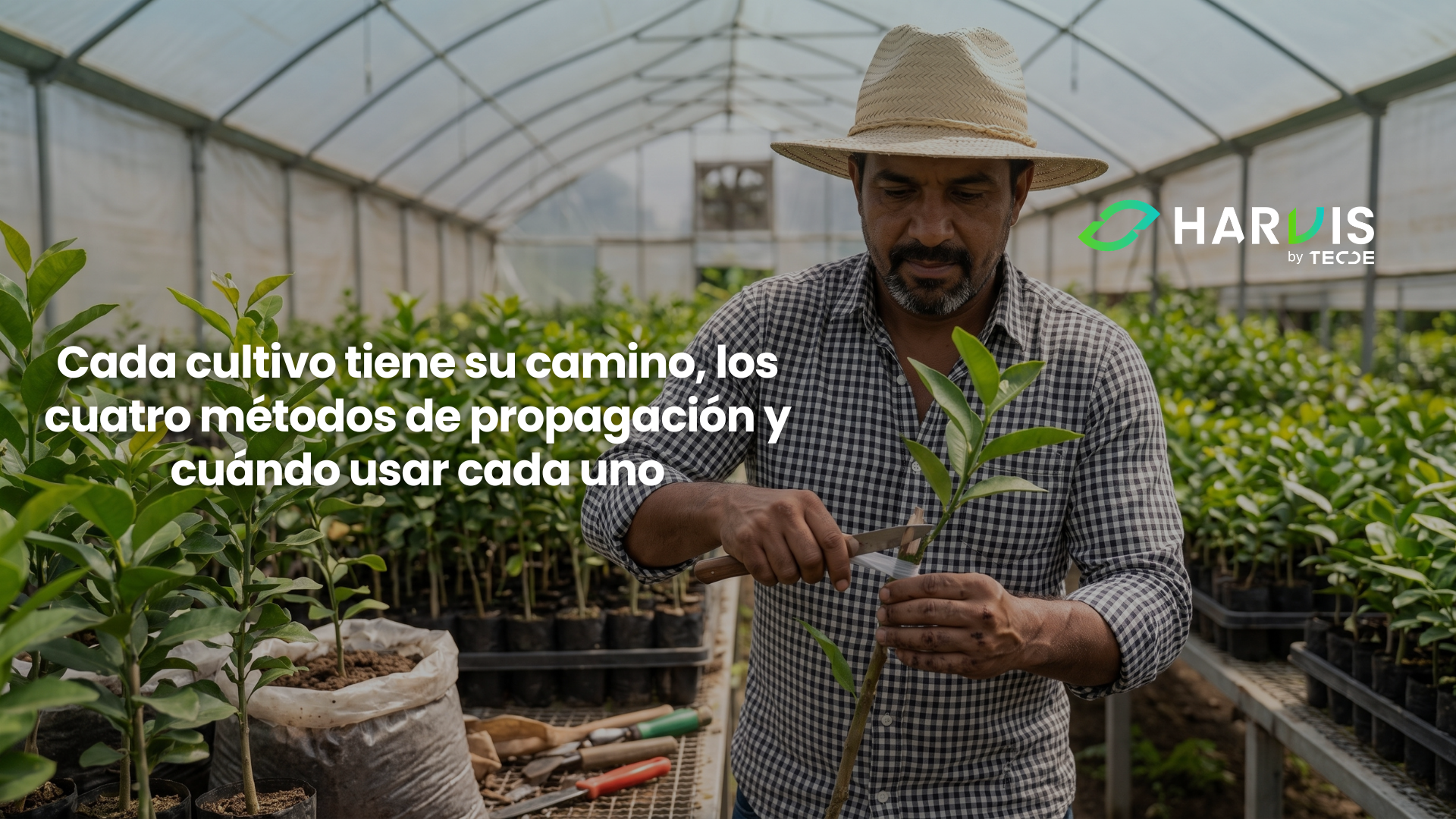
In the previous blog, we saw that the ceiling of your crop is set by the quality and origin of the material you plant. Assuming you have chosen good material, the next practical question arises: how will you multiply it to take it to the field? The answer is not unique or universal, because each species has a different biology, and each propagation method delivers different results in terms of uniformity, time to the first harvest, health, and cost.
Understanding these paths matters because a part of your lot's future behavior is defined here, in how the plant was produced before it reached your hands. A seed coffee does not behave the same as a clone, a grafted avocado on a good rootstock withstands what a seedling would not, and a lab blueberry arrives free of diseases that a poorly managed cutting could carry. Let’s explore the four main paths of propagation, with their advantages, limitations, and the crops where each one shines, so you can recognize which is suitable in each case.
The Seed: The Path of Variability
Seed propagation, also known as sexual propagation, is the oldest and most economical method. It consists of planting the seed that results from the fertilization between two plants, and its great virtue is that it combines the genetic material of both parents, generating variability. This variability is the raw material for genetic improvement, because from the diversity of a population of seedlings, breeders select the best, and it is also the source of a crop's ability to adapt to new conditions. Additionally, there are two notable practical advantages: its low cost and its ease of producing large quantities of plants, along with an important health benefit, as many pathogens present in the mother plant do not pass to the offspring through the seed, making the seed a naturally cleaner pathway.
The problem is that this same variability works against you when what you seek is a uniform crop faithful to a known variety. In highly heterozygous species, which are most fruit trees, plants born from seed do not come out identical to their mother; instead, they segregate and show differences in vigor, productivity, and fruit quality. This is compounded by the so-called juvenile period, which is the time it takes for a seed plant to mature and start producing, and which is usually considerably longer than that of a vegetatively propagated plant. In many fruit trees, this delay can mean several additional years of waiting before the first harvest, a huge cost in a commercial project.
For this reason, seeds are now reserved for specific situations where their variability is not a problem or even an advantage. They are used to produce rootstocks on which the desired variety is then grafted, used in breeding programs to create new varieties, and used in crops where the species maintains acceptable fidelity by seed. Coffee is a good example of this last case, because being a predominantly self-pollinating species, its conventional varieties, such as those improved by Cenicafé, maintain their characteristics when propagated by certified seed, as long as that seed comes from a controlled source that guarantees its purity.
Vegetative Propagation: The Path of Fidelity
When you need each plant to be identical to a selected mother, the path is vegetative or asexual propagation, which multiplies the plant from a portion of itself rather than from a seed. Since there is no fertilization or genetic mixing, the offspring is a clone, meaning a genetically identical copy that faithfully preserves the fruit quality, productivity, and disease resistance of the mother plant. This fidelity, known as faithful reproduction to type, is why vegetative propagation dominates commercial fruit growing, where lot uniformity is key for management and market.
The classic forms of vegetative propagation include cuttings, which are portions of stem or branch that are induced to form roots, and air layering, which consists of rooting a branch while still attached to the mother plant before separating it. Both methods allow for obtaining plants faithful to type and usually shorten the juvenile period, so the plant starts producing earlier than a seed plant. Blueberries illustrate this path well, because since their seeds do not produce plants faithful to type due to their high heterozygosity, they are primarily multiplied by cuttings taken from selected mother plants, thus preserving the characteristics of the variety.
This path, however, has two limitations worth noting. The first is that not all species root easily from cuttings, and Arabica coffee is a notable case of a species that is difficult to root by conventional methods, complicating its cloning through this route. The second is a risk we already mentioned in the previous blog, which is that vegetative propagation can transmit diseases from the mother plant to the entire offspring, in addition to generating genetically uniform populations that become more vulnerable if a disease manages to overcome their resistance. For this reason, vegetative propagation requires starting from healthy, certified mother plants, a precaution that is not optional but the foundation of reliable material.
Grafting: The Best of Two Plants in One
Grafting is a special and very powerful form of vegetative propagation that deserves its own space, because it solves a problem that no other method addresses. It consists of joining two different plants into one, taking the aerial part of the variety you want to produce, called the scion or graft, and joining it onto the root system of another plant, called the rootstock or pattern. The result is an individual that combines the best of both, the fruit quality of a proven variety above and the root qualities of a selected rootstock below, such as resistance to soil diseases, tolerance to salinity or lime, and control of tree vigor.
Grafting also provides two other decisive advantages. Since the bud or scion is taken from an adult tree that has already surpassed its juvenile stage, the grafted plant starts producing much earlier than a seedling, significantly shortening the time to the first harvest. And since it is vegetative propagation, it faithfully maintains the characteristics of the scion variety. For all these reasons, there are crops where grafting is not an option but practically an obligation.
Avocado is the clearest example, because the Hass scion is grafted onto rootstocks that provide resistance to root rot caused by Phytophthora cinnamomi and tolerance to other soil conditions, something that a seed avocado could not guarantee uniformly. Citrus follows the same logic, as the desired variety is grafted onto rootstocks that define tolerance to diseases and soil conditions, and grafting is always done from certified buds to avoid transmitting viruses such as tristeza or greening. In these crops, choosing the right rootstock is as important as choosing the variety, because both travel together in the same plant throughout its life.
Were your plants propagated by the right method for your crop and your goal? That decision, made in the nursery, continues to influence your lot many years later. Harvis helps you understand how the origin of your material reflects in its behavior. Talk to our team →

Tissue Culture: The Frontier of Propagation
At the most advanced frontier of propagation is tissue culture, also called micropropagation, which consists of multiplying plants from very small portions of tissue in sterile laboratory conditions. This technique takes vegetative propagation to a scale and precision that classical methods cannot reach, because it allows for producing large quantities of identical plants, in a small space, at any time of the year, and regardless of climate. Its health advantage is enormous, as starting from clean tissue and applying techniques such as meristem culture can yield virus-free plants and other pathogens, which is especially valuable in crops threatened by transmissible diseases.
Coffee shows why this technique is so relevant today. Conventional varieties propagate well by seed, but the more modern F1 hybrids, created by crossing traditional varieties with wild relatives, produce between twenty and forty percent more than the best pure lines. The problem is that, due to their heterozygous nature, those hybrids do not maintain their qualities if propagated by seed, so they must be cloned, and since Arabica roots poorly from cuttings, the main route for multiplying them on a large scale is somatic embryogenesis, a form of tissue culture that generates complete plants from leaf tissue cells. Through temporary immersion bioreactors, this technique allows for producing hundreds of thousands of embryos uniformly and with high genetic stability, opening the door to spreading those high-yield hybrids that would otherwise be impossible to multiply. Blueberries follow a similar path, as micropropagation is used to quickly generate large quantities of healthy plants from selected varieties, complementing or replacing propagation by cuttings.
The downside of tissue culture is its cost and technical demands, as it requires laboratories, specialized personnel, and refined protocols for each genotype. In coffee, for example, the cost of a seedling obtained through somatic embryogenesis has been estimated at around twenty-three cents, compared to about twelve cents for a rooted mini-cutting. That extra cost per plant is justified when the material being multiplied is of high value, when guaranteed health is needed, or when a scale is required that manual methods cannot deliver, which is why tissue culture has become the key tool for disseminating the most advanced materials.
How to Choose the Right Path
With these four paths on the table, the decision of which to use depends on three factors that should be weighed together. The first is the objective, because if you seek variability for improvement or are going to produce rootstocks, seed makes sense, while if you need fidelity to a variety and uniformity in the lot, the path is vegetative, whether by cuttings, grafting, or laboratory. The second is the biology of the species, as some maintain fidelity by seed like conventional coffee, others do not root from cuttings like Arabica, and others depend on grafting to take advantage of a rootstock like avocados and citrus. The third is the balance between time, cost, and scale.
On that balance, it is worth being specific. Seed is the cheapest and simplest method, but it imposes the longest juvenile period and does not guarantee uniformity. Cuttings and air layering are of moderate cost, preserve the variety, and shorten the time to production, although they depend on the species rooting well. Grafting requires more skilled labor, but it is irreplaceable when you want to join a good rootstock with a good scion, and it significantly reduces the time to the first harvest by starting from adult material. Tissue culture is the most expensive per plant and has the highest technical demands, but it is the only method capable of simultaneously delivering guaranteed health, absolute uniformity, and industrial scale. There is no method better than another in the abstract, but a method more suitable for each crop, each objective, and each budget.
The Method of Yesterday Continues to Work in Your Lot Today
When many lots are observed together, something appears that is rarely connected to its real cause. Much of the variability that a producer sees within the same lot, those plants that mature out of sync, that yield differently, or that produce fruit of uneven quality, originates not from current management but from the method with which that material was propagated years ago. A lot established with seed from a segregating species carries that heterogeneity throughout its life, while one established with clonal material faithful to type tends to be much more even. The propagation decision, made just once, continues to express itself harvest after harvest.
This link is difficult to see from a single plant or a single cycle, because variability is easily attributed to soil, climate, or management, but it becomes recognizable when the behavior data of many lots is crossed with information on how their material was propagated. By relating the uniformity of ripening, yield, and quality with the origin method and the age of the planting, it is possible to distinguish when the irregularity of a lot responds to something correctable with management and when it comes from a base of heterogeneous propagation that no practice will completely equalize. Recognizing that difference helps make better decisions, from adjusting management by sectors to considering the renewal of a lot whose variability is structural.
As we already addressed in our blog on Hass Avocado, behind a profitable crop is a chain of technical decisions that starts long before planting, and the propagation method is one of its most determining links. In the next blog of this season, we will focus on what happens after choosing the method, the critical care in the nursery, and the moment of transplanting, when a well-propagated plant can strengthen or weaken depending on how it is managed. The idea worth keeping today is that there is no single propagation path, but the right path for each crop, and getting that choice right is planting on even and healthy bases.
Make sure your plants reach the field by the right path for your crop. Write to us on WhatsApp and receive technical assistance for your propagation, planting, and renewal decisions. Talk to a Harvis expert →
Consulted References
- Encyclopædia Britannica. (n.d.). Horticulture: Propagation. https://www.britannica.com/science/horticulture/Propagation
- In Vitro Mass Propagation of Coffee Plants (Coffea arabica L. var. Colombia) through Indirect Somatic Embryogenesis. (2023). Plants / PMC. https://pmc.ncbi.nlm.nih.gov/articles/PMC10052142/
- Etienne, H., et al. (2024). Coffee somatic embryogenesis: Advances, limitations, and outlook for clonal mass propagation and genetic transformation. Advances in Botanical Research / ScienceDirect. https://www.sciencedirect.com/science/article/abs/pii/S0065229624000582
- Georget, F., et al. (2017). Somatic embryogenesis-derived coffee plantlets can be efficiently propagated by horticultural rooted mini-cuttings. Scientia Horticulturae / ScienceDirect. https://www.sciencedirect.com/science/article/pii/S0304423816306574
- University of California ANR. (n.d.). Avocado Rootstocks (Rootstock Book, Cap. 4). https://www.ccfruitandnuts.ucanr.edu/sites/default/files/2016-09/166374.pdf
- University of Florida / IFAS. (n.d.). Citrus Nursery Production Guide, Chapter 7: Seed and Budwood Production. https://ask.ifas.ufl.edu/publication/HS1336
- da Graça, J. V., Kunta, M., Setamou, M., and Dale, J. (2020). The Texas certified virus-free citrus budwood program. Subtropical Plant Science. http://www.subplantsci.org/wp-content/uploads/2020/07/SAES-daGraca-et-al.7-7-2020.pdf
- In Vitro Propagation of the Blueberry 'Blue Suede™' (Vaccinium hybrid). (2023). Plants / PMC. https://pmc.ncbi.nlm.nih.gov/articles/PMC10421453/
- Micropropagation of blueberry through in vitro shoot culture. (n.d.). ResearchGate. https://www.researchgate.net/publication/320457598
- Volk, G. M., et al. (2021). Challenges and Prospects for the Conservation of Crop Genetic Resources. Plants / PMC. https://pmc.ncbi.nlm.nih.gov/articles/PMC7761154/
- Smith, L. A., Dann, E. K., Pegg, K. G., Whiley, A. W., Giblin, F. R., Doevendans, E., and Kopittke, R. V. (2011). Field assessment of avocado rootstock selections for resistance to Phytophthora root rot. Australasian Plant Pathology / ResearchGate. https://www.researchgate.net/publication/226342612
- Cenicafé / Federación Nacional de Cafeteros. (n.d.). Variedades mejoradas con resistencia durable a la roya. https://www.cenicafe.org/es/index.php/cultivemoscafe/variedadesmejoradas