

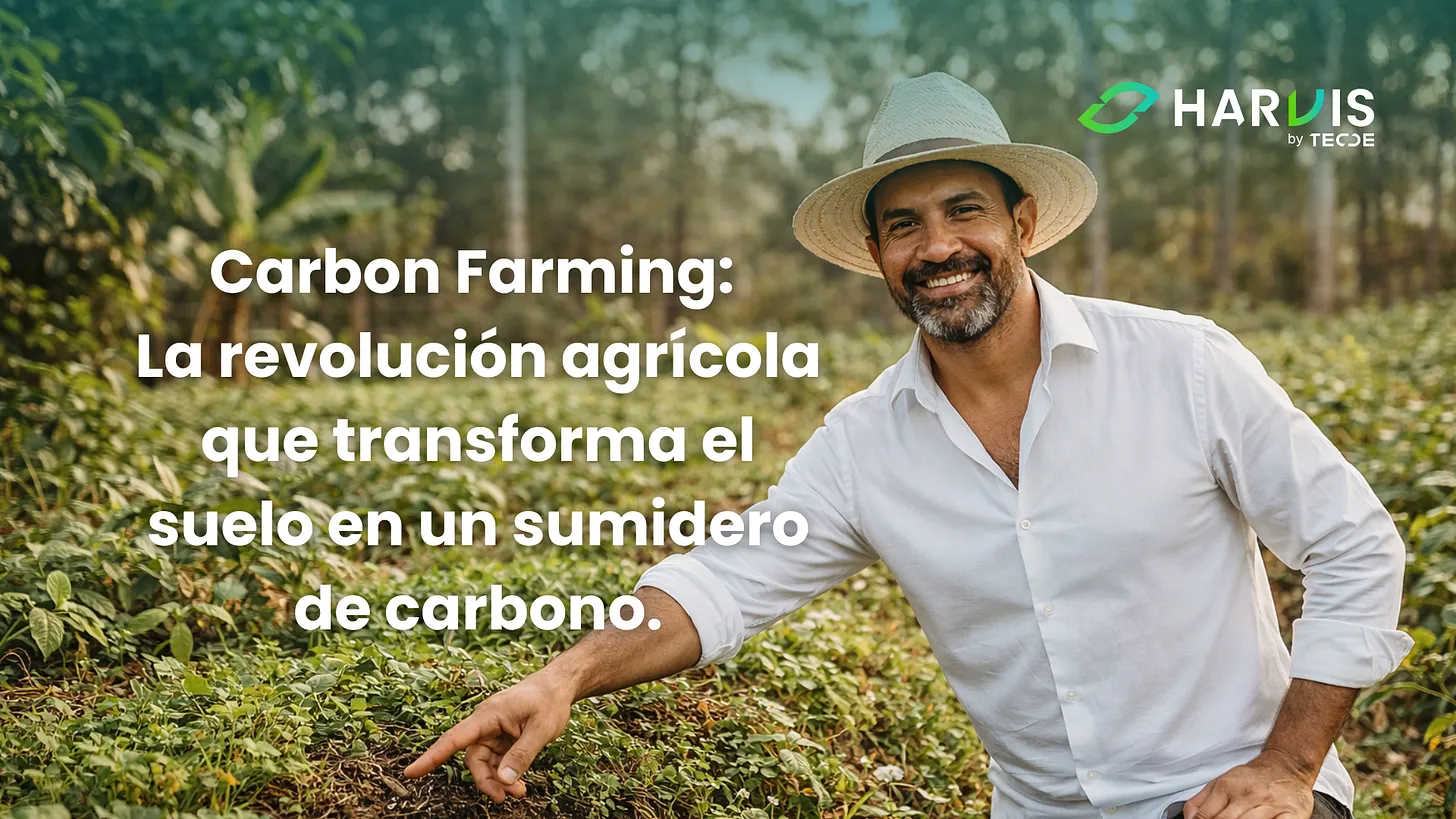
In our previous editions, we explored everything from ecosystem bioactivation to functional microbiological networks in the soil. Each concept has led us to a fundamental understanding: agriculture in the 21st century must not only nourish crops but actively capture atmospheric carbon. Today we delve into carbon farming: the revolutionary convergence of agricultural productivity, ecosystem regeneration, and monetization of climate services that is completely redefining the economic value of agriculture.
Today we want to talk about a concept that transcends the traditional notion of "sustainable agriculture" for a more transformative one: carbon farming: a comprehensive scientific methodology that uses regenerative agricultural practices specifically designed to maximize the capture of atmospheric carbon in plant biomass, soil organic matter, and root systems, simultaneously creating improvements in fertility, soil structure, and functional biodiversity while generating additional income through the marketing of verified carbon credits.
Modern agriculture faces a fundamental transformation: evolving from a sector that contributes to 25% of global greenhouse gas emissions to becoming the planet's main carbon sink. Agriculture accounts for 25% of global greenhouse gas emissions and 12% of those in the European Union, but simultaneously possesses the technical potential to reverse this negative contribution through the massive implementation of carbon farming practices that not only neutralize these emissions but actively capture additional carbon from the atmosphere.
Carbon farming operates through the synergistic optimization of multiple biogeochemical processes that simultaneously increase agricultural productivity and soil carbon storage. Carbon farming is a new expression that refers to a variety of regenerative agricultural practices that result in carbon sequestration in the soil, roots, and leaves of food products. This systemic approach transcends isolated techniques to create self-regulating agroecosystems where each agronomic intervention simultaneously contributes to carbon capture, fertility improvement, biodiversity increase, and generation of monetizable ecosystem services.
The fundamental mechanisms of carbon farming include the increase of root biomass through cover crops and perennial pastures that develop extensive and deep root systems, maximizing both nutrient exploration and carbon deposition in deep soil horizons. The integration of trees and shrubs in agroforestry systems exponentially multiplies carbon capture through long-lasting woody biomass, while roots establish mycorrhizal associations that transport carbon from the surface to stable soil strata where it remains sequestered for decades.
Cover cropping represents perhaps the most cost-effective intervention to initiate massive carbon capture in agricultural systems through the establishment of crops specifically selected to maximize root biomass production and organic residue contribution to the soil. Multi-species cover crops combine perennial grasses such as winter oats and rye that develop extensive fibrous root systems, legumes such as vetch and clover that fix atmospheric nitrogen while providing high-quality proteins to the soil, and crucifers such as mustard and forage radish that break compaction and mobilize nutrients from deep strata.
Scientists have qualified the return of plant residues to the field as an effective method for retaining carbon in the soil. Optimized residue management maintains permanent organic covers that protect the soil surface while continuously feeding the microbial communities responsible for forming stable organic matter. No-till systems eliminate mechanical disturbances that accelerate the oxidation of organic matter, preserving the structure of aggregates that physically protect organic carbon from accelerated microbial mineralization.
Diverse rotations integrate crops with different root architectures, phenological cycles, and residue contributions to maximize the temporal efficiency of carbon capture throughout the agricultural year. Perennial grasses such as tall fescue and tufted grass develop root systems that extend up to 3-4 meters deep, depositing carbon in soil horizons where microbial activity is limited and stabilization is maximized. Deep-rooted crops such as alfalfa and chicory explore compacted soil strata, creating macropore channels that improve infiltration while establishing active rhizospheres that stimulate humus-forming microbial activity.
The successful monetization of carbon farming requires measurement, reporting, and verification (MRV) systems that accurately quantify the real increases in soil organic carbon and establish additionality, permanence, and leakage avoidance that ensure the environmental integrity of the generated carbon credits. By 2025, scalable technology is essential for robust verification of carbon credits and management in agriculture.
Remote monitoring systems use high-resolution multispectral satellite imagery to continuously assess proxy indicators of carbon capture such as normalized difference vegetation indices (NDVI), leaf area indices (LAI), and biomass estimates through spectral reflectance modeling. Machine learning algorithms process time series of satellite data to detect changes in vegetation cover, duration of active growth periods, photosynthetic intensity, and biomass accumulation that directly correlate with carbon capture rates.
Field technologies include soil respiration sensors that quantify soil CO₂ emissions to establish net carbon balances, differentiating between newly incorporated carbon and historical carbon through isotopic analysis of ¹³C/¹²C. Electrical conductivity penetrometers map the spatial variability of organic matter within each plot, optimizing sampling strategies and providing accurate estimates of total carbon stocks through geostatistical interpolation.
Specialized laboratories for soil carbon analysis have developed standardized protocols that quantify not only the total organic carbon content but also the specific fractions of carbon with different degrees of stability and permanence. Labile carbon represents the most metabolically active but least permanent fraction, while humified carbon constitutes long-lasting reservoirs that persist for decades without disturbances. Physical fractionation analyses separate carbon associated with different aggregate sizes, providing predictive information about the long-term stability of sequestered carbon.
Emerging Technologies
The global carbon farming market is experiencing explosive growth driven by corporate demand for high-quality offsets and government recognition of agriculture as a natural climate solution. The carbon farming market is projected to reach $2.34 billion by 2034 from $531.8 million in 2024, growing at a CAGR of 15.98% during the forecast period 2024-2034.
BloombergNEF estimates that carbon farming could produce $13.7 billion in carbon credits annually by 2050, combining avoidance credits generated through improved management of inputs such as fertilizers and fuels, along with higher-value removal credits facilitated by soil carbon sequestration.
Agricultural carbon credits are classified into multiple categories according to the generation mechanism and the level of demonstrable additionality. Soil carbon sequestration credits represent verified increases in soil organic carbon stocks through the implementation of regenerative practices such as cover crops, rotational grazing, and agroforestry systems. Emission reduction credits quantify decreases in nitrous oxide (N₂O) emissions through optimized nitrogen fertilization management, improved nutrient use efficiency, and application of nitrification inhibitors.
In this market, farmers or ranchers can sell a carbon credit to investors for each metric ton of carbon that their land sequesters. Current prices for agricultural carbon credits range between $15 and $50 per ton of CO₂ equivalent sequestered, depending on factors such as verification methodology, projected permanence, co-benefits, and third-party certifications. Projects that integrate multiple ecosystem services such as biodiversity conservation, water quality improvement, and erosion reduction access premium markets with prices exceeding $80 per ton.
Commercial carbon farming programs have demonstrated technical and economic viability through large-scale implementations that combine scientific rigor with agricultural profitability. Indigo Ag has issued nearly 1 million credits to date, becoming the largest agricultural soil carbon program approved by market registries. The Climate Action Reserve (CAR) approves its credits and confirms their eligibility for sale, establishing quality and transparency precedents for the emerging industry.
Successful projects integrate multiple dimensions of value that transcend simple carbon capture to generate quantifiable improvements in agricultural productivity, input efficiency, climate resilience, and economic profitability. Participating producers report increases of 15-25% in yields of major crops through improvements in soil fertility, soil structure, and water retention capacity. Savings in synthetic fertilizers reach 20-40% through improved nutrient cycling and biological nitrogen fixation by integrated legumes.
Income diversification through carbon credits provides additional cash flows that stabilize agricultural operations against commodity price volatility. Carbon farming contracts typically establish commitments of 10-20 years that guarantee predictable income of $50-150 per hectare annually, depending on site sequestration potential and implemented practices. This economic stability facilitates investments in no-till equipment, efficient irrigation systems, and precision agriculture technologies that enhance both productivity and carbon capture.
Integration with Agroforestry Systems and Regenerative Grazing
Agroforestry systems represent the most promising frontier of carbon farming through the strategic integration of tree components that exponentially multiply carbon capture while diversifying agricultural production. Trees interspersed in annual crops (silvopastoral systems) capture carbon simultaneously in aerial biomass, deep root systems, and leaf litter deposition that continuously enriches the surface organic matter of the soil.
Fast-growing tree species such as paulownia, hybrid eucalyptus, and specialized willows can sequester 10-25 tons of CO₂ per hectare annually in woody biomass, while their deep root systems establish preferential channels that improve infiltration and explore nutrients from soil strata inaccessible to annual crops. Systematic pruning provides biomass for organic mulch that protects the soil and continuously feeds the humus-forming microbial communities.
Regenerative grazing optimizes carbon capture in grassland ecosystems through intensive rotations that mimic natural herbivory patterns, stimulating vigorous growth of perennial grasses and maximizing root carbon deposition. Rotational grazing systems with rest periods of 30-90 days allow complete recovery of vegetation while animal manure contributes high-quality organic matter that is quickly incorporated into the soil through stimulated biological activity.
Technical Challenges and Innovation Opportunities
Carbon farming faces significant technical challenges related to the spatial and temporal variability of carbon capture, the long-term permanence of sequestered carbon, and the development of standardized methodologies that ensure additionality and prevent leakage. Soil carbon credits are marketable certificates obtained by farmers implementing practices to increase carbon sequestration in the soil, but precise quantification requires sophisticated measurement protocols that can detect relatively small changes in large reservoirs of soil carbon.
Interannual climatic variations significantly influence carbon capture rates, creating uncertainties in credit generation projections that complicate financial planning and long-term contractual commitments. Extreme weather events such as severe droughts, floods, or exceptional temperatures can temporarily release sequestered carbon, requiring continuous monitoring systems and insurance mechanisms that protect both producers and buyers of credits.
Emerging innovations include the development of plant varieties specifically optimized to maximize root carbon deposition, using genetic selection and biotechnology to increase the root/shoot ratio, the production of carbon-rich exudates, and the longevity of root systems. Next-generation biofertilizers combine aggregate-forming microorganisms with biostimulants that accelerate humification and stabilize organic carbon against accelerated microbial mineralization.

State of the Art and Future Perspectives
Within the industrial decarbonization strategies being implemented under the Green Deal, carbon absorption and capture in agricultural soils will constitute an important part of the effort in the European Union to achieve climate neutrality by 2050. This political prioritization accelerates the development of regulatory frameworks, incentive systems, and organized markets that will facilitate the massive scalability of carbon farming over the next decade.
Emerging technologies include artificial intelligence systems that automatically optimize crop rotations to maximize carbon capture according to specific soil and climatic conditions, predict optimal windows for implementing regenerative practices, and model the evolution of carbon stocks under different management scenarios. IoT sensors distributed in the field provide continuous data on soil temperature, moisture, pH, and microbial activity that feed real-time optimization algorithms.
Farmers, ranchers, and forest landowners can generate carbon credits by adopting practices to reduce emissions or sequester carbon on their land, and carbon markets can provide them with new income opportunities through carbon credit sales. Emerging government support includes subsidy programs for the adoption of regenerative practices, minimum price guarantees for agricultural carbon credits, and preferential financing for investments in carbon farming technologies.
Regional agricultural carbon markets are evolving towards more sophisticated systems that recognize environmental co-benefits through differentiated payments for multiple ecosystem services. Projects that combine carbon capture with biodiversity conservation, water quality improvement, erosion reduction, and provision of habitat for pollinators access premium markets with higher prices and longer-term contracts.
Ecosystem Impact
Carbon farming generates environmental benefits that transcend simple carbon sequestration to contribute to the comprehensive restoration of degraded agricultural landscapes. The increase in soil organic matter dramatically improves soil structure, creating stable aggregates that increase porosity, improve infiltration, and reduce compaction that limits root growth and nutrient exploration.
Crop diversification and the integration of perennial species establish functional habitats for beneficial organisms including native pollinators, natural pest enemies, and soil fauna that provide critical ecosystem services for sustainable agricultural productivity. Permanent vegetation strips and biological corridors connect fragments of natural ecosystems, facilitating species migration and genetic exchange that maintains viable populations of native biodiversity.
Hydrological benefits include increases of 30-60% in soil water retention capacity, reductions of 50-80% in surface runoff, and significant improvements in aquifer recharge through enhanced infiltration. Permanent vegetation establishes deep root systems that stabilize soil aggregates, reduce erosion, and filter pollutants before they reach surface and groundwater bodies.
The transformation towards climate-positive agriculture is scientifically validated, technologically feasible, and economically viable. It only requires accelerated implementation and political support to facilitate the massive transition towards carbon farming systems that simultaneously feed humanity and regenerate planetary climate stability.
Each hectare converted to carbon farming, each ton of carbon sequestered, each verified credit, each regenerative practice implemented builds the foundation of an agriculture that not only produces food but actively heals the climate while generating economic prosperity for rural communities.
"The future of food security and climate stability is being written in every gram of carbon we capture in our soils, in every regenerative practice we implement, in every carbon credit we verify to transform agriculture from a contributor to the climate problem into a protagonist of the solution."
In our next edition, we will explore:
Blockchain in food traceability: how consumers can already trace from field to plate.
📚REFERENCES CONSULTED
- Food and Agriculture Organization of the United Nations (FAO). "Soil Carbon Sequestration". 2025. https://www.fao.org/soils-portal/soil-management/secuestro-de-carbono-en-el-suelo/es/
- United States Department of Agriculture (USDA). "USDA Releases Assessment on Agriculture and Forestry in Carbon Markets". October 2023. https://www.usda.gov/about-usda/news/press-releases/2023/10/23/usda-releases-assessment-agriculture-and-forestry-carbon-markets
- BloombergNEF. "Unlocking Agricultural Carbon Market Opportunities". May 15, 2025. https://about.bnef.com/insights/nature-and-agriculture/unlocking-agricultural-carbon-market-opportunities/
- Research and Markets. "Carbon Farming Market Research 2025: Focus on Application, Product, Carbon Credit and Debit and Opportunities for Agricultural Stakeholders". February 11, 2025. https://www.businesswire.com/news/home/20250211816108/en/
- S&P Global. "Soil carbon credits: Opportunities and challenges ahead". November 14, 2024. https://www.spglobal.com/commodityinsights/en/market-insights/blogs/agriculture/022323-soil-carbon-credits-opportunities-and-challenges-ahead
- Farmonaut. "Carbon Credit Verification In Agriculture: 7 Key Strategies". July 2, 2025. https://farmonaut.com/blogs/carbon-credit-verification-in-agriculture-7-key-strategies
- CarbonCredits.com. "Agricultural Carbon Credits and Carbon Farming Guide". March 10, 2025. https://carboncredits.com/what-are-carbon-credits-in-agriculture/
- Earth.Org. "Soil Carbon Credits: Promises and Problems". September 2025. https://earth.org/soil-carbon-credits-the-promises-and-uncertainties-of-a-new-climate-market/
- PAC Network. "The AgriCapture project seeks to reduce carbon emissions through agricultural soil". 2025. https://www.redpac.es/noticia/el-proyecto-agricapture-busca-reducir-las-emisiones-carbono-traves-del-suelo-agrario
- Neiker. "CO2FARM Project: identifying the keys to establishing a carbon farming market". July 2, 2024. https://neiker.eus/es/noticias/proyecto-co2farm-identificando-las-claves-para-establecer-un-mercado-de-agricultura-de-carbono/
- Indigo Ag. "Carbon Credits Program". 2025. https://www.indigoag.com/carbon-credits