

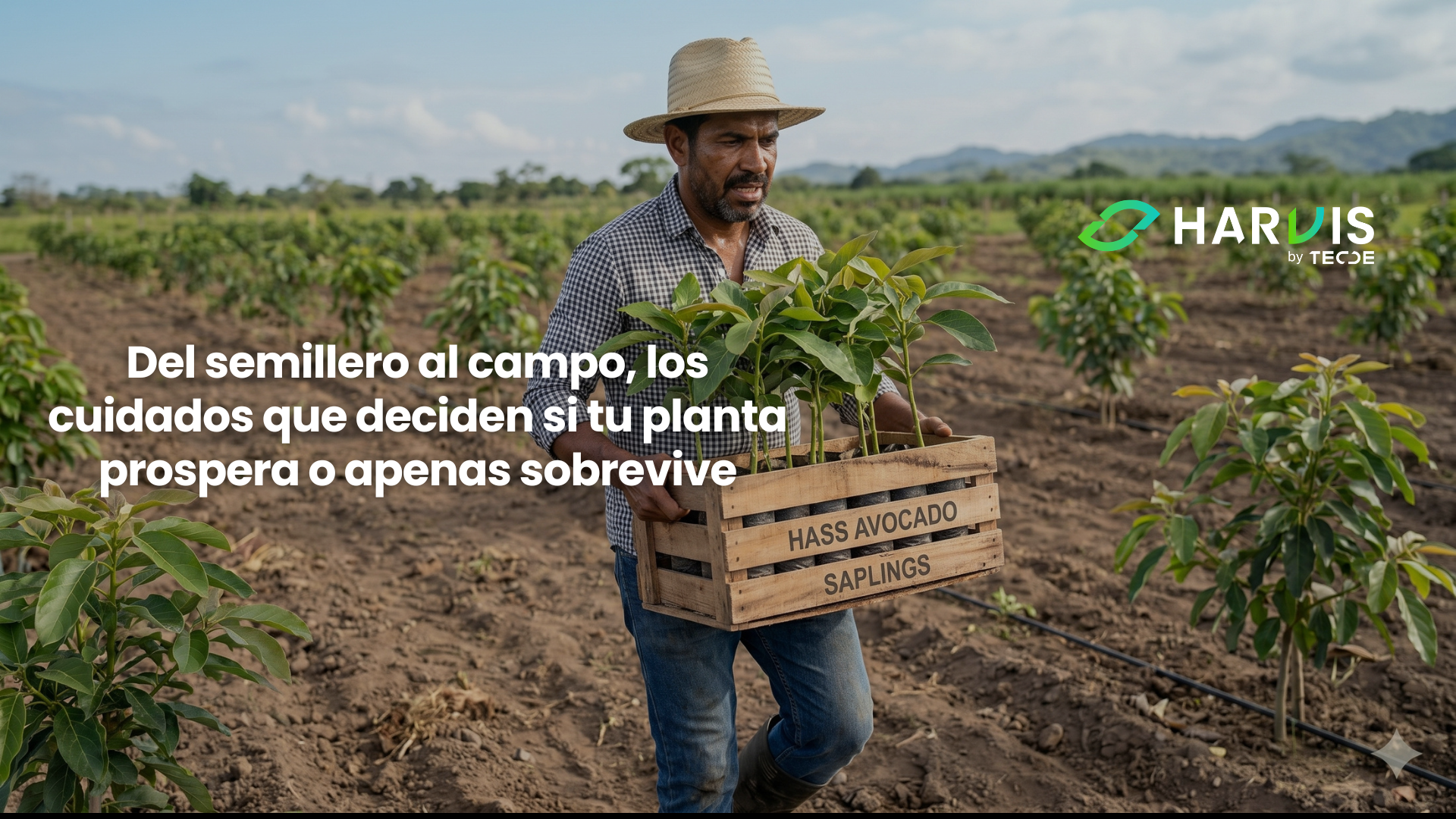
The previous two blogs took us from the selection of genetic material to the method of multiplying it. Now that seed, cutting, or grafted plant needs to grow until it is ready for the field, and that journey occurs in the nursery. It is a short stage compared to the life of a perennial crop, but disproportionately decisive, because a plant that leaves the nursery strong and well-formed establishes quickly and begins its production with an advantage, while one that leaves weak or stressed takes longer to establish, is more vulnerable to diseases, and often never reaches the potential that its genetics promised.
The problem is that the weaknesses that develop in the nursery often manifest later, already in the field, when it is easy to blame the soil, the climate, or a pest. A plot with low initial survival or with disparate plants does not always have a soil problem, but rather plants that arrived poorly formed or stressed from the seedling stage. That’s why it is worth carefully traversing the three critical stages of this journey: seed germination, plant construction in the nursery, and transplanting with its prior hardening, because succeeding in each one is what turns good material into a plant that truly thrives.
Germination: The Awakening of the Seed
Everything starts with germination, that moment when a seed that seemed inert activates its metabolism and gives rise to a new plant. For this to occur, four basic conditions must work together: sufficient moisture to hydrate the tissues, an appropriate temperature for each species, oxygen to breathe, and, in many species, light of a certain quality. When any of these factors are lacking, or when they are not within the range required by the species, germination is delayed or simply does not happen, which is why controlling these conditions in the seedling stage is the first task of a good nursery.
There are seeds that do not germinate even when all conditions are favorable, and this phenomenon has a name: dormancy or latency. Dormancy is a survival mechanism by which the seed remains dormant until certain conditions are met, and it can have different causes, from a hard and impermeable coat that prevents water entry, known as physical dormancy, to an internal blockage of the embryo, called physiological dormancy. The interesting thing is that behind dormancy and its breaking is the same hormonal balance we covered in the previous season, because it is abscisic acid that keeps the seed dormant, while gibberellins are what wake it up and activate germination when the right moment arrives. The seed, at its core, makes a hormonal decision about when to wake up.
Knowing the type of dormancy allows for the correct pre-germination treatment to break it. In the case of a hard coat, scarification is used, which involves physically weakening the coat through mechanical means or hot water to allow water entry. For physiological dormancy, stratification is employed, which exposes the seed to controlled temperature and humidity conditions for a time to trigger the hormonal changes that activate germination, and also the use of gibberellins applied externally, which accelerate and uniform the germination of species that would otherwise germinate slowly or unevenly. One case worth noting is that of recalcitrant seeds, such as those of coffee and avocado, which do not tolerate drying or long-term storage and lose viability quickly, so they must be planted fresh, shortly after being extracted from the fruit. Recognizing these particularities prevents the loss of entire seed lots due to improper handling.
The Nursery: Where the Plant is Built
Once the seed has germinated or the cutting has rooted, the nursery is the space where that seedling transforms into a plant ready for the field, and everything that happens there is written into its structure. Managing environmental conditions is the first key, because light, humidity, temperature, and aeration determine how the plant grows. Insufficient light produces elongated and weak plants that stretch in search of clarity, while excess can burn young tissue; poorly managed humidity favors diseases or dehydrates the seedling; and poor aeration creates a warm and humid environment where fungi that attack young plants proliferate. The balance of these factors produces a compact, vigorous, and healthy plant.
The substrate is the other pillar of the nursery, as it is the medium where the roots develop and from which the plant takes water and nutrients. A good substrate combines several qualities that rarely offers soil alone: good moisture retention without waterlogging, sufficient aeration for the roots to breathe, drainage that evacuates excess water, and a structure that supports the plant. This is complemented by the importance of the substrate's pH, which must be adjusted to what each crop needs to absorb nutrients, a particularly critical point in blueberries, which require a markedly acidic substrate, close to a pH of four and a half, without which the plant does not thrive no matter how many nutrients it receives. A poorly formulated substrate condemns the plant to poor root development from the start, and a poorly constructed root in the nursery is a weakness that the plant will carry to the field.
A technological evolution of traditional nurseries worth knowing are compressed pellets, also called propagation tablets or discs. Their idea is as simple as it is powerful: to combine the container and substrate into a single dry and ultra-compact element that replaces plastic trays, nursery bags, and loose soil. They are made from peat or compressed coconut fiber, come wrapped in a fine biodegradable net that keeps the substrate in place, and when hydrated, they expand to form an aerated growth medium ready for planting. Their greatest advantage appears precisely at the most delicate moment we will see next: transplanting, because by taking the complete pellet to the ground without removing the plant, root disturbance is avoided, which significantly reduces transplant stress and improves survival. This is complemented by a cleaner and more uniform medium, as the substrate comes sterilized from the factory, and a saving of water and labor that makes them attractive for nurseries producing at scale, even for acclimatizing plants coming from the lab. It is worth noting, however, two nuances: that coconut fiber is a more sustainable alternative than peat, whose extraction has an environmental cost, and that the cost per plant of these pellets is somewhat higher than that of traditional systems, so their convenience depends on the value of the material you are propagating.
The health of the nursery closes this trio of care, because a seedbed is, due to its density and controlled environment, an ideal place for pests and diseases to settle if precautions are not taken. Starting with clean or disinfected substrate, using pathogen-free irrigation water, and maintaining strict hygiene of tools and spaces is what prevents a healthy plant from becoming contaminated just when it is most vulnerable. This topic is so important that we will dedicate the next complete blog of the season to it, so for now, it is enough to retain it as an essential part of nursery management.
Nutrition in the Nursery: Feeding Without Spoiling
Nutrition during the nursery stage deserves a separate look, because it has its own logic that differs from that of established crops and where it is easy to make costly mistakes. The goal in the nursery is not to produce the largest or most lush plant, but the most balanced one, with a good proportion between the aerial part and a strong root system, because it will be that root that supports the plant at the time of transplanting and in its first months in the field.
Excess early nitrogen stimulates accelerated foliage growth at the expense of root development, producing tall and showy but unbalanced plants, with an aerial part that their roots will not be able to support when transplant stress arrives. That’s why the recommendation is for balanced fertilization adjusted to the stage of development, more moderate in nitrogen at the beginning to favor the roots, and more complete as the plant grows. Studies show that adequate fertilization in the nursery improves the quality of the plant and its subsequent performance in the field, because it allows it to accumulate nutrient reserves that it will use just when it needs them most, during establishment.
A plant that leaves the nursery with good nutrient levels, including microelements that, as we saw, ignite hormones and build antioxidant defenses, arrives in the field better prepared to withstand transplant stress and adverse conditions. Nursery nutrition not only builds the plant but also loads its reserves for the most difficult moment of its early life. This is complemented by the optimal duration in the nursery, which varies according to the crop and the size of the plant being sought, and which also has its sweet spot, because a plant that is transplanted too young is fragile, while one that remains too long in the nursery may coil its roots in the container and suffer more during transplanting. Taking the plant out at its right moment, neither too early nor too late, is part of the art of good nursery management.
Did the plants you are going to take to the field come out of the nursery strong and well-formed, or do they carry weaknesses that are not yet visible? What happens in the seedbed reflects in the establishment and in the first years of production. Harvis helps you connect the quality of your material with its performance in the plot. Talk to our team →

Transplanting and Hardening: The Most Critical Moment
If there is a moment in the early life of a plant where a large part of its future is at stake, it is during transplanting. No matter how well-raised it is, moving from the protected environment of the nursery to the open field is a shock, and that shock has a technical name: transplant stress. Its main cause is the loss and damage of roots that occurs when moving the plant, because by losing part of its root system, the plant sees its ability to absorb water and nutrients reduced just when it faces more demanding conditions. That’s why transplant stress shares many responses with drought stress, as in both cases the plant struggles to obtain the water it needs with a diminished root system. The symptoms are recognizable: wilting, yellowing of leaves, stunted growth, leaf drop, and in severe cases, plant death.
The most effective tool to reduce that shock is hardening, also called acclimatization, which consists of gradually preparing the plant for the conditions it will face in the field before taking it there. Instead of abruptly transitioning from the gentle environment of the nursery to the sun, wind, and variable temperatures of the field, the plant is gradually exposed to those conditions over a period of one to two weeks, allowing it to adjust its physiology and arrive at transplanting much more resilient. This process directly connects with what we saw in the previous season, because hardening works by subjecting the plant to mild and controlled stress, which preemptively activates its defense mechanisms, and in fact, research shows that hardening plants with moderate irrigation deficit, and even with applications of abscisic acid, improves their tolerance to transplant stress. It is the same logic of preparing defenses before difficulties arrive that we covered in relation to El Niño, now applied to the nursery.
The moment of transplanting is the other determining decision, and it should be chosen based on the plant's phenology and the climatic conditions. Transplanting at the beginning of a rainy season, when the soil has moisture and the plant can recover its roots without suffering from thirst, is very different from doing so entering a drought, when the plant with diminished roots immediately faces the worst of scenarios. This can be complemented by tools that strengthen the plant during the transition, such as inoculation with mycorrhizal fungi, which extend the reach of the roots and improve water and phosphorus absorption, and the use of biostimulants that reinforce stress resistance. Choosing the right moment and accompanying the transplant with these supports is what turns a risky step into a safe transition.
Many Field Failures Started in the Nursery
A good part of the establishment problems, that low initial survival, that uneven growth, those plants that never take off well, do not originate in the field where they manifest, but in the nursery from which they came. A poorly nourished plant, with poorly formed roots due to inadequate substrate or coiled from excessive time in the container, or one that was not hardened before transplanting, arrives in the field with a disadvantage that even the best subsequent management can hardly compensate. The problem was, from the beginning, in the seedbed.
This link is difficult to see from the plot, because when a plant fails in the field, the gaze naturally turns to the soil, irrigation, or pests, and rarely to the nursery that was left behind months before. But it becomes recognizable when the establishment and early performance data of many plots are crossed with information about the origin and management of the material in the nursery. By relating survival, initial vigor, and uniformity with the origin and quality of the plants, it is possible to distinguish when an establishment problem responds to a correctable field condition and when it comes from a weakness that the plant brought from the seedling stage, and that therefore requires reviewing the source of the material rather than the management of the plot.
Ensure that your plants arrive in the field strong and ready to establish themselves. Write to us on WhatsApp and receive technical assistance for nursery management, early nutrition, and transplanting your crop.
Consulted References
- FAO. A Guide to Forest Seed Handling (germination conditions, dormancy, and stratification). https://www.fao.org/4/ad232e/ad232e08.htm
- Dormancy Breaking Treatments in Northern Wild Rice Seed Suggest a Physiological Source of Dormancy (classification of physical and physiological dormancy types). bioRxiv. https://www.biorxiv.org/content/10.1101/2021.09.10.459785.full.pdf
- Exogenous gibberellin can effectively and rapidly break intermediate physiological dormancy of Amsonia elliptica seeds (2022). PMC (gibberellins and breaking physiological dormancy). https://www.ncbi.nlm.nih.gov/pmc/articles/PMC9643720/
- The physiological basis of containerised tree seedling transplant shock: A review (transplant stress due to root loss; similarity with water stress). ResearchGate. https://www.researchgate.net/publication/228631717
- Tree Establishment: A Review of Some of the Factors Affecting Transplant Survival and Establishment (2009). Arboriculture & Urban Forestry (root and nutrient loss, hardening, biostimulants). https://auf.isa-arbor.com/content/35/1/10
- Preparing for the Worst: Enhancing Seedling Traits to Reduce Transplant Shock in Semi-Arid Regions (2024). Forests / MDPI (hardening with water deficit and abscisic acid). https://www.mdpi.com/1999-4907/15/9/1607
- Combined effects of cotyledon excision and nursery fertilization on root growth, nutrient status and outplanting performance of Quercus variabilis container seedlings (2017). PMC (nursery fertilization improves quality and field performance). https://www.ncbi.nlm.nih.gov/pmc/articles/PMC5436658/
- Soil Moisture Stress Induces Transplant Shock in Stored and Unstored Douglas-Fir Seedlings of Varying Root Volumes (plant size and root volume in transplant survival). ResearchGate. https://www.researchgate.net/publication/233558668
- Etienne H. et al. (2024). Coffee somatic embryogenesis: Advances, limitations, and outlook (acclimatization and hardening of nursery on a large scale). ScienceDirect. https://www.sciencedirect.com/science/article/abs/pii/S0065229624000582
- Challenges and Prospects for the Conservation of Crop Genetic Resources (2021). PMC (recalcitrant coffee and avocado seeds, planting fresh). https://pmc.ncbi.nlm.nih.gov/articles/PMC7761154/
- Clemson Cooperative Extension. Blueberry (Home & Garden Information Center) (acid substrate requirement, pH close to 4.5). https://hgic.clemson.edu/factsheet/blueberry/
- Jiffy Group. Jiffy Pellets (compressed peat and coconut fiber tablets with biodegradable net; eliminating transplant stress, sterility, and saving water and labor). https://jiffygroup.com/products/jiffy-pellets/