

In recent years, digital transformation has begun to radically change the way we understand livestock farming. In our previous publications, we explored how antibiotic traceability, applied biotechnology, and the use of sensors and satellites have redefined production systems.
These innovations have shown us that technology not only optimizes efficiency but also paves the way for more sustainable and regenerative models.
Today, we want to take a step further and delve into one of the most promising trends: the valorization of livestock waste through digital technologies.
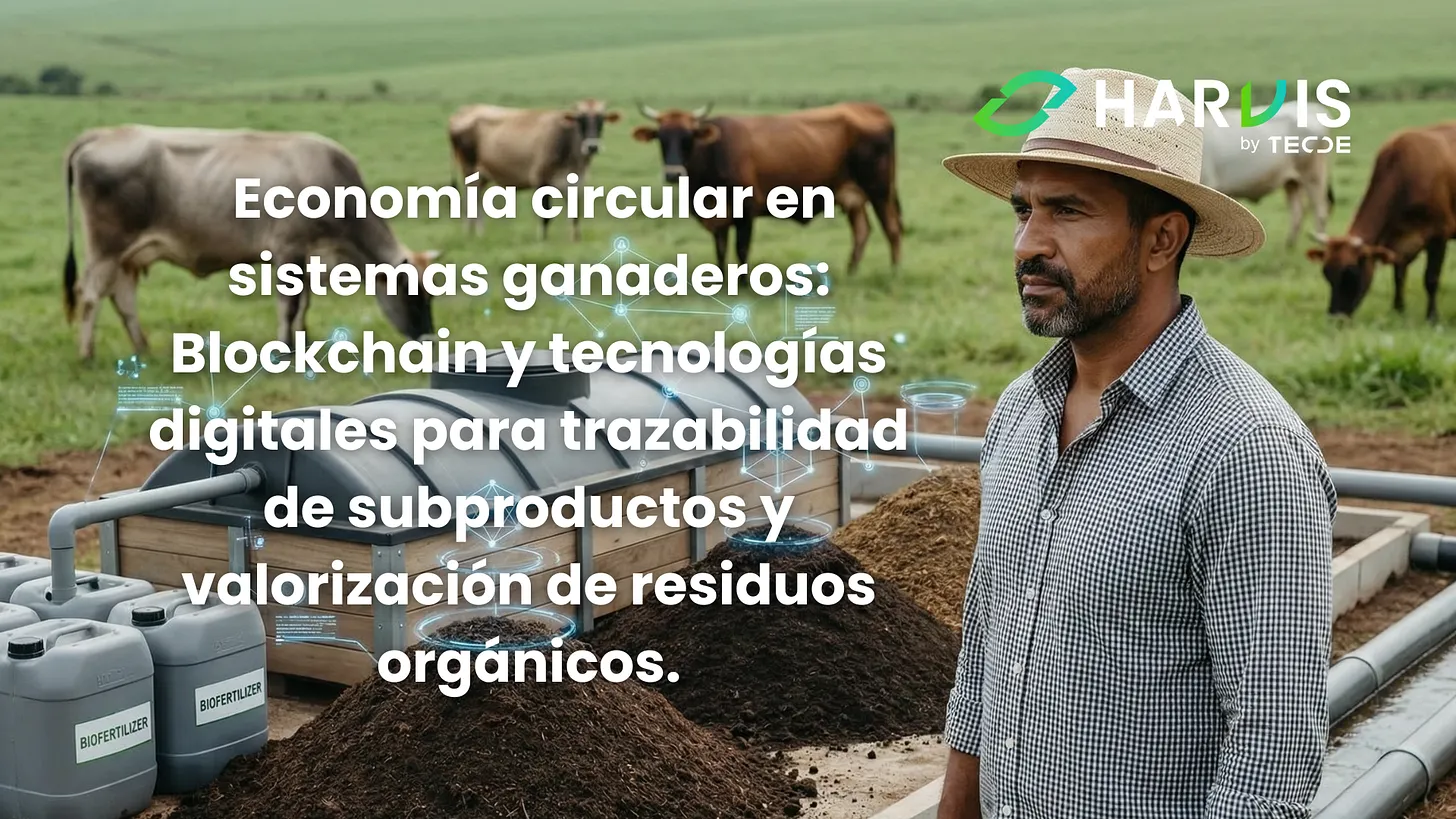
We refer to systems that integrate biodigesters equipped with IoT, blockchain platforms for traceability, algorithms that optimize composting, and digital marketplaces where certified organic fertilizers are marketed as high-value products.
♻️ From Waste to Resource: The New Value of Manure
Livestock systems worldwide generate nearly 8 billion tons of manure annually, equivalent to 85% of all agricultural organic waste. This massive volume represents flows of nutrients, energy, and biomass that have historically been considered an environmental problem.
Poorly managed manure can contaminate groundwater, emit greenhouse gases, and affect public health. However, thanks to the convergence of emerging technologies, it is now possible to transform this liability into a source of clean energy, organic fertilizers, and carbon credits.
Instead of viewing waste as a cost, the new digital livestock farming turns it into traceable and profitable resources.
🔄 Livestock Waste: Environmental Liability or Economic Asset?
Cattle manure is much more than waste: it contains nitrogen, phosphorus, potassium, and a huge amount of carbon-rich organic matter. A dairy cow can produce between 9 and 15 tons of manure per year, providing nutrients that, on a large scale, even surpass the global production of synthetic fertilizers.
The challenge arises when this waste is stored under anaerobic conditions. In that scenario, each cubic meter of manure can release more than a kilogram of methane, a gas with a warming potential 30 times greater than CO₂.
Additionally, the leaching of nitrates and phosphorus contaminates aquifers and rivers, affecting both human health and aquatic ecosystems.
Therefore, the question is no longer whether livestock waste is a problem or an opportunity, but how to accelerate its transformation into circular, verifiable, and sustainable models.
⚗️ Anaerobic Digestion and Smart Composting
The heart of the circular economy in livestock is in the biological valorization of organic matter.
Anaerobic biodigesters, powered by microbial consortia, convert manure into biogas (rich in methane) and high-quality biofertilizer.
Thanks to IoT sensors, it is possible to monitor critical variables such as temperature, pH, pressure, and solid levels in real-time, automatically adjusting conditions to maximize energy production and process efficiency.
On the other hand, smart composting uses controlled aerobic degradation to transform waste into a stable product, rich in nutrients and free of pathogens.
Modern systems incorporate oxygen, moisture, and temperature sensors connected to automated turners, allowing for a perfect balance between aeration and heat.
Moreover, machine learning algorithms analyze historical data from each process (temperature, humidity, C:N ratio) to predict behaviors and reduce composting time by 15–30%, without sacrificing quality.
💰 Total Valorization: Biochar and Carbon Credits
Beyond compost, technologies such as controlled pyrolysis allow for the conversion of dry manure into biochar, a charcoal with high nutrient retention and carbon sequestration capacity.
Applied to soil, it improves structure, water infiltration, and biological activity, reducing dependence on synthetic fertilizers.
Each ton of biochar can prevent the emission of up to 4 tons of CO₂ equivalent, combining environmental and economic benefits.
And by integrating sensors and digital records, these results can be certified, verified, and marketed as carbon credits on specialized platforms.
Technology is already transforming waste valorization. Try Harvis and discover how to integrate IoT sensor information to optimize the data produced from the biodigestion and composting processes of your production system.
🔗 Blockchain Technology for Byproduct Traceability
In the digital age, traceability is synonymous with trust.
Blockchain platforms allow for the recording of each stage of the production process, from the origin of the manure to the final product sold in the market.
Each batch of compost or biochar can be represented by a token or NFT, which contains detailed information about its origin, composition, laboratory analysis, and environmental footprint.
In this way, buyers scan a QR code and access the complete history of the product, with verifiable and auditable data.
Smart contracts automate payments and distribute income among system participants, ensuring transparency and fairness for all actors, especially small producers.
Additionally, digital marketplaces connect those who generate waste with processors and end consumers, optimizing logistical routes and ensuring product quality through blockchain-based reputation systems.
🚀 The Future of Circular Livestock Economy
Projections indicate that by 2035, nearly 70% of livestock waste in developed countries will be digitally valorized.
This not only responds to new environmental regulations but also to the growing demand for traceable and regeneratively certified products.
At the same time, precision nutrition applied to animal feeding will reduce nitrogen and phosphorus excretions by 20–25%, decreasing the burden on valorization systems.
With the help of methane sensors and AI-adjusted diets, even enteric emissions could be transformed into marketable carbon credits, generating economic incentives aligned with climate mitigation.
“Yesterday's waste is tomorrow's resource. Digital technology turns circular economy promises into measurable, traceable, and profitable realities.”
🌱 Take the First Step Towards Circular Livestock Farming
The future of livestock farming is not just about producing more, but about producing better, with traceability, efficiency, and sustainability.
Harvis integrates digital monitoring, intelligent analytics, and environmental traceability into a single tool designed for producers who want to leap into the circular economy.
📚 Sources of Information
- Intergovernmental Panel on Climate Change (IPCC). “Climate Change 2024: Mitigation of Climate Change - Agriculture, Forestry and Other Land Use Chapter”.https://www.ipcc.ch
- Food and Agriculture Organization of the United Nations (FAO). “Livestock Environmental Assessment and Performance Partnership - Manure Management”. 2024. https://www.fao.org/partnerships/leap
- Bioresource Technology. “IoT-enabled optimization of anaerobic digestion processes for livestock waste valorization”. Chen et al., 2024. https://www.journals.elsevier.com/bioresource-technology
- Renewable and Sustainable Energy Reviews. “Biomethane production from livestock manure: Technical potential and economic viability”. 2025. https://www.journals.elsevier.com/renewable-and-sustainable-energy-reviews
- Waste Management. “Advanced composting technologies with real-time monitoring for agricultural organic waste”. Kumar et al., 2024. https://www.journals.elsevier.com/waste-management
- Journal of Cleaner Production. “Life cycle assessment of biochar production from livestock manure: Climate change mitigation potential”. 2024