

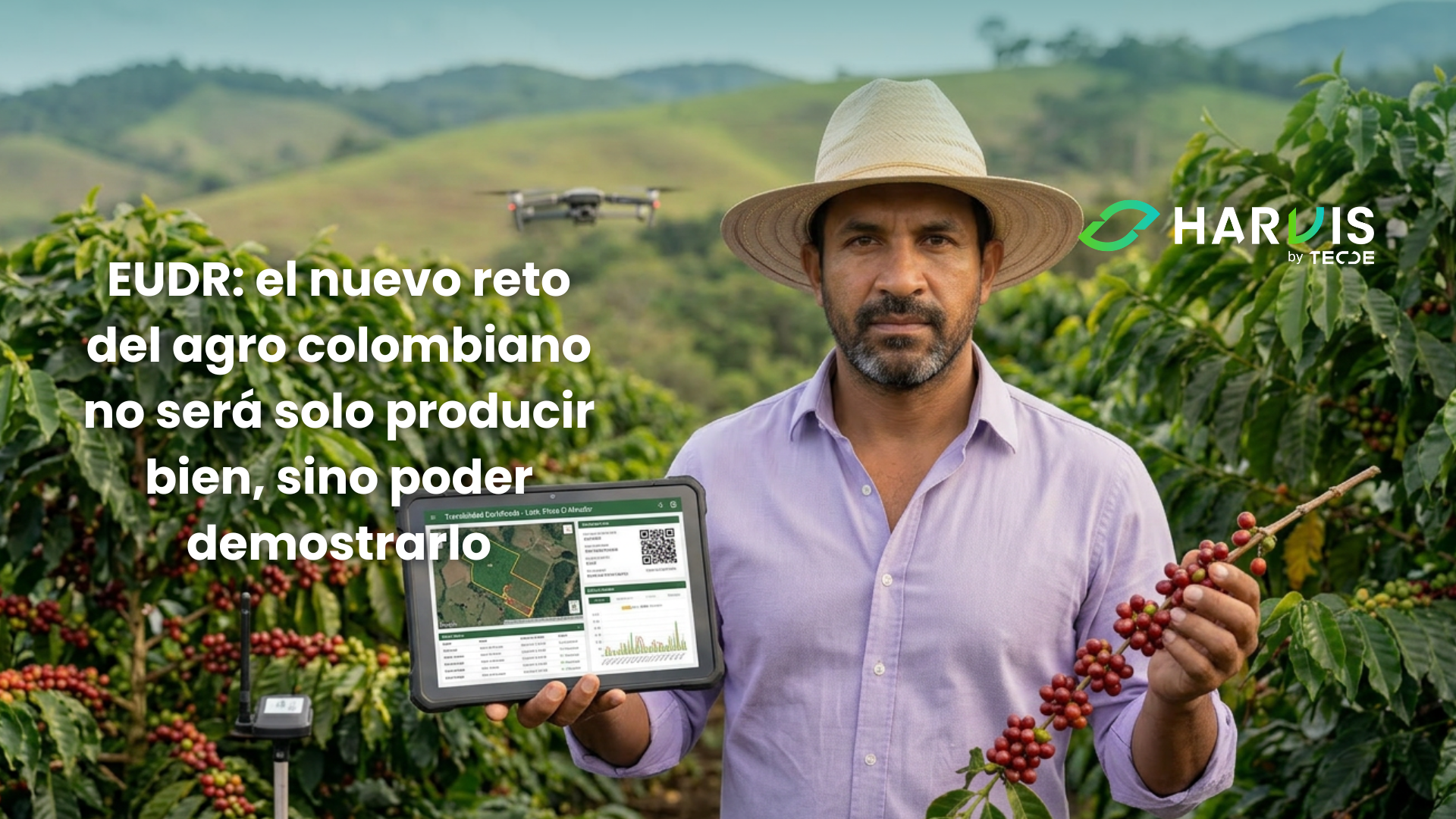
For a long time, producing well was enough to export; having good quality, meeting certifications, and building business relationships opened doors in international markets. Today, the scenario is changing; buyers no longer just want to know what you produce, but exactly where, how, and under what environmental and legal conditions your products were produced.
In recent months, many Colombian producers exporting coffee, cocoa, palm, or livestock products to Europe have started receiving different requests from their usual buyers. They no longer just ask for quality certificates or laboratory analyses; they now also request GPS coordinates of production lots, satellite verification of forest cover, and legal documentation that was previously unnecessary. It’s not that importers have become more demanding out of whim; they are preparing to comply with Regulation EUDR 1115/2023, a European regulation that comes into full effect on December 30, 2026.
And although many Colombian companies and producers have already been advancing in sustainability and international certifications, the focus is now also on the ability to technically demonstrate it, with verifiable information and detailed traceability.
This change may sound overwhelming at first, especially if it’s the first time you’ve heard about EUDR or if you’re not clear on what it exactly entails. But as with any adaptation process, the most important thing is to first understand what it is about, what they really ask of you, and what the most practical route to comply is; we still have time to manage.

But... what is the EUDR?
It is not simply a new certification or a sustainability recommendation.
The EUDR (European Union Regulation on deforestation-free products) aims to ensure that products entering the European market do not contribute to global deforestation.
What EUDR asks for:
The EUDR regulates seven raw materials and all their derivatives: coffee (green, roasted, instant, extracts), cocoa (bean, butter, powder, chocolate), palm oil (crude, refined, derivatives), rubber (latex, natural rubber products), soy (grain, oil, flour), beef (meat, leather, gelatin), wood (logs, furniture, paper).
For the Colombian context, the most relevant products are coffee, cocoa, palm, and livestock. Although we do not significantly produce soy and rubber is marginal, these four sectors involve hundreds of thousands of producing families and represent over $3 billion in annual exports to Europe.
An important aspect that many producers still do not grasp is that even if your production does not go directly to Europe, you may still need to comply with EUDR. Why? Because large international marketers and processors like Nestlé, Unilever, Cargill, among others, are unifying their traceability standards globally and will not manage different systems for different markets. If the cooperative you belong to or your direct buyer processes for both Europe and other destinations, they will likely require EUDR compliance for their entire chain, regardless of where your specific product ends up, which is why it is very important to know what this regulation consists of and what you need to guarantee your exports to Europe.
This does not mean you should panic; rather, it is the time to learn more about the regulation and understand that this trend towards greater traceability is not just a temporary European issue; it is the direction in which international trade in agricultural products is moving.
Now we will delve into the specific technical aspects of EUDR so you can understand exactly what you need and how you can prepare:
The four pillars of EUDR:
First: Precise geolocation of where you produce
This means you need to have the exact geographic coordinates of your productive lots. For the regulation, it is not enough to say: "my farm is in the municipality of Pitalito" or "I have crops in the El Placer village." You absolutely need GPS coordinates expressed in latitude and longitude with at least six decimal places.
For permanent crops like coffee, cocoa, or palm:
- If your lot is less than 4 hectares, a central GPS point of the productive area is sufficient.
- If your lot exceeds 4 hectares, you need a polygon that defines the perimeter, with several GPS points around.
For livestock, the issue is a bit more complex because you need coordinates for ALL the properties where the animal was during its life. A calf that was born on one farm, raised on another, and fattened on a third requires traceability of all three locations.
The good news is that obtaining these coordinates is not as complicated as it sounds. Nowadays, with technology, it can be done with free applications on your smartphone that have sufficient accuracy or with more specialized equipment like a GPS; the important thing is to do it now, calmly, and not leave it for the last moment.
Second pillar: Demonstrate that there has been no recent deforestation
The coordinates you provide will be verified with publicly available satellite images to compare forest cover as of December 31, 2020, with the current situation. The European Commission uses platforms like Global Forest Watch and data from the Copernicus Program of the European Space Agency for this analysis.
This is where some complexities may arise, especially in regions where there has been recent agricultural expansion:
- Cocoa: In areas like Caquetá or Putumayo, where cocoa was established between 2018-2024 as a substitute for illicit crops, many hectares had high stubble or secondary forest before cultivation. Satellite imagery may show this as "change in forest cover," even though it was part of legitimate government programs.
- Coffee: In areas of coffee expansion in Meta, Huila, or Caquetá, where new crops were established on land with previous vegetation.
- Palm: Plantations established between 2015-2022 in areas like Tumaco or Cesar that replaced pastures with scattered vegetation.
- Livestock: Systems that expanded grazing areas by eliminating stubble or introducing silvopastoral systems that, paradoxically, may show an increase in tree cover (which is positive).
If your coordinates show any alert of coverage change, it does not automatically mean you are blocked. It means you need to document what happened: Was it maintenance of an existing crop? Was it removal of pastures for renewal? Was it transformation authorized with environmental permission? All that documentation must be organized and ready.
Third pillar: Compliance with Colombian legislation
The product must not only be free from deforestation but also comply with all relevant national laws. This includes:
- Legal land tenure: registered deeds, updated certificate of tradition and freedom.
- Environmental permits when applicable (land use changes, forest exploitation).
- Labor compliance: formalized workers, social security up to date.
- For livestock: ICA registration of the property, health certifications, mobilization guides.
- For wood: valid forest exploitation licenses.
This pillar is where the historical informality of Colombian agriculture tends to clash a bit with the requirements of modern international trade. Many producers have situations that work locally but do not meet complete legal formalities: unpartitioned succession lands, verbal leases, workers without written contracts, properties without updated registration.
With this, it is not about judging these realities, which have historical reasons and complex contexts. But beyond that, it does imply that you need to start formalizing them if the goal is to maintain access to European markets.
Fourth pillar: Due Diligence Declaration
The European importer must present a formal declaration (DDS) certifying that they verified all the previous information and that the product meets the requirements. This declaration is uploaded to the European TRACES system and has serious legal implications for the importer if the information turns out to be false or incomplete; that is why importers are being very careful and demanding with their suppliers. It is not personal distrust; it is direct legal responsibility.
Why the certifications you have are not enough?
If you have Rainforest Alliance, organic certification, RSPO for palm, or Good Livestock Practices, excellent. Those certifications are still valuable and facilitate various aspects of the process. But they do not exempt you from specifically complying with EUDR.
Read our article on Certifications:
Certifications verify sustainable practices, agrochemical management, labor conditions, biodiversity conservation. All of that is important and is recognized. However, EUDR asks for specific additional elements that traditional certifications do not fully cover:
- Georeferencing with six decimal places precision (many certifications use approximate locations).
- Specific satellite verification of no-deforestation post-December 31, 2020.
- Legal due diligence declaration signed by the importer.
- Complete documentation of legal land tenure.
So, the certifications you have are an excellent starting point because they demonstrate that your practices are already heading in the right direction, but you need to complement them with the specific technical requirements of EUDR.
Practical compliance route according to your type of production
For coffee or cocoa producers:
- Georeference your lots: You can hire a professional surveyor or use free mobile applications if you have a smartphone with GPS. Walk the perimeter of your lot taking points, or mark the central point if it is less than 4 hectares. Save the data in digital format.
- Review your land legal situation: If you have formal deeds, perfect. If not, this is the time to start formalization: if it’s succession, start partitioning; if it’s a lease, formalize a written contract.
- Coordinate with your cooperative or exporter: Ask them what format of information they need, what platform they use, what their deadlines are. Don’t wait for them to seek you out; take the initiative.
For palm producers:
- Verify your current georeferencing: If you already have coordinates from RSPO or internal systems, check that they have the required precision (six decimal places).
- Strengthen legal documentation: If there is any informal aspect in your title, work on resolving it. Palm has historically faced global controversies over deforestation, so the documentation must be impeccable.
- Implement fruit traceability: You need to be able to trace each batch of harvested fruit back to the specific property of origin.
For livestock producers:
Identify all the properties in your chain: List where your animals are born, raised, and fattened. You will need GPS coordinates for each location. Update ICA records: Property certification, vaccinations up to date, complete mobilization guides. Formalize workers: Written contracts, social security up to date. It is a requirement of Colombian legal compliance that EUDR verifies.
Available tools and supports
You are not alone in this process. There are several organizations and initiatives working to facilitate compliance:
- Unions and federations: The Coffee Federation, Fedecacao, Fedegán, and Fedepalma have support programs for georeferencing and traceability. Consult with your local organization about what services they offer.
- Technological platforms: For Colombian producers, platforms like Harvis can adapt their functionalities to include EUDR compliance modules with user-friendly interfaces in Spanish.
- Cooperatives: Many are implementing collective georeferencing and traceability systems. Working together reduces individual costs.
- State support: Consult with entities like UPRA, ANT (for land formalization), ICA (for livestock certifications) about technical assistance programs and financial support.
The real timelines you need to consider
There are approximately 7 months left until December 30, 2026. It may sound like enough time, but when you break down the actual process, you see that the margin is not that wide:
- Professional georeferencing: 1-2 months (considering hiring time, execution, and data processing)
- Land formalization (if you don’t have deeds): 3-4 months (notarial procedures, registration, possible corrections)
- Satellite verification and supporting documentation: 1 month
- Coordination with exporter/cooperative: 1-2 months (information upload, validation, corrections)
- Margin for unforeseen events: they always appear
The recommendation is to start as soon as possible, not because there is an imminent emergency, but because an orderly process with enough time is much less stressful and costly than a rushed last-minute one.
Looking at this as an opportunity, not just a burden
EUDR represents additional work and, in many cases, economic investment that was not planned. That is undeniable, and it is valid to generate concern. But it is also worth looking at the constructive side:
- Formalization that you would eventually need: Many of the EUDR requirements (formal deeds, registered workers, up-to-date permits) are things that sooner or later you would need to grow, access credit, or formally inherit the farm. EUDR is accelerating a process that was already convenient.
- Market differentiation: Producers who achieve EUDR compliance early will have a competitive advantage. They will be preferred suppliers for importers who need to secure their supply.
- Systems that improve your management: Georeferencing, traceability, organized records not only serve EUDR. They also help you manage your production better, make data-driven decisions, and negotiate better prices.
- Access to premium markets: Europe pays better prices, especially for sustainable and traceable products. Complying with EUDR keeps you in that market.
One step at a time
You don’t need to solve everything tomorrow. But you do need to start. Choose a concrete action this week:
- Call your cooperative and ask what support they offer for EUDR.
- Contact a local surveyor or download a georeferencing app.
- Review the status of your deeds or start a consultation for formalization.
- Go to Global Forest Watch and familiarize yourself with the platform.
- Organize your current documentation in an orderly file.
Every step you take now is a step you won’t have to take rushing in December 2026.
EUDR is the new reality of international trade in agricultural products. It is not going to disappear or soften. But it is completely possible to comply if approached methodically, with adequate support and enough time.
Consulted references
- European Union. (2023). Regulation (EU) 2023/1115 on deforestation-free products. EUR-Lex.
- UPRA. (2025). Colombia prepares to comply with Regulation EUDR 1115/2023. https://upra.gov.co/
- Sustainable Society. (2025). Practical obligations of EUDR for coffee, cocoa, and palm producers. https://sociedadsostenible.co/
- Coffee, Forest, and Climate Agreement. (2026). EUDR implementation guide for the Colombian coffee sector. https://acuerdocafebosqueyclima.com/eudr/
- Luker Chocolate. (2025). Update on EUDR regulation. https://lukerchocolate.com/
- Coolx. (2026). EUDR and agricultural products: Guide for Exporters. https://coolx.earth/
- AENOR. (2026). EUDR Certification: fighting deforestation. https://www.aenor.com/
- Analdex. (2026). Colombian exports: EUDR regulated products. https://analdex.org/
- Fedecacao. (2026). Colombian cocoa: exports and EUDR compliance. https://www.fedecacao.com.co/
- Harvis. (2026). Agricultural management and traceability platform. https://harvis.app/