



If you've been reading this series, you already know that with nitrogen, the problem is loss: it evaporates, leaches, or escapes through some natural process. With phosphorus, it almost happens the opposite in one of the cases, and that's why it confuses so much. Phosphorus doesn't go anywhere; it stays right there, in the top few centimeters of the soil, exactly where you applied it. The problem is that it remains in a form that your crop cannot utilize.
It is one of the most frustrating situations in nutrient management. You apply phosphorus year after year, conduct soil analysis, and the report still says "low phosphorus." The natural reaction is to apply more, but in many cases, it's not that the phosphorus has gone; it's that everything you've applied, and what you applied last year, and the year before, is chemically blocked, out of reach of the roots. You're buying a nutrient that your soil already has but won't release.
Phosphorus (P) is an irreplaceable nutrient; it is part of DNA and RNA, participates in photosynthesis, and is the currency with which every plant cell stores and spends energy. No plant grows without it, and there is no element that can replace it. Understanding why your soil retains it and how to unlock it is the difference between continuing to buy phosphorus every cycle or starting to use what is already buried on your farm.
What you apply is not what your crop can take
When you buy phosphate fertilizer, the label plays a trick on you again, just like with nitrogen. DAP says 18-46-0, MAP says 11-52-0, triple superphosphate (TSP) says 0-46-0. That middle number is the percentage of P₂O₅ (phosphorus pentoxide), which is how the industry measures phosphorus content. But that number tells you how much phosphorus is in the bag, not how much will reach the root.
When you apply any source of phosphorus, as soon as the granule dissolves and releases phosphate into the soil solution, a reaction called fixation begins. In acidic soils, which dominate much of the productive tropical areas of Latin America, the soil is loaded with iron (Fe) and aluminum (Al); these elements have a very high affinity for phosphate, capturing it and forming insoluble compounds that the plant cannot absorb. Phosphorus remains there, in your soil, but is practically turned into stone, and this is no minor problem, as it is estimated that nearly 40% of the world's acidic soils are deficient in phosphorus precisely due to this fixation with iron and aluminum. In the most common soil orders of the humid tropics, Oxisols and Ultisols, available phosphorus can be as low as 1 to 5 ppm, a minimal amount compared to what a crop needs. And fixation is rapid; it occurs within hours or days after application, especially when using highly soluble sources like superphosphates.
Another characteristic that distinguishes phosphorus is that it is poorly mobile. Nitrate travels with water; phosphate hardly moves. It stays close to where the granule fell, having a huge practical consequence: if phosphorus is broadcast applied on the surface, roots that are 15 or 20 centimeters deep may never reach it. And what they do reach, the acidic soil has already fixed.
What is truly counterintuitive is that your soil analysis may continue to report "low phosphorus" after years of applying it, not because it has been lost, but because it has accumulated all in fixed forms. Technicians call it legacy phosphorus, a bank of phosphorus buried in your soil that you paid for but cannot cash in.
Why the response is so different between one field and another
Here is the question many producers ask: why does my neighbor apply the same formula and their crop responds, while mine continues to show deficiency? In the case of phosphorus, the answer is almost always due to pH; since soil pH is the factor that determines how much of your phosphorus remains available and how much gets fixed, we can see in acidic soils (pH below 5.5), iron and aluminum dominate and fix phosphate. In alkaline or calcareous soils (pH above 7), the problem changes actors but not results, as now calcium combines with phosphorus and forms insoluble calcium phosphates. Maximum phosphorus availability occurs in a narrow range, around neutral pH (6.0 to 6.5). Outside of that window, a portion of what you apply gets blocked regardless of the source.
There is one case that deserves special attention because it directly affects two of the most important crops in the region. Soils derived from volcanic ash, Andisols, where much of Colombia's coffee and Hass avocado is grown, are world champions in fixing phosphorus. They contain forms of amorphous aluminum with extraordinary phosphate retention capacity. In these soils, it is not uncommon for most of the applied phosphorus to be fixed in the first cycle, which is why a coffee plantation or an avocado orchard in volcanic soil requires a completely different phosphorus management than a crop in sandy or alluvial soil.
And it's not just pH and soil origin; texture, clay content, and especially organic matter modulate fixation. Organic matter acts as a shield; its compounds coat the sites where iron and aluminum would fix phosphate, leaving more phosphorus free for the plant. That's why two fields with the same dose and the same crop can have radically different phosphorus availability depending on their pH, mineralogy, organic matter content, and liming history. Your neighbor's dose is not your dose. What works in their field may be getting fixed in yours.
The forms of phosphate and when each one works
Not all sources of phosphorus behave the same, and choosing poorly can mean paying for phosphorus that gets fixed immediately. Soluble sources, triple superphosphate (TSP), MAP, and DAP, release phosphorus quickly. More than 90% of their phosphorus is water-soluble, making them very efficient when the crop needs available phosphorus right away. The flip side is that this same solubility exposes them to rapid fixation in acidic soils. Among them, there are differences that matter; MAP (11-52-0) slightly acidifies the area around the granule, which can help in alkaline soils; DAP (18-46-0) does the opposite, temporarily raising the pH next to the granule, and is the most used phosphate fertilizer in the world because it also provides nitrogen. TSP (0-46-0) has the highest concentration of pure phosphorus, with no nitrogen.
Rock phosphate is the other side of the coin; it has low reactivity and slow release. Applied directly to the soil, it represents less than 1% of global consumption because it only works well under very specific conditions: soils with pH below 5.5, high moisture, good clay and organic matter content, low calcium content, and surface application incorporated with tillage. In the right acidic soil, a reactive rock phosphate can be an economical and gradual release source. In the wrong soil, it's wasted money. A 22-year experiment in tropical soils in Brazil showed that reactive rock phosphate matched the yield of triple superphosphate when applied at sufficient doses, although at low doses, superphosphate was superior.
The practical lessons we have are: first, since phosphorus does not move, apply it localized, in bands, in the planting hole, in the drip zone of the tree, to place it where the roots are and reduce its contact with all the fixing soil. Second: the choice of source should be backed by a soil analysis. The pH of your field tells you which source makes sense. Without that information, you're guessing.
Why it is important to manage phosphorus applications well
There is a fact that few producers know that completely changes the way of thinking about this nutrient: phosphorus is not manufactured; all the phosphorus you apply on your farm came from a mine. It comes from rock phosphate, a finite and non-renewable mineral that formed over millions of years and is concentrated in very few places on the planet.
The figures show how concentrated the business is. In 2024, global production of rock phosphate was 240 million tons, led by China (45.8%), Morocco (12.5%), the United States (8.3%), Russia (5.8%), and Jordan (5%). And Latin America? It barely figures with Brazil producing 2.2% and Peru 2.1%. The rest of the region is mostly a net importer. The concentration becomes more concerning for the future as projections indicate that by 2100, North Africa could concentrate nearly 95% of the world's phosphorus reserves, putting the supply of an essential nutrient for food in the hands of very few.
The regional paradox is almost absurd; Peru extracts rock phosphate from its deposits, exports it raw, that rock is processed in Brazil, and then several countries re-import it already converted into finished fertilizer. Colombia produces a small amount, around 47,000 tons in 2023, fourth in the region, and imports most of its rock phosphate, mainly from Morocco. No Latin American producer can isolate their phosphorus cost from a global market they do not control, and phosphorus prices have risen nearly 50% since 2020.
But the most important thing is not just the price; phosphorus is a strategic, finite, and irreplaceable resource. About 90% of what is extracted is destined for fertilizers, and there is no substitute for it in food production. Estimates on how long rock phosphate will last vary widely, from a few decades to over three centuries, but there is consensus on one thing: the quality and accessibility of reserves are decreasing, and costs will continue to rise. That's why utilizing phosphorus is not just a matter of pocket. Every kilo that is uselessly fixed in your soil, or lost through erosion into a river, is a kilo of an irreplaceable resource that does not come back. The good news is that phosphorus can be recovered from wastewater, manures, and agricultural by-products, and there is a real opportunity for circular economy in the region.
Do you know in which of your fields phosphorus is getting fixed and in which you already have an accumulated bank that you could take advantage of? Harvis crosses pH, organic matter, and the history of each field to show you where applying phosphorus makes sense and where you would be paying for something your soil already has. Talk to us here →

The strategies that unlock phosphorus
Before discussing how to unlock it, it is worth answering a question that many producers ask: why is less phosphorus always applied than nitrogen and potassium?
The numbers confirm it at all scales. Globally, in 2024, 112.4 million tons of nitrogen were consumed, compared to 47.5 of P₂O₅ and 40.5 of potassium (K₂O); phosphorus is less than half of nitrogen. In technified coffee, the reference recommendation from Cenicafé is 300 kg/ha/year of N, 260 of K₂O, and only 50 of P₂O₅; phosphorus is about one-sixth of nitrogen. In Hass avocado, a production of 20 tons per hectare extracts about 52 kg of N, 94 of K₂O, and only 21 of P₂O₅; phosphorus is by far the least removed. The numbers confirm it at all scales. Globally, in 2024, 112.4 million tons of nitrogen were consumed, compared to 47.5 of P₂O₅ and 40.5 of potassium (K₂O); phosphorus is less than half of nitrogen. In technified coffee, the reference recommendation from Cenicafé is 300 kg/ha/year of N, 260 of K₂O, and only 50 of P₂O₅; phosphorus is about one-sixth of nitrogen. In Hass avocado, a production of 20 tons per hectare extracts about 52 kg of N, 94 of K₂O, and only 21 of P₂O₅; phosphorus is by far the least removed.
There are two reasons behind this. The first is biological; plants simply contain and extract much less phosphorus than nitrogen or potassium. In avocado fruit, phosphorus represents only 0.35% of the dry matter, compared to almost 2% of potassium. The second is soil dynamics; since phosphorus is poorly mobile and accumulates (that legacy phosphorus we already talked about), you don't need to replenish it constantly like nitrogen, which is lost in every cycle. Once you've built a good level of phosphorus in the soil, maintenance doses are low.
With that clear, here are the strategies that truly move the needle:
- Correct the pH first and foremost. It is the most powerful and most ignored measure. If your soil is acidic, raising the pH from 5.0 to a range of 6.0–6.5 through liming releases phosphorus that was fixed by aluminum. In many cases, liming delivers more phosphorus to your crop than applying another bag of fertilizer. Before increasing the phosphate dose, check the pH: phosphorus may already be in the soil waiting for you to open the door.
- Apply localized and at the right time. Place phosphorus in bands or in the planting hole, close to the roots, not broadcast. And concentrate it during the stages of highest demand; phosphorus is critical during establishment, flowering, and fruit filling. In perennial crops, a good base of phosphorus at planting time defines root development for the following years.
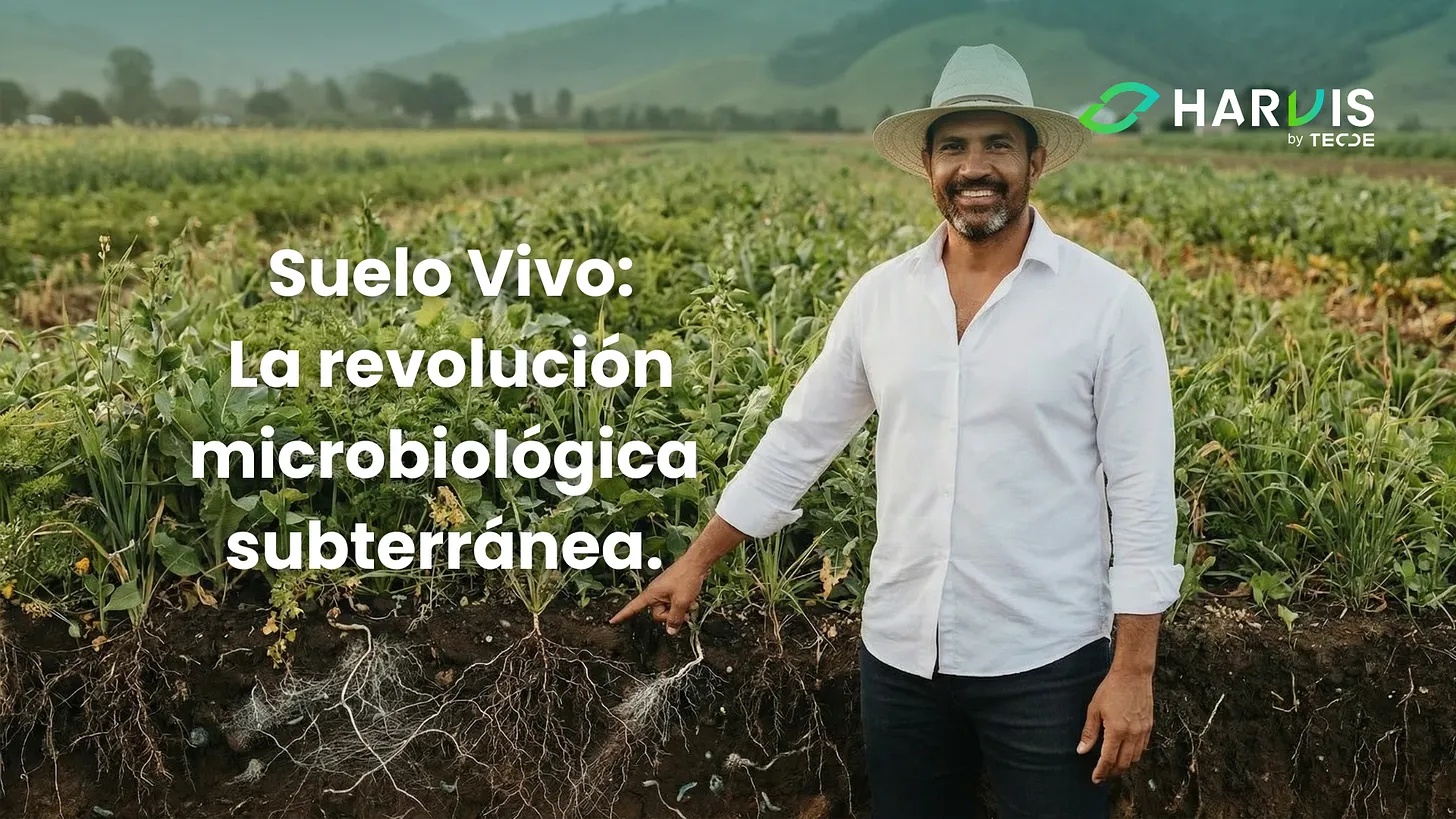
- Use soil biology to your advantage. There are phosphate-solubilizing bacteria (from the genera Bacillus and Pseudomonas, among others) and arbuscular mycorrhizal fungi that release fixed phosphorus and deliver it to the plant. Their effect can be enormous; recent studies show that inoculation with mycorrhizae can reduce the recommended dose of phosphate fertilizer by up to 80%. These microorganisms are literally the keys that unlock the legacy phosphorus bank in your soil. As we already addressed in our blog Living Soil: the ecosystem beneath your feet that decides your harvest, which you can read here, the microbial life of the soil is what activates and releases the nutrients that roots actually absorb. With phosphorus, this is literal: without those solubilizing microorganisms working, much of the phosphorus in your soil will remain blocked no matter how many bags you apply.
- Add organic matter. Organic fertilizers —compost, chicken manure, composted coffee pulp— serve a triple function: they provide slowly released phosphorus, feed solubilizing microorganisms, and coat fixation sites, leaving more phosphorus free.
- Cash in on the phosphorus you already have. Many soils with years of fertilization have accumulated a considerable bank of legacy phosphorus. A well-interpreted soil analysis tells you if that bank exists. If your phosphorus level is already above the critical point, applying more does not increase yield, it only adds costs and risk of contamination.
And that last point connects with something that almost no one warns about: excess phosphorus also costs a lot. Above the level that the crop needs, extra phosphorus does not translate into more production, but it does bring problems. The first is micronutrient blocking; excess phosphorus interferes with the absorption of zinc (Zn) and iron (Fe), inducing deficiencies that are common precisely in over-fertilized avocado and citrus orchards. The second is environmental; phosphorus washed away by erosion into rivers and reservoirs accelerates eutrophication, that explosive growth of algae that suffocates aquatic life. And the third is silent but serious; phosphate fertilizers carry traces of cadmium (Cd), a toxic heavy metal that accumulates in the soil with continuous use and transfers to crops. European regulation already sets strict limits on cadmium in fertilizers for this reason. Applying more phosphorus than necessary accelerates that accumulation without any productive benefit.
The phosphorus that is in your soil, but your crop does not see
When one crosses the data of many fields over several cycles, a pattern emerges that goes against intuition. Fields with the worst phosphorus deficiency are almost never the ones that received less fertilizer. They are the ones with the lowest pH and the highest aluminum saturation, the fields where everything that was applied, cycle after cycle, got fixed.
Two neighboring producers can apply exactly the same formula and the same dose. One harvests well; the other drags phosphorus deficiency year after year. The difference is not in the bag they bought; it is in the pH, in the exchangeable aluminum, and in the soil origin of each field. The first has soil that releases phosphorus; the second has one that sequesters it.
The data that only emerges when crossing several fields is that some of your fields probably do not need more phosphorus at all. They have a bank of legacy phosphorus accumulated from years of application, and what they lack is not fertilizer but pH correction or biological activity to release it. Other fields are genuinely deficient and will respond to application. Distinguishing between the two, crossing pH, aluminum saturation, organic matter history, soil order, previous liming, and the phosphorus that each harvest actually took, is what separates a fertilization recommendation that saves money from one that wastes it.
The most expensive phosphorus is not the one you are going to buy. It is the one you already bought, buried in your soil, and your crop cannot touch. The difference between wasting it and cashing it in is not in applying more; it is in knowing, field by field, where it is blocked and why.
References consulted
- Osorio N.W. (2014). Nutrient Management in Tropical Soils. National University of Colombia. ISBN 978-958-44-9746-8. https://www.bioedafologia.com/informacion-libro
- UPRA (2025). Sheet of phosphate fertilizers: rock phosphate, phosphate (P₂O₅), superphosphates, DAP, MAP. Agricultural input price index. Ministry of Agriculture of Colombia. https://upra.gov.co/sites/default/files/2025-11/Ficha de los fertilizantes fosfatados_roca fosfórica, fosfato (P2O5), superfosfatos, DAP, MAP.pdf
- Sanzano A. The Phosphorus of the Soil. Chair of Edaphology, National University of Tucumán. https://s9a0d11af78cd478d.jimcontent.com/download/version/1563476239/module/7956239776/name/El Fosforo del suelo.pdf
- Khan F. et al. (2023). The Global Dilemma of Soil Legacy Phosphorus and Its Improvement Strategies under Recent Changes in Agro-Ecosystem Sustainability. ACS Omega. https://pubs.acs.org/doi/10.1021/acsomega.3c00823
- Sadeghian K.S. and González O.H. (2012). General fertilization alternatives for coffee plantations in production. Technical Advances Cenicafé No. 424. https://biblioteca.cenicafe.org/jspui/bitstream/10778/1107/3/avt0424.pdf
- On the fixation of phosphorus in calcareous soils. CSIC. https://digital.csic.es/bitstream/10261/78801/1/Sobre la fijación del fósforo en suelos calizos.pdf
- Martins T.S. et al. (2025). Long-term management strategies to optimize phosphorus utilization in a tropical maize and soybean succession. Field Crops Research, Vol. 322. https://www.sciencedirect.com/science/article/abs/pii/S0378429025000322
- Intagri. Management of Phosphorus in Acid Soils. https://www.intagri.com/articulos/suelos/manejo-del-fosforo-en-suelos-acidos
- Espinosa J. Volcanic Soils, Phosphorus Dynamics, and Potato Production. CIP. https://cipotato.org/wp-content/uploads/congreso ecuatoriano 2/JESPINOZA.pdf
- Phosphorus reserves depletion, concentration in a single geographical location. (2024). East African Journal of Science, Technology and Innovation. https://eajsti.org/index.php/EAJSTI/article/download/1307/279/6748
- Phosphorus Reserves, Resources and Uses (2022). https://www.fertilizer.org/wp-content/uploads/2023/04/2023ArgusIFAPhosphateRockResourcesandReservesFinal.pdf
- Mora-Quilismal S.R. et al. (2021). Biofertilization with phosphate-solubilizing bacteria and arbuscular mycorrhizal fungi in potato cultivation. Tropical Crops, INCA. http://scielo.sld.cu/scielo.php?script=sci_arttext&pid=S0258-59362021000200002
- Unlocking phosphorus resources: phosphate-solubilizing microorganisms as a green strategy for activating phosphorus in acidic red soils (2025). Frontiers in Microbiology. https://www.frontiersin.org/journals/microbiology/articles/10.3389/fmicb.2025.1630650/full
- AGROSAVIA. Technology for Avocado Cultivation — Nutrition and Fertilization. https://repository.agrosavia.co/bitstreams/72f26968-4e57-4967-a089-fd8b844a16e7/download
- Sustainable management of avocado fertilization. ICIA. https://www.icia.es/icia/download/Aguacate/10.pdf
- Cenicafé. General fertilization alternatives for coffee plantations in production (Technical Advance 424). https://biblioteca.cenicafe.org/jspui/bitstream/10778/1107/3/avt0424.pdf
- Enhancing soil health and phosphorus use efficiency with modified biochar amendment (2025). Science of the Total Environment. https://www.sciencedirect.com/science/article/abs/pii/S0048969725024349