


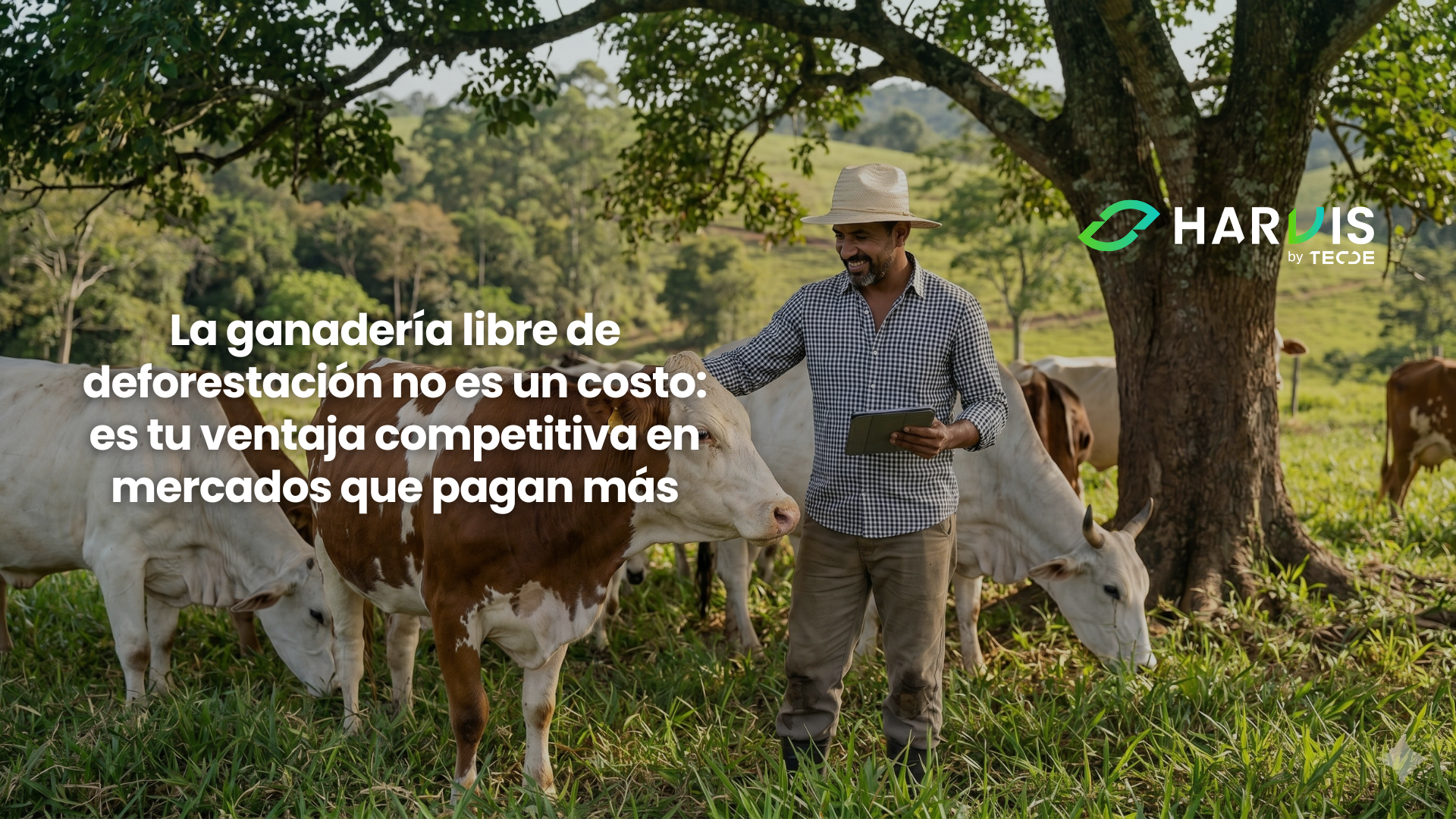
For many ranchers, the word "sustainability" comes attached to three things: more paperwork, more requirements, and less money. It's understandable. There are new regulations, certifications, audits, and a supply chain that demands more from the primary producer while margins are already tight. The distrust is legitimate. But there is a problem with that framing: it ignores the numbers. When you review data from farms that adopted silvopastoral systems in the dry Caribbean or Cesar, the picture changes radically. Milk production does not decrease; on the contrary, it can increase by more than 50%. Weight gain in beef cattle does not fall; it improves by about 30%. The carrying capacity in many cases goes from 0.9 animals per hectare to 3 or 4 in the same space. These are not figures from a government brochure. They are reported by Agrosavia in their own comparative studies with real ranchers in the country.
And if you add to that the fact that extensive cattle ranching with deforestation has its days numbered in Colombia, with Law 261 already approved in the Senate and advancing in the House, and with the Beef NAMA functioning as a public state policy, the calculation becomes even clearer: transforming the farm today is more profitable than being left out of the markets tomorrow.
This is not a blog about environmental regulation. It is a blog about how some Colombian ranchers are already capturing a competitive advantage that most still do not see.
Production does not decrease when you change the system
The most resilient myth in Colombian cattle ranching is that being sustainable requires producing less to conserve more. Intensive Silvopastoral Systems (SSPi) demonstrate the opposite, and the data is hard to ignore.
A conventional cattle system produces an average of 794 liters of milk per hectare per year. A well-implemented SSPi can reach 2,849 liters per hectare per year [2]. This is not a marginal improvement; it is more than triple. The mechanism is not magic, as the shade of the trees creates a microclimate that reduces the thermal stress of the cattle, improves the nutritional quality of the grass, and makes the animals eat more and better for more hours of the day. In terms of available green forage, productivity in SSPi reaches 23,479 kg per hectare, compared to 15,638 kg in the traditional system, which is 50% more food produced in the same space, without a single additional kilo of concentrate.
For meat, the data points in the same direction. Research from the Biorum Group at the National University reports greater weight gain in steers under silvopasture, with a microenvironment that also reduces the presence of pests such as the hematophagous fly and pasture bugs by more than 50% [4]. Fewer pests mean less investment in animal health. And that directly lowers the cost per kilo produced, without touching the selling price.
How much does it cost to implement this change? Establishing a complete Intensive Silvopastoral System (SSPi) with high density of forage shrubs and timber trees requires an initial investment that ranges between $9 and $11 million per hectare, according to recent agricultural cost reports. Although the figure is higher than it was a few years ago due to the cost of inputs, the math of the return remains compelling, as this investment begins to be reflected in net income between year 4 and year 5, when milk production can rise from 4 to 5 liters per cow per day, and external supplementation costs plummet. Additionally, there is the future income from timber, fruit, and environmental services. The Sustainable Colombian Cattle Ranching Project by TNC Colombia documented that participating farms increased their income by USD 576 per hectare. This is not an isolated figure; it is the result of more than a decade of field monitoring in multiple regions of the country.
The animal load also changes the business from within. A conventional pasture supports 0.9 animal units per hectare. A well-managed silvopastoral one can sustain between 3 and 4. More animals in the same space, with better feeding and lower health costs, is exactly what a cattle business needs to improve its margin per hectare.
Law 261 and the Beef NAMA: they are not a punishment, they are a roadmap with a deadline
Colombia currently has two policy instruments in place that will define what type of cattle ranching is viable in the coming years. Ignoring them does not stop them; it only puts some ranchers at a disadvantage compared to those who are already preparing.
The first is the NAMA (Nationally Appropriate Mitigation Action), which refers to the Nationally Appropriate Mitigation Actions for Sustainable Cattle Ranching, already approved as a public state policy. Its objective is to reduce greenhouse gas emissions from the meat and milk chains and increase carbon capture in bovine agroecosystems. Its concrete goal: a 20% reduction in emissions from the cattle sector by 2030, with prioritized actions in the 7 regions that concentrate 51.8% of bovine emissions and 47.6% of the national herd. The World Bank, Fedegán, CIAT, CIPAV, and the Ministry of Agriculture support its implementation. It is not a declaration of good intentions; it has funding, a roadmap, and concrete mechanisms for productive reconversion.
The second instrument is Bill 261 of 2024, approved in the Senate plenary in October 2025 and currently in the House of Representatives. Its purpose is technical and precise to connect in real-time the animal traceability systems, SINIGAN, SNIITA, and SIGMA, with the monitoring of forests from IDEAM and the data from the multipurpose cadastre. The result is a system that can say, lot by lot and in real-time, whether a cattle is being raised in an area of active deforestation or not.
What matters most for the producer are two concrete elements created by the project. The first is the Deforestation-Free Beef Certificate, which will be issued by the Ministry of Environment based on cross-referenced information from all systems. It may become a mandatory requirement for processing plants, auctions, and exporters in high environmental risk areas. The second is the creation of High Surveillance Zones, where the ICA will intensify the control of cattle movement, verify documents, and track buying and selling flows in real-time.
In practical terms for the rancher who cannot demonstrate that their cattle do not come from deforested areas, they may be excluded from access to formal auctions and export markets. Those who already keep records, have traceability, and work their pastures with trees, have the strongest position today when those requirements become mandatory. Do you want to know which lots on your farm have the greatest potential for sustainable reconversion? Request a demo from Harvis

The seal, the markets that pay more, and carbon credits
As we have already addressed in our blog Intelligent Cattle Ranching, which you can read here, well-recorded data is the first tool to improve the profitability of a farm. In sustainable cattle ranching, that same data also becomes the passport to access markets with differential prices.
Complying with Good Livestock Practices (BPG) paves the way for the Colombian Environmental Seal (NTC 6550:2021), elevated to legal status by Law 261. It is not just a symbolic recognition: it is a commercial differential that starts to matter to buyers who pay more. Export markets for quality meat and dairy products recognize efforts in animal welfare and sustainable production, and this translates into price differentiation and income for ranchers who implement these systems. Colombian beef has real advantages that the global market is beginning to value clearly: it is grass-fed, with water and salt, without anabolic steroids, with animal welfare, and with a lower environmental footprint compared to intensive systems from other latitudes. What was once called productive backwardness is now starting to be called a strategic asset.
Additionally, there is a source of income that very few ranchers are still capturing: carbon credits. When a farm adopts agro-silvopastoral systems, plants live fences, implements high-density rotational grazing, and allocates areas for reforestation, it can certify and sell tons of captured or reduced CO₂. In Colombia, the national carbon tax for 2025 is set at $27,399 per ton, and companies that need to offset their emissions buy those credits in the voluntary market. A rancher with a well-established SSP can generate verified credits that other industries buy to meet their environmental commitments. It does not replace income from meat and milk, but it is a real, constant, and growing flow that conventional extensive ranching will never be able to generate.
The complete account is that the sustainable rancher has sources of income that the conventional one does not know, such as timber, fruits, environmental services, and carbon, and costs that the conventional one pays excessively and he does not, such as oversized animal health, low animal load, degraded pastures, and soils that lose productivity year after year without anyone noticing.
The money that the eye cannot see
The cattle farms I accompany reveal a pattern that is hard to see from the inside, as the profitability gap between a sustainable rancher and a conventional one is not primarily in the price they receive for a kilo of meat or a liter of milk. It is in the cost per unit produced.
When the data on carrying capacity, forage efficiency, days of pasture occupancy, investment in health, and productivity per cow are crossed among farms in the same region and same thermal floor, those with silvopastoral components, even if partial, consistently show a cost per liter or per kilo produced between 15% and 25% lower. Not because they sell more expensively, but because they spend less to produce the same. The fly costs less. The grass yields more. The animal eats better with less supplement.
The second pattern is more revealing, and the profitability inflection point in farms making the transition does not appear at the beginning of the reconversion. It appears between the third and fifth year, when the carrying capacity starts to rise, when the timber has its first harvests, and when the traceability records have enough history to negotiate with buyers who pay a premium for certified sustainability. That inflection point can only be anticipated if the baseline data is available from today.
The rancher who already keeps traceability records, who already has trees in their pastures, and who already knows the productive history of each lot, does not face a radical transformation when Law 261 is enacted. They only need to show what they have already done. Those who wait for the regulation to force them to comply start from scratch with a deadline looming. Sustainable cattle ranching is not a bet on the future. For those who have their data organized today, it is already a present advantage.
- Agronegocios.co, "Silvopastoral systems as a financial strategy for profitability in farms" (2026) — https://www.agronegocios.co/finca/sistemas-silvopastoriles-como-una-estrategia-financiera-para-la-rentabilidad-en-fincas-4359036
- Contexto Ganadero, "Reasons why silvopastoral systems generate money" (2024) — https://www.contextoganadero.com/ganaderia-sostenible/razones-por-las-cuales-los-silvopastoriles-le-generan-dinero
- Agencia de Noticias UNAL Medellín, "Silvopasture, an alternative to produce low or neutral carbon meat and milk" — https://agenciadenoticias.unal.edu.co/detalle/silvopastoreo-alternativa-para-producir-carne-y-leche-bajas-o-neutras-en-carbono
- Contexto Ganadero / Agrosavia, "Investment in silvopastoral systems reflects profitability" (2023) — https://www.contextoganadero.com/ganaderia-sostenible/inversion-en-sistemas-silvopastoriles-se-refleja-en-la-rentabilidad-agrosavia
- TNC Colombia, "Sustainable Colombian Cattle Ranching — project results" — https://www.nature.org/es-us/sobre-tnc/donde-trabajamos/tnc-en-latinoamerica/colombia/ganaderia-colombiana-sostenible/
- CIPAV, "Nationally Appropriate Mitigation Action NAMA for Sustainable Cattle Ranching in Colombia" — https://cipav.org.co/accion-de-mitigacion-nacionalmente-apropiada-nama-de-la-ganaderia-bovina-sostenible-en-colombia/
- Fedegán, "The Beef NAMA" — https://www.fedegan.org.co/columna-presidente/la-nama-bovina
- Dejusticia, "For sustainable and deforestation-free meat production" (Dec. 2025) — https://www.dejusticia.org/por-una-produccion-de-carne-sostenible-y-libre-de-deforestacion/
- Senate of the Republic of Colombia, "Senate advances in the bill for sustainable and deforestation-free cattle ranching" (Sept. 2025) — https://www.senado.gov.co/index.php/el-senado/noticias/6867-senado-avanza-en-proyecto-de-ley-para-una-ganaderia-sostenible-y-libre-de-deforestacion
- Sustainable Society, "Sustainable and deforestation-free cattle ranching: Law 261 and perspectives for 2026" (Nov. 2025) — https://sociedadsostenible.co/ganaderia-sostenible-y-libre-de-deforestacion-avance-del-proyecto-de-ley-261-de-2024-y-perspectivas-para-2026-en-colombia/
- Italcol, "Sustainable cattle ranching: the challenge of reducing pollution while increasing productivity" (2023) — https://italcol.com/ganaderia-sostenible/
- Contexto Ganadero, "Beef costs what it is worth (of Values)" (Mar. 2026) — https://www.contextoganadero.com/columna/la-carne-bovina-cuesta-lo-que-vale-de-valores
- Contexto Ganadero, "Carbon credits, a new business for ranchers" (2024) — https://www.contextoganadero.com/ganaderia-sostenible/bonos-de-carbono-nuevo-negocio-para-ganaderos
- Enel Colombia, "National Carbon Tax Credits — value 2025" — https://www.enel.com.co/es/empresas/enel-generacion/bonos-de-carbono.html
- UNAL, "National University of Colombia: Logbook Bulletin - Medellín Campus - Silvopasture, the alternative to produce low or neutral carbon meat and milk." Accessed: May 30, 2026. [Online]. Available: https://unimedios.medellin.unal.edu.co/bitacora/academia-u-n/1134-silvopastoreo-la-alternativa-para-producir-carne-y-leche-bajas-o-neutras-en-carbono.html