

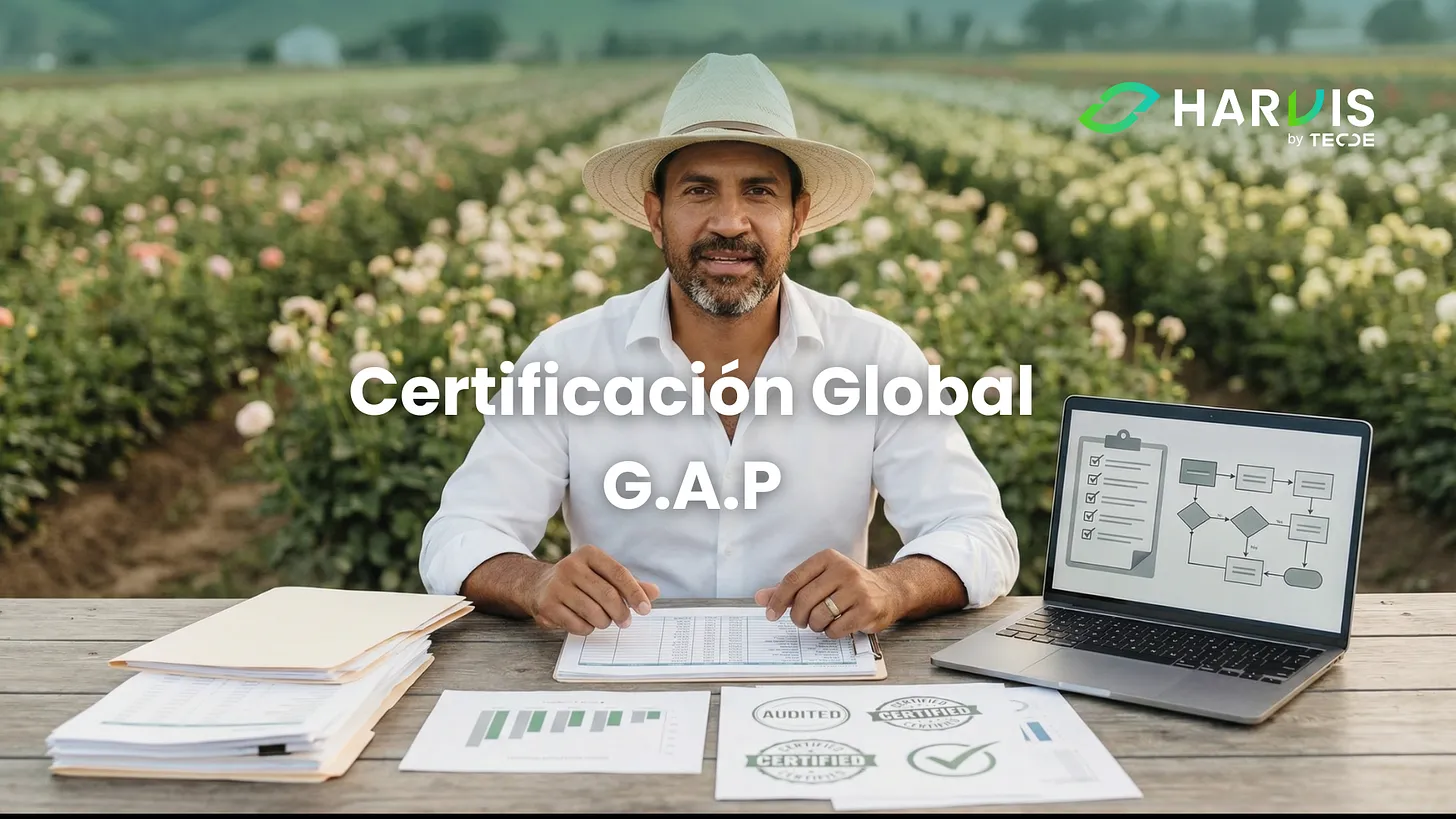
🥑The BPA standard of unique norms that globally encompasses agricultural production.
In our previous edition, we have been addressing the relevance of certifications as keys to access international markets. Just as the fundamental role of ICA certifications in the traceability and quality of Colombian agricultural products ensures that the exported product does not negatively affect the destination market, this time we take a step further to talk about one of the most recognized and demanded ethical and quality standards by buyers worldwide: GlobalG.A.P. More than a technical requirement, GlobalG.A.P. is a guarantee that agricultural production is carried out under good agricultural practices, with a comprehensive focus on safety, sustainability, labor welfare, and environmental care. For the producer dreaming of crossing borders, GlobalG.A.P. is not just a requirement; it is the key that opens the doors to the most demanding markets.
🌿What is GlobalG.A.P?
It is one of the global standards that guarantees quality, safety, and sustainability in agricultural production, covering every stage of the process, from the farm to the arrival of the product to the final consumer. The main solutions it integrates are:
🍊Integrated Farm Assurance (IFA): the main reference for primary production (fruits, vegetables, combinable crops, and more).
🍊Chain of Custody (CoC): to ensure that products marketed with GLOBALG.A.P. claims come from certified sources.
🍊Add-ons and modules: GRASP (social assessment), SPRING (water management), Animal Welfare, and others specific to scope. Currently, version 6 of the standard is in effect covering the following topics:
🌳 Restoration, protection, and enhancement of biodiversity and habitats on farms: GLOBALG.A.P. requires that the producer not only avoids environmental degradation but also implements practices that promote biodiversity. This involves:
✔️ Maintaining and restoring natural areas such as hedges, riparian zones, and biological corridors.
✔️ Protecting native species and avoiding the introduction of invasive species.
✔️ Designing the farm considering refuge areas for beneficial wildlife (birds, pollinating insects).
Objective: to ensure an ecological balance that favors production and preserves ecosystems in the long term.
💧 Efficient water use, protection of water sources, and wastewater management: The standard establishes criteria to protect this vital resource, comply with local regulations, and ensure its future availability focused on:
✔️ Monitoring water consumption and avoiding waste.
✔️ Using technical irrigation (drip, micro-sprinkling) to optimize the resource.
✔️ Maintaining buffer zones around rivers, lakes, or wells.
✔️ Properly treating and disposing of wastewater, avoiding direct discharge into water bodies.
♻️ Implementation of management and recycling systems to minimize waste and prevent pollution: A documented plan is required to reduce the environmental footprint and avoid soil, water, and air pollution, taking into account:
✔️ Separation of organic, recyclable, and hazardous waste.
✔️ Safe disposal of agrochemical containers (triple rinsing, delivery to authorized centers).
✔️ Reduction of packaging and use of biodegradable or recycled materials. 💡 Improvement of energy efficiency and reduction of non-renewable energies. With the aim of reducing costs, making more rational use of resources, and contributing to the reduction of greenhouse gas emissions, GlobalG.A.P promotes that the producer:
☑️ Records and analyzes their energy consumption.
☑️ Switches to LED lighting, efficient motors, and low-consumption equipment.
☑️ Considers renewable sources (solar, wind) for farm processes.
☑️ Optimizes machinery to reduce fossil fuel consumption.
🪳 Integrated pest management for crop protection primarily through natural methods: Mainly, GlobalG.A.P promotes healthier production methodologies that seek to protect human health and preserve beneficial fauna prioritizing:
✔️ Pest prevention through crop rotation, physical barriers, and biological control.
✔️ Constant monitoring to detect intervention thresholds.
✔️ Selective and minimal use of chemical pesticides, always as a last resort.
🔥 Responsible use of resources and raw materials from sustainable sources in compound feeds: In the pursuit of ensuring that the entire production chain is consistent with responsible practices, the certification requires:
✔️ Verifying that raw materials do not come from deforested or overexploited areas.
✔️ Prioritizing certified suppliers in sustainability.
✔️ Reducing the use of ingredients with a high environmental impact.
🌍 Environmental impact assessment: With the aim of making evidence-based decisions to minimize damage and comply with international standards, the producer must conduct periodic diagnostics that include:
✔️ Identification of environmental risks in productive activities.
✔️ Documented preventive and corrective measures.
✔️ Review and update of the plan as conditions on the farm or legislation change.

What is GLOBALG.A.P. IFA v6 SMART- GFS?
It is the latest version of the Integrated Farm Assurance standard, which establishes the requirements for certifying good agricultural, livestock, and aquaculture practices. Its goal is to ensure that products are grown, raised, or produced safely, sustainably, and socially responsibly, meeting the demands of international markets.
1️⃣ IFA v6 Smart:
✔️ Designed to facilitate access for small and medium producers.
✔️ With simplified language and criteria adapted for more agile implementation.
✔️ Allows for a progressive approach to full certification.
2️⃣ IFA v6 GFS (Global Food Safety)
✔️ Recognized by the Global Food Safety Initiative (GFSI), making it accepted by the most demanding supermarket chains and buyers.
✔️ Stricter in safety and traceability requirements.
✔️ Generally requested for exports to markets such as the European Union, United States, Canada, Japan, and large global retailers.
3️⃣ Scopes and complements that buyers often request:
✔️ IFA (Plants – F&V): certifies the farm/crop in the field (Requested for fresh fruit).
✔️ PHA (Produce Handling Assurance): certifies post-harvest cooling, selection, packaging, storage. Recognized by GFSI and supports FSMA compliance for the U.S.
4️⃣ CoC (Chain of Custody): for those producers who will declare GLOBALG.A.P./GGN in the trading chain, collection center, packing house, ensuring segregation and traceability from the field to the customer.
5️⃣ RASP v2 social/labor, now stricter and with P&Cs of labor rights as Major Must.
📑What are the certification options and when are they convenient?
🧑🌾 Option 1. Individual producer:
✔️Single site: one single farm.
✔️Multisite without QMS: several farms under the same legal entity, without a quality management system (QMS).
✔️Multisite with QMS: several farms under the same legal entity with QMS
🧑🌾 Option 2. Group of producers
The group (legal entity) holds the certificate; all members fall under the group's QMS. Which to choose? If the producer is an exporter with several farms and centralized processes and wants to audit a sample instead of 100% each year, it is advisable to choose Option 1 multisite with QMS or Option 2 group. But if the producer has a single farm, or a few manageable farms, Option 1 single/multisite without QMS may suffice.
📑What is the QMS?
It stands for Quality Management System. In the context of GLOBALG.A.P. IFA v6, it is a set of procedures, records, and controls that an organization with multiple producers or production sites must implement to ensure that all comply with the requirements of the standard uniformly and consistently. The QMS is not optional when:
✔️ Certification is requested as option 2 (groups of producers or companies with multiple production sites).
✔️ The same company manages several farms or production units that are under a single certificate.
🌿 Elements that GLOBALG.A.P. requires in the QMS
✔️ Documented quality policy and objectives: Written declaration of commitment to food safety, sustainability, and compliance with the standard.
✔️ Clear organizational structure: Organizational chart and defined roles for all personnel involved in production and management.
✔️ QMS manual: Document that describes how the organization meets each point of the GLOBALG.A.P. standard. Includes standard operating procedures (SOPs), forms, and records.
✔️ Annual internal audits: Documented evaluations of each producer or site before the external certification audit.
✔️ Corrective action plan: Procedure for correcting non-conformities detected in internal or external audits.
✔️ Training and competence of personnel: Evidence of ongoing training in food safety, environment, labor welfare, and safe handling of inputs.
✔️ Total traceability: System that allows tracking the product from the farm to the final customer, with clear and updated records.
✔️ Complaint management: Procedure for receiving, recording, investigating, and resolving complaints from customers, authorities, or consumers.
✔️ Document and record control: All records must be legible, dated, signed, and kept for a minimum period (normally 2 years).
✔️ Risk assessment: Identification of environmental, safety, and labor risks, with control measures. At this stage, it is essential to identify the customer and their requirements, whether they require certification v6 GFS or allow v6 SMART. Both share the logic of Principles & Criteria and require 100% Major Must and ≥95% Minor Must to certify.
🕵️So what is the path to obtaining the GLOBALG.A.P IFA v6 certification?
1️⃣ Consult essential regulations: Download and review the official documents, all available for free on the GLOBALG.A.P. site. This first phase is essential to understand the requirements and certification structures:
✔️General Regulations for individual producers (IFA v6 Smart & GFS) https://documents.globalgap.org/documents/220929GGGRRulesforIPv60Sep22_en.pdf
✔️Specific general regulation for groups or multisite with QMS (Option 2)
:https://documents.globalgap.org/documents/240902GGGRRulesforQMSv60Aug24_en.pdf
✔️Control Points and Compliance Criteria (PC-CC) IFA v6 Smart and GFS – Fruits and Vegetables:
These are the specific requirements that the agricultural operation must meet to obtain certification.
✅ Each PC describes exactly what must be done or met in a specific area.
✅ The CC are the Compliance Criteria. They are the practical and verifiable guide to demonstrate that the PC is being met.
✅ IFA Smart PCs for Fruit & Vegetables: https://documents.globalgap.org/documents/220929IFAGFSPCsFVv60Sep22en.pdf
Summary of changes and transition tools from v5 to IFA v6
✅Summary of changes and transition tools:
https://www.globalstd.com/wp-content/uploads/2018/05/com69en.pdf?utm_source=chatgpt.com
2️⃣ Understand the type of certification as applicable. If the producer needs IFA v6 Smart, which is the most flexible option, or IFA v6 GFS recognized by GFSI.
The following comparative PDF allows identifying which best fits the producer's needs: Smart vs GFS – IFA v6: overview https://globalgapsolutions.org/wp-content/uploads/2022/04/220413SmartGFSComparisonEN.pdf
3️⃣ Initial assessment (diagnosis or self-assessment)
Conduct a self-assessment against the PC-CC (Control Points). If it is a group or multisite, it is important to validate the document Rules for QMS to understand the quality management requirements (profiles, internal audits, traceability, continuous improvement plan, etc.)
https://documents.globalgap.org/documents/220929GGGRRulesforQMSv60Sep22_en.pdf
4️⃣ Continuous Improvement Plan
IFA v6 requires a documented continuous improvement plan, with concrete objectives, dates, and follow-up.
https://documents.globalgap.org/documents/220929IFASmartPCsFVv60Sep22en.pdf
5️⃣ Implementation and evidence in the field
It is required to adapt the productive practices of the farm according to the PC-CC found, including: food safety, traceability, biodiversity, energy, waste, water, climate, IPM, etc. For groups or multisite: documentation of these evidences at the QMS level must also be ensured.
6️⃣ Internal audit: Program of internal audits or periodic self-assessments. It is recommended to document corrective actions and progress in the Continuous Improvement Plan.
7️⃣ Selection of certifying body (CB): Each producer or group of producers chooses a CB accredited by GLOBALG.A.P. to whom they must submit the collected documents and audit plan.
8️⃣ External audit and certification: The auditor will review documentation, practices, and compliance with PC-CC. If everything is in order, the certificate with GGN number (GLOBALG.A.P. Number) is issued.
9️⃣ GLOBALG.A.P. platform and follow-up: Once certified, the GLOBALG.A.P. system allows managing the certificate, sharing reports, and keeping the producer's data updated.
🔟 Annual recertification
The producer must maintain records, improvements, internal audits, and the revised improvement plan. It is renewed each year with the certifying body. Implementing GLOBALG.A.P. may seem complex at first, but having the right support facilitates the process and ensures compliance with all requirements. There are specialized consulting entities that guide producers at every stage: from the initial diagnosis, preparation of evidence and records, to the internal audits prior to certification. In this sense, Harvis offers solutions to document and digitize the necessary information, allowing producers to manage their data in an orderly, secure manner, and aligned with the requirements of the standard. This not only accelerates preparation for the audit but also optimizes daily operations and traceability on the farm.
☝️Competitive advantages of having GlobalG.A.P.
✔️ Access to premium markets: Major retailers worldwide require it.
✔️ Facilitates export: the certification is recognized in over 130 countries, eliminating trade barriers and speeding up negotiations.
✔️ Higher prices: Up to 15-20% over the local market value.
✔️ Immediate trust: international buyers reduce internal audit processes when holding a valid certificate.
✔️ Reduction of rejections: Having this certification allows compliance with food safety standards of the EU and the U.S.
✔️ Attraction of investors: Brands and funds prioritize certified farms. The GLOBALG.A.P. certification is not just a label on a package: it is a real commitment to quality, food safety, the environment, and social responsibility. Obtaining it means opening doors to new markets, ensuring the trust of customers and consumers, and standing out in an increasingly demanding and competitive sector. Now that you know the foundations, benefits, and steps to get certified, the next step is to act: get informed, surround yourself with strategic allies, and do not hesitate to seek specialized advice. Remember that at Harvis we have integrated tools that facilitate the documentation and digitization of your farm's information so that you comply with regulations quickly and securely. In our next edition, we will take another step and explore other key certifications for export, such as Rainforest Alliance, Fair Trade, Organic (USDA/EU), SMETA, and BRCGS, among others. All of them are part of the path that a modern producer can follow to strengthen their competitiveness and demonstrate to the world their commitment to sustainability and quality. Because getting certified is much more than a requirement: it is a declaration of excellence.