

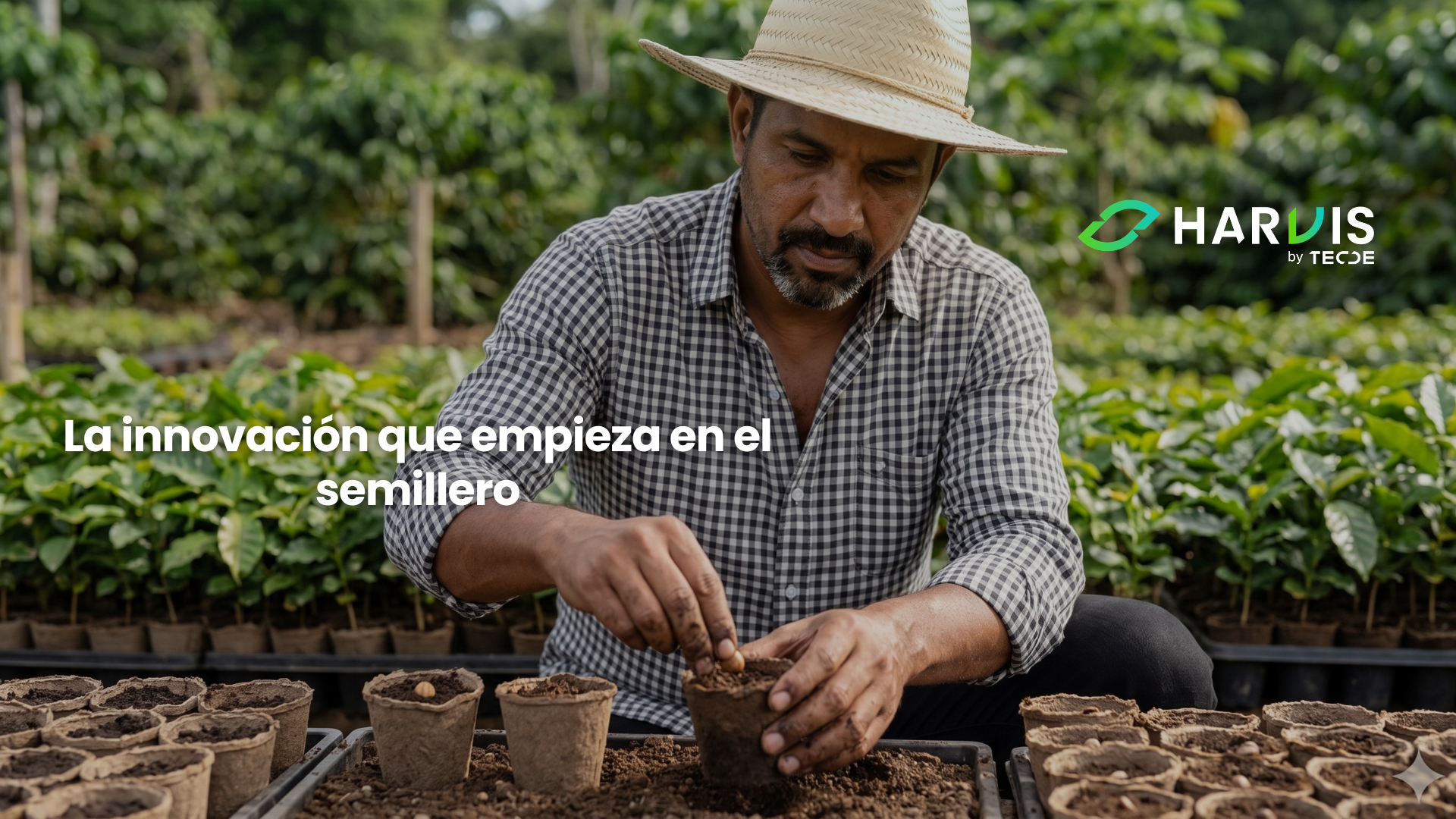
Throughout this season, it became clear that properly establishing a perennial crop is a chain of decisions that starts long before planting in the field. Choosing good genetic material, multiplying it by the correct method, caring for germination and transplanting, and protecting the young plant from pests and diseases are links that support everything that comes afterward. Technological innovation is acting on each of those links, and in this last blog, we will see how, with a special emphasis on a tool that addresses several classic nursery headaches at once.
This tool is the compressed peat or coconut fiber pellets, also called propagation discs or pellets. We mentioned them briefly in previous blogs, but they deserve their own development because they directly address the issues that most concern plant producers: root development, germination timing and uniformity, reduced transplant stress, and, above all, control of damping off, that complex of pathogens that is one of the biggest nightmares of the nursery stage. We will examine them in depth and then broaden our view towards the other innovations that are redefining the propagation of important crops.
The Peat and Coconut Pellets or Discs: The Nursery in One Piece
The idea behind these pellets is to unify in a single element what were traditionally two separate things: the container and the substrate. They are made by compressing peat, coconut fiber, or a mixture of both, until forming a dry and ultra-compact disc that is wrapped in a fine biodegradable net, and that when hydrated expands to several times its size to become a small block of substrate ready for planting. This design eliminates plastic trays, nursery bags, and loose soil all at once, replacing them with a clean, uniform, and easy-to-handle unit.
Their first great virtue lies in the physical quality of the medium they offer to the root. These pellets, especially those made of coconut fiber, maintain high porosity that retains available oxygen for the roots even after watering, because coconut resists compaction well and maintains a good balance between air and water within the block. That aerated and moist environment is exactly what a young root needs to grow vigorously and well-branched, and the net that wraps the pellet allows the roots to penetrate it without obstruction, forming a compact root ball that supports the entire structure of the plant. A root that develops under these conditions reaches transplanting better formed than one that grew in compacted or poorly drained substrate.
The second great virtue appears precisely at transplanting, and it is the one that stands out the most from this technology. Since the plant is not removed from the substrate but rather the entire pellet is taken to the soil or the next container, the roots are not disturbed at all, which drastically reduces transplant stress that we described in the blog about germination and nursery. The plant simply continues to grow, without the slowdown that comes from losing fine roots and having to recover them, allowing it to establish faster and with fewer losses. This is complemented by cleaner and more uniform handling, and savings in water and labor that make them attractive for nurseries producing on a large scale. Together, they provide a fairly complete response to several nursery problems gathered in a single piece.
The Blow to Damping Off: The Health Advantage That Matters Most in the Nursery
If there is one area where these pellets show their greatest value, it is in controlling damping off, and here the scientific evidence is compelling. As we saw in the previous blog, damping off is caused by pathogens such as Pythium, Phytophthora, Rhizoctonia, and Fusarium, several of which are true water molds that thrive in waterlogged and poorly aerated substrates. The structure of these pellets tackles that problem at its root, because their high porosity and good drainage prevent the saturation conditions that these pathogens need to establish themselves, removing the anaerobic environment that favors their reproduction.
To that physical advantage, coconut fiber adds a remarkable property that peat does not have. Various studies have demonstrated that coconut actively suppresses damping off pathogens. A comparative trial found that tomato seedlings grown in coconut fiber reduced the incidence of damping off by between 41 and 90 percent, depending on the species of Phytophthora or Pythium involved, compared to those grown in peat. Another study reported reductions in the populations of these pathogens of between 68 and 76 percent, and in the incidence of the disease of between 94 and 100 percent, in coconut substrate compared to peat. Subsequent research showed that this suppression is largely due to beneficial microorganisms associated with coconut fiber, such as certain fungi that compete with pathogens and can inhibit their growth directly.
The contrast with peat is important, and it is worth being honest about it. Peat has excellent physical and chemical properties, but it is almost never suppressive against Rhizoctonia and Pythium, so a pure peat pellet offers the advantage of drainage and starting from a clean medium, but not the biological suppression that coconut does offer. Therefore, if the goal is to minimize the risk of damping off, pellets with a coconut component lead the way. In any case, no pellet is an absolute shield, because excessive and sustained watering can recreate the conditions that favor pathogens even in the best substrate, so these tools significantly reduce risk but do not replace good water management or the other health practices we discussed in the previous blog.
Advantages, Disadvantages, and Their Use in Coffee Nurseries
With all of the above on the table, it is advisable to balance the advantages and disadvantages and relate them to the crop that interests us most: coffee. Among the advantages, we have already seen the main ones: an aerated medium that favors the root, zero disturbance at transplanting, an environment that reduces damping off, greater uniformity of plants, and savings in water and labor. Additionally, there is more uniform germination, as the substrate maintains constant moisture and aeration in each pellet, helping seedlings emerge evenly, a valuable point in coffee, whose seed germinates slowly and asynchronously by nature.
Regarding timing, it is important to be precise to avoid creating false expectations. The speed of coffee germination depends mainly on seed treatment and temperature and humidity conditions, rather than the type of container, and in fact, pre-germination treatments of soaking have managed to reduce the start of germination to nearly twenty-two days in varieties like Colombia. What the pellets provide is not so much to accelerate germination itself, but to offer optimal and uniform conditions for it to occur, and to ensure that the resulting seedling reaches transplanting with an intact and well-formed root. In specific studies of substrates for Coffea arabica seedlings, mixtures of peat, coconut, and materials that improve aeration, combined with mycorrhizae and biostimulants, have been evaluated with good results on root growth and plant vigor.
The disadvantages also deserve honesty. The first is cost, as the price per plant of these pellets is higher than the traditional coffee system, which uses bags filled with a very economical mixture of soil and decomposed pulp, so their convenience depends on how much you value uniformity, health, and labor savings against that extra cost. The second is environmental, connecting with the sustainability season, because peat comes from peatlands whose extraction has a high environmental cost and is not renewable on human scales, while coconut fiber is a renewable byproduct of the coconut industry, making it the more sustainable option of the two. The third is technical, as coconut fiber often requires washing and conditioning beforehand to remove excess salts and balance its chemistry before planting, and the net that wraps some pellets may take time to degrade. The fourth is management, as a small pellet has a limited volume of substrate and can dry out if watering is not careful. For coffee nurseries, the practical reading is that these pellets are a promising innovation, especially when seeking uniform production, reinforced health, and labor efficiency, and their adoption depends on whether those gains justify the additional cost compared to traditional seedlings.
Is it worth it for your nursery to make the leap to these new propagation technologies? The answer depends on your crop, your scale, and your objectives, and on an honest balance between cost and benefit. Harvis helps you evaluate which innovation makes sense for your case.

Beyond the Substrate: Biotechnology, Biostimulants, and Data
The pellets are just one part of a much broader wave of innovation that is transforming propagation, and it is worth exploring the others to close the season with a complete vision. On the biotechnological front, tissue culture and somatic embryogenesis that we described in the blog about propagation methods are allowing large-scale multiplication of materials that were previously almost impossible to clone. In coffee, this is the way to spread F1 hybrids that produce between twenty and forty percent more than conventional lines but must be propagated clonally due to being heterozygous. In blueberries, micropropagation quickly generates large quantities of healthy and true-to-type plants, and in avocado and citrus, clonal propagation of selected rootstocks ensures resistance to root diseases and the uniformity that seed does not guarantee.
Biostimulants and beneficial microorganisms are another rapidly expanding front, and they fit naturally in the nursery. The application of mycorrhizae in the seedbed improves nutrient absorption and strengthens the plant against stress and root pathogens, and biostimulants reinforce resistance at the most vulnerable moments, such as germination and transplanting. In the substrate studies for coffee that we mentioned, the addition of mycorrhizae and biostimulants to the mix showed positive effects on seedling development, and they are tools that combine very well with substrate pellets to enhance their benefits. This biological approach also reduces dependence on synthetic products, aligning with the preventive health practices we defended in the previous blog.
Finally, there is the data and monitoring front, which brings precision to the nursery. Humidity, temperature, and electrical conductivity sensors allow for precise control of germination and growth conditions, automated irrigation systems deliver the right amount of water at the right time, and the digital recording of planting dates, germination percentages, and treatments applied turns nursery management from an intuitive art into a measurable and improvable operation. This is the area where a platform like Harvis contributes the most, because crossing nursery data with the conditions of the destination lot and the weather forecast allows for better decisions on when to plant, when to transplant, and which material is suitable for each situation. Propagation ceases to be an isolated stage and integrates into the complete planning of the crop.
The Advantage of Starting Well Accumulates Over the Years
When observing the performance of many lots over time, a pattern emerges that ties together the meaning of this entire season. The advantages gained in propagation—a uniform plant, with a well-formed root, healthy and established without setbacks—do not remain in the first months but accumulate throughout the entire productive life of the crop. A lot that starts evenly and vigorously enters production sooner, responds better to management, and suffers less under stress, while one that starts unevenly and weakly drags that disadvantage year after year, no matter how much is invested in caring for it afterward. Innovation in propagation is not an expense of the initial stage but an investment whose return is collected throughout the life of the plantation.
This pattern is difficult to appreciate from a single season, because the effects of good or bad propagation unfold slowly, but it becomes evident when comparing lots with different origins and nursery management over several cycles. Relating the uniformity, vigor, and health of an established crop to how it was propagated allows us to understand how much of its current performance was decided in the nursery, and therefore how much can be improved by intervening in that stage in future plantings. Recognizing that link is what turns propagation into a lever of profitability and not just a simple procedure prior to planting.
As we have already addressed in our blog on Regenerative Biotechnology for Crop Protection, which you can read here, biological and technological tools are changing the way we produce in a healthier and more sustainable manner, and propagation is one of the first places where that change becomes tangible. With this blog, we close the season dedicated to propagation, a journey that started with the selection of genetic material and its reliable sources, went through multiplication methods, germination and transplant care, and nursery health, and ends here, in the innovations that are redefining how a plant is born. The idea worth holding onto, which summarizes the entire season, is that a profitable crop does not start on the day of planting in the field, but much earlier, in every careful decision surrounding the birth of the plant.

Bring innovation to your nursery and build uniform and healthy crops from day one. Write to us on WhatsApp and receive technical assistance to choose the propagation technologies that best fit your crop and scale.
Consulted References
- Jiffy Group. (n.d.). Jiffy Pellets. https://jiffygroup.com/products/jiffy-pellets/
- Candole, B., & Evans, M. (2004). Suppression of soil-borne diseases caused by Pythium and Phytophthora species in coconut coir-based substrates. HortScience, 39. Reviewed in HortTechnology, 19(1). https://journals.ashs.org/horttech/view/journals/horttech/19/1/article-p96.xml
- Hyder, N., et al. (2009). In Vitro Suppression of Soilborne Plant Pathogens by Coir. HortTechnology, 19(1). https://journals.ashs.org/horttech/view/journals/horttech/19/1/article-p96.xml
- Compost amendments enhance peat suppressiveness to Pythium ultimum, Rhizoctonia solani and Sclerotinia minor. (2010). Biological Control / ScienceDirect. https://www.sciencedirect.com/science/article/abs/pii/S1049964410002197
- Suppression of Seedling Damping-Off Caused by Pythium and Rhizoctonia in Container Media. (2008). Plant Disease / PubMed. https://pubmed.ncbi.nlm.nih.gov/18943125/
- Effects of different substrate formulations on production of coffee seedlings. (n.d.). Acta Horticulturae / ISHS. https://ishs.org/ishs-article/1305_10/
- Pregerminative treatments in seeds of Coffea arabica var. Colombia and Coffea canephora var. Robusta. (n.d.). Electricveg. https://www.electricveg.com/rubiaceae/coffea-arabica.html
- Etienne, H., et al. (2024). Coffee somatic embryogenesis: Advances, limitations, and outlook for clonal mass propagation. Advances in Botanical Research / ScienceDirect. https://www.sciencedirect.com/science/article/abs/pii/S0065229624000582
- In Vitro Propagation of the Blueberry 'Blue Suede™' (Vaccinium hybrid). (2023). Plants / PMC. https://pmc.ncbi.nlm.nih.gov/articles/PMC10421453/
- University of California ANR. (n.d.). Avocado Rootstocks (Rootstock Book, Cap. 4). https://www.ccfruitandnuts.ucanr.edu/sites/default/files/2016-09/166374.pdf
- Upstart University. (n.d.). Why (Or Why Not) To Use Peat Pellets for Seedlings. https://university.upstartfarmers.com/blog/why-use-peat-pellets-seedlings