

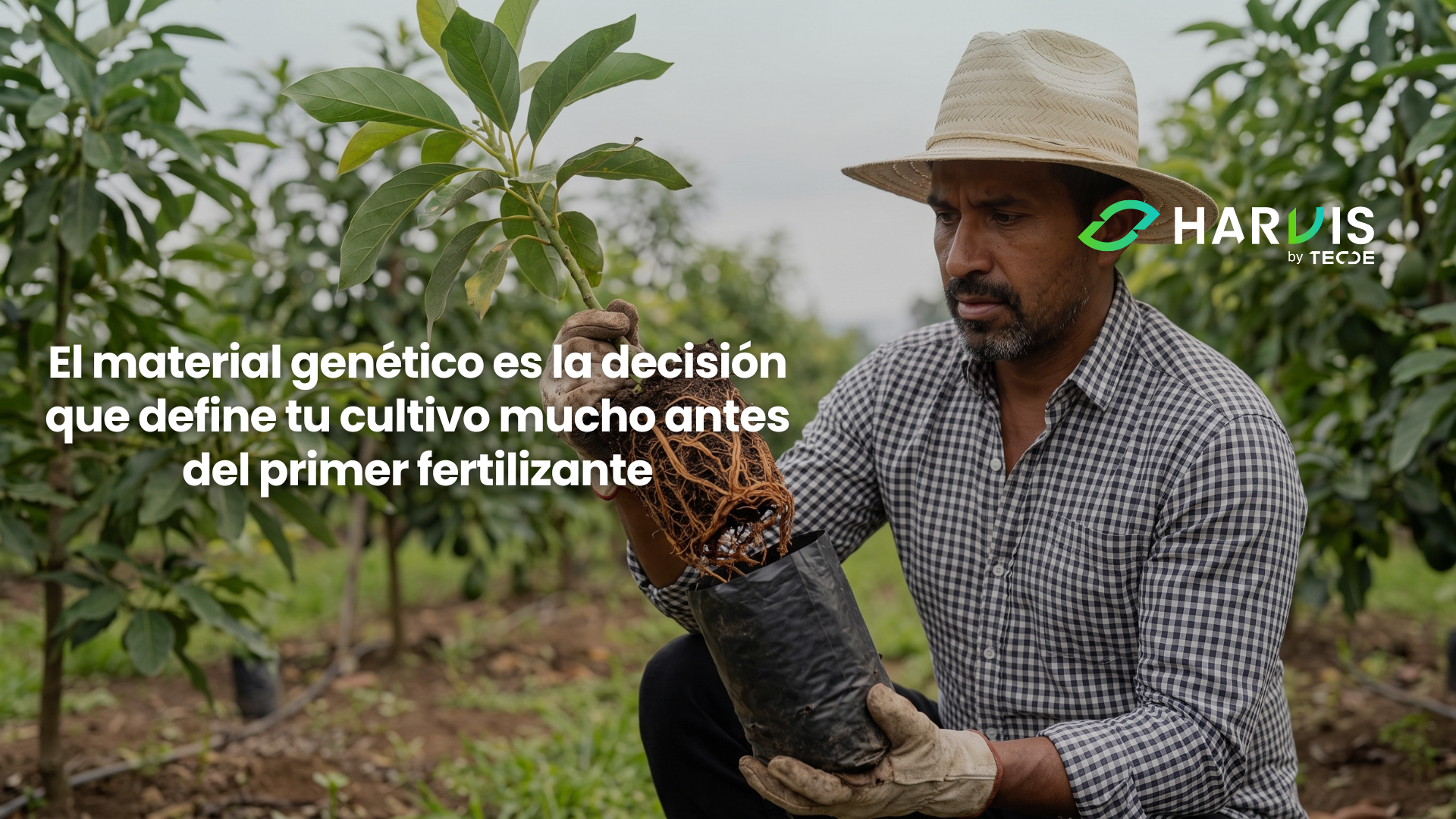
In long-cycle crops like coffee, avocado, citrus, and blueberry, almost all management decisions are reversible. If you fertilize poorly one year, you adjust the next; if irrigation fails, you correct it; if a pest appears, you manage it. There is only one decision that does not work this way, and that is the choice of the material you plant, because a tree that enters the lot with inadequate genetics or with a disease that traveled inside the seed will produce below its potential for the fifteen, twenty, or more years that the planting lasts, no matter how much you invest later in caring for it.
This makes the selection of genetic material the investment with the highest return and the highest risk of your entire project, and yet, it is where many producers spend the least time thinking and where they are most tempted by the price. The seed or nursery plant represents a minimal fraction of what it will cost to establish and maintain a hectare during its productive life, but it defines the upper limit of what that hectare can give you. It is worth taking a moment to consider how to make that decision well: what makes a material superior, what invisible dangers a dubious origin hides, and how to recognize a reliable source.
The Decision That Governs the Next Twenty Years
The difference between an annual crop and a perennial one completely changes the weight of genetics. In a short-cycle crop, if the material does not perform, you lose one harvest and start over. In a perennial one, you inherit that decision for the entire life of the planting, and the cost of making a mistake multiplies with each year and each tree. Planting inferior material is not a one-time mistake; it is a permanent ceiling on your profitability.
That ceiling has a name, and it is the genetic potential of the material you planted. A well-selected cultivar has written in its genes how much it can produce, how resistant it is to the diseases in your area, what quality of fruit it delivers, and how well it tolerates stress, and no management practice can push it beyond that limit. You can approach its maximum with good nutrition and care, but you can never exceed it. That is why genetics is not just another input, but the framework within which all the others operate.
To this, we add a factor that weighed less before and is now decisive: climate change. Suitability studies project that the conditions for crops like coffee and avocado will change significantly in much of their current producing areas, which means that the material you plant today must be prepared not only for the climate you know but for the one that is coming. Choosing a cultivar for its drought resistance, resistance to new diseases, or higher temperatures has ceased to be a luxury and has become a way to protect an investment that will last decades. The genetic decision is, at its core, a long-term bet, and it is advisable to make it with the best information available.
What Makes Genetic Material Superior
Good material is not simply the one that produces the most, but the one that combines several attributes that rarely come together, and that combination looks different in each crop.
In coffee, the genetic improvement work of Cenicafé in Colombia offers a clear example of what a superior material means. Varieties like Castillo and Cenicafé 1 were developed to combine high productivity, resistance to rust and coffee cherry disease, good cup quality, and a low stature that facilitates harvesting. What is interesting is that they are composite varieties because they are formed by several lines with different resistance mechanisms that share the same agronomic attributes, and that internal genetic diversity is precisely what makes rust resistance durable over time instead of breaking down after a few years. Such material allows for coffee farming that does not depend on fungicides to control rust, which reduces costs and protects profitability. Developing the Cenicafé 1 variety took nearly twenty years of research, a testament to how much knowledge lies behind a truly superior seed.
In avocado, the superiority of the material hinges on two pieces that work together: the rootstock and the canopy. The canopy, almost always Hass, provides the fruit quality that the market pays for, while the rootstock defines resistance to the main threat to the crop, root rot caused by Phytophthora cinnamomi, as well as tolerance to salinity and calcareous soils. Selected clonal rootstocks like Dusa have proven to maintain healthier and more productive trees under high disease pressure, while other materials die under the same conditions. A clonally propagated rootstock faithfully preserves the qualities that researchers selected, while a seed-propagated one is genetically variable and can behave unpredictably. Superiority, in avocado, starts underground.
In citrus, something similar occurs because they are also propagated by grafting: the rootstock defines a large part of the tolerance to diseases and soil conditions, while the grafted variety contributes the type of fruit. The choice of material here is closely linked to health because citrus are particularly vulnerable to diseases transmitted in propagation material, a point we will return to shortly.
In blueberry, the criterion that most defines success or failure is the chilling requirement of the variety. Each cultivar needs to accumulate a certain number of hours of low temperatures to bloom correctly, and that number varies enormously among different types, from varieties that require more than six hundred hours to low-requirement materials adapted to warm climates that bloom with very few. Planting a high-chilling-requirement variety in a warm area results in poor flowering and failed harvests, while modern low-chill and perennial habit varieties open the possibility of producing blueberries in areas where it was previously unthinkable. The varietal selection adjusted to the specific climate of your farm is, in blueberry, the first and most determining decision.
The Invisible Passenger That Comes with the Seed
There is a risk in propagation material that is not visible when purchasing it and can ruin an entire planting: the transmission of diseases through the seed, buds, or cuttings. Many viruses, bacteria, and fungi travel hidden inside material that appears perfectly healthy at first glance, and they establish themselves in the lot without the producer knowing that they introduced them themselves.
The case of citrus is the most illustrative. Diseases like citrus tristeza virus and Huanglongbing, known as greening or HLB, are transmitted in propagation material and are devastating, to the point that there is no cure for HLB once the tree is infected. These diseases are difficult to detect in buds and rootstocks, so they are unintentionally introduced even in areas that were previously free of them, and once in the field, they spread to neighboring trees and older plantations. In avocado, something similar occurs with root rot; a nursery that produces plants on contaminated substrate or relies solely on fungicides can deliver plants without visible symptoms that already carry the infection inside, and this manifests only after transplanting, when you have already invested in establishing the lot.
The damage from these pathogens on yield is not minor. In fruit trees, viral infections transmitted by propagation material can dramatically reduce production, with losses in some cases exceeding forty or fifty percent of the crop's potential, and they also affect quality, appearance, and the longevity of the trees. To this, we add a more subtle risk linked to clonal propagation, genetic uniformity: when an entire lot comes from the same identical material, a disease that manages to overcome its resistance can wipe out the entire planting, something that composite coffee varieties seek to avoid through their internal diversity.
All this explains why seed or plant of unknown origin, the one that seems like a bargain due to its low price, is often the most expensive investment a producer can make. The initial savings are paid back multiplied by years of low production, in costs of disease control that should never have entered, and, in the worst case, in the loss of the entire planting. The price of propagation material should never be evaluated in isolation but against the two decades of production that this material will condition.
Do you know where the material you have or are about to plant really comes from? The origin of your seed defines a ceiling that no subsequent practice can lift. Harvis helps you evaluate whether the material of each lot is up to your investment. Talk to our team →

Reliable Sources, Certification, and Traceability
In the face of these risks, the most effective and economical long-term protection is simple: buy certified material from a reliable source and maintain traceability of its origin. Certification is not a bureaucratic procedure; it is the guarantee that the material has been evaluated, is free of the most dangerous pathogens, and corresponds faithfully to the variety it claims to be.
Each crop has systems designed for this. In coffee, the only way to guarantee that you are planting the genetic diversity responsible for durable resistance is to acquire certified seed produced by Cenicafé and distributed through the official channels of the National Federation of Coffee Growers. In citrus, there are certification programs for virus-free buds that maintain mother trees in greenhouses protected against insects and subject them to periodic laboratory tests for tristeza and HLB, delivering healthy material to nurseries that is true to the variety. In avocado, the technical recommendation is to demand certified and disease-free plants, produced in nurseries that disinfect their substrate, use clean water, and apply strict sanitation measures instead of relying solely on fungicides. And in blueberry, since propagation by cuttings or tissue culture defines health and varietal fidelity, it is advisable to start from clean material and suppliers who support the genetic identity of their plants.
Behind all these systems is the phytosanitary authority of each country, which in the case of Colombia is the ICA, responsible for registering and monitoring nurseries and establishing the standards that propagation material for sale must meet. Buying from a nursery registered with the phytosanitary authority, demanding documentation that supports the origin and health of the material, and keeping those records is what gives you traceability: the ability to know exactly where each plant in your lot came from and what guarantees it has. That traceability not only protects you but is increasingly a requirement of export markets, which want to know that your product comes from healthy and legal material. Investing a little more in certified and traceable material is, in practice, the cheapest insurance policy that exists for a planting that will last decades.
The Genetic Ceiling That Is Not Visible in the Lot
Much of the low-yield lots do not produce little due to a management, soil, or nutrition problem, but because of the material that was planted years ago, either because it was genetically inferior, because it carried a disease that became chronic, or simply because it aged and lost its productive potential. The genetic ceiling set on the day of planting continues to act silently, cycle after cycle, while the producer searches for the cause of their low yield in everything else.
This pattern is difficult to see from the individual lot because a mediocre yield can be attributed to a thousand factors, but it becomes evident when comparing lots with different genetic material under similar conditions. Harvis crosses the historical productivity of each lot with information about its age, its material of origin, and its behavior in relation to the conditions of the area, to identify which lots are limited by their genetic floor and are real candidates for renewal, replanting, or re-grafting, instead of continuing to receive investments in management that will never achieve their goal because the limit lies elsewhere.
The value of this is to avoid continuing to spend on a lot whose problem is not solved with more fertilizer or better irrigation, but with a structural decision about its material. Distinguishing, lot by lot, when low yield is a correctable management problem and when it is a genetic ceiling that can only be lifted by replanting is one of the most important and least evaluated economic decisions in a perennial crop. Recognizing it in time can mean the difference between years of recovered profitability and years of wasted investment on material that will never be able to respond.
As we have already addressed in our blog on ICA Certifications: what a farm must meet to export, the health and traceability of the crop are now requirements that open or close markets, and all of that starts with the material you plant. With this season, we take the first step on a complete journey through propagation, from the choice of material to the most recent innovations, because properly establishing a perennial crop is the foundation upon which everything else rests.
In the upcoming blogs, we will explore the different propagation methods and when to use each one, the critical care in the nursery and transplanting, the main pests and diseases that threaten young material, and the innovations that are transforming the propagation of coffee, avocado, citrus, and blueberry. The idea worth remembering today is simple: your crop starts to be decided long before the first fertilization, in the quality and origin of the material you put in the ground.
Ensure that your crop starts with the correct material and not with an invisible ceiling. Write to us via WhatsApp and receive technical assistance to evaluate the genetic material of your lots and your planting or renewal decisions.
Consulted References
- National Academy of Agricultural Sciences (NAAS). Certification of Quality Planting Material of Clonally Propagated Fruit Crops (impact of viruses on yield, quality, and longevity of perennial fruit trees). https://naas.org.in/Policy%20Papers/Policy%20107.pdf
- Flórez C.P. et al. Cenicafé 1: New low-stature variety, highly productive, resistant to rust and CBD, with greater physical quality of the grain. Technical Advances Cenicafé 469. https://www.cenicafe.org/es/publications/avt0469.pdf
- Alvarado G., Posada H.E., Cortina H.A. (2005). Castillo: New coffee variety with resistance to rust. Technical Advances Cenicafé 337. https://biblioteca.cenicafe.org/bitstream/10778/401/1/avt0337.pdf
- Cenicafé / National Federation of Coffee Growers. Improved varieties with durable resistance to rust (importance of certified seed and composite variety). https://www.cenicafe.org/es/index.php/cultivemoscafe/variedadesmejoradas
- Grüter R. et al. (2022). Expected global suitability of coffee, cashew, and avocado due to climate change. PLoS ONE, 17(1). https://www.ncbi.nlm.nih.gov/pmc/articles/PMC8791496/
- Smith L.A., Dann E.K. et al. Field assessment of avocado rootstock selections for resistance to Phytophthora root rot (clonal rootstocks tolerant to Phytophthora cinnamomi). https://www.researchgate.net/publication/226342612
- University of California ANR. Avocado Rootstocks (Rootstock Book, Cap. 4; clonal vs. seed rootstocks, attributes provided by the rootstock). https://www.ccfruitandnuts.ucanr.edu/sites/default/files/2016-09/166374.pdf
- UC IPM. Phytophthora Root Rot / Avocado (certified disease-free plants and nursery sanitation). https://ipm.ucanr.edu/agriculture/avocado/phytophthora-root-rot/
- Partially Resistant Avocado Rootstock Dusa Shows Prolonged Upregulation of NLR Genes in Response to Phytophthora cinnamomi Infection (2022). PMC (rootstock resistance). https://www.ncbi.nlm.nih.gov/pmc/articles/PMC8963474/
- UC IPM. Tristeza Disease Complex / Citrus (use of certified virus-free buds; Citrus Clonal Protection Program). https://ipm.ucanr.edu/agriculture/citrus/tristeza-disease-complex/
- University of Florida / IFAS. Citrus Nursery Production Guide, Chapter 7: Seed and Budwood Production (certification of buds, material true to the variety). https://ask.ifas.ufl.edu/publication/HS1336
- da Graça J.V. et al. (2020). The Texas certified virus-free citrus budwood program (protected greenhouses, PCR testing for CTV and HLB). http://www.subplantsci.org/wp-content/uploads/2020/07/SAES-daGraca-et-al.7-7-2020.pdf
- In Vitro Propagation of the Blueberry ‘Blue Suede’ (Vaccinium hybrid) (2023). Plants / PMC (propagation by cuttings and micropropagation, pathogen-free material). https://pmc.ncbi.nlm.nih.gov/articles/PMC10421453/
- Mississippi State University Extension. Establishment and Maintenance of Blueberries (chilling requirement by variety type and climatic adaptation). https://extension.msstate.edu/publications/establishment-and-maintenance-blueberries
- Challenges and Prospects for the Conservation of Crop Genetic Resources (2021). PMC (coffee, avocado, and citrus are not true to type by seed; clonal propagation). https://pmc.ncbi.nlm.nih.gov/articles/PMC7761154/