

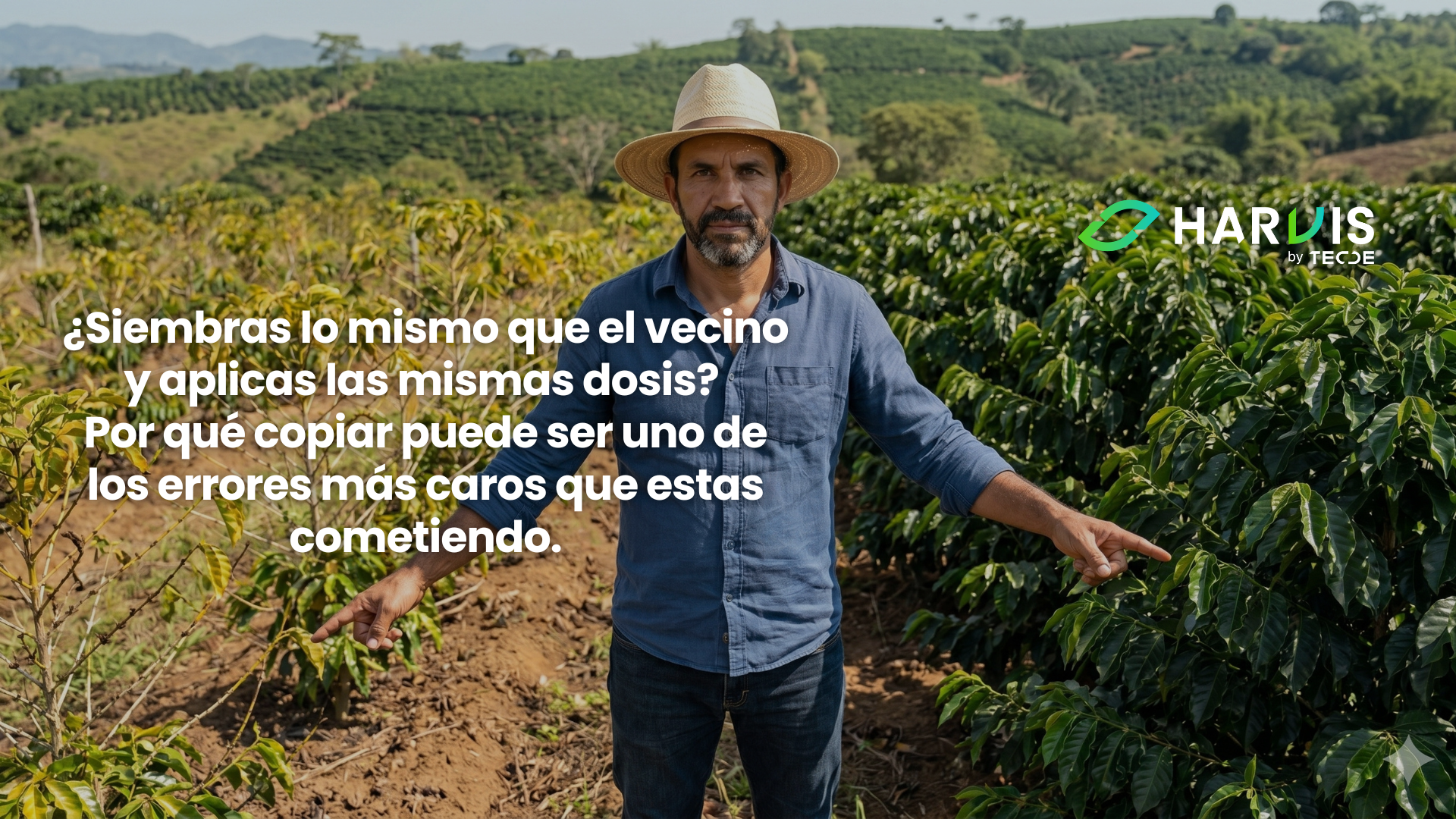
There is a scene that repeats itself in almost all producing regions of Colombia. A crop starts to yield good prices, let’s say Hass avocado, and suddenly everyone in the neighborhood wants to plant avocado. The neighbor who has been in coffee for twenty years clears a plot and plants trees. The one next door, who barely knows the crop, copies the planting density of the first. And when it comes time to fertilize, the question that circulates from farm to farm is not "What does my soil need?", but "What are you applying?". Thus, a recommendation that was born for a specific plot, on a specific farm, with a specific soil, ends up replicated in twenty different properties as if they were all the same piece of land.
The problem is that they are not. And that difference, which seems minor, is behind a good part of the silent losses in agriculture: investments in crops that should never have been planted in that location, over-application of fertilizers that the soil already had, and under-application in plots that did need them. Copying the neighbor feels safe because "it worked for him", but in agronomy, that logic is exactly what destroys profitability.
In this blog, we will discuss why each property, and even each plot within the same property, is different, and how digital and precision agriculture allows, for the first time within reach of the common producer, to stop managing by imitation and start managing by information.
The mirage of trendy crops
Planting what is yielding good prices seems like a rational decision, and sometimes it is. The problem arises when the decision is made by looking at the neighbor's pocket and not the conditions of one’s own farm. A profitable crop on a farm with good drainage, suitable pH, and optimal altitude can be a financial disaster three kilometers away, on a farm with compacted soils, waterlogging, or a different microclimate.
Agronomy has a concept that explains this clearly: the potential yield of the site, defined as the maximum production that can be obtained in a specific location with optimal water supply, adequate nutrient levels, and high-standard management. Each site has its own ceiling, and that ceiling is defined by variables that cannot be copied: soil type, slope, radiation, rainfall regime, and the management history of that particular land. Planting a crop without knowing the real potential of the site is betting blindly, regardless of how well it worked for the neighbor.
The difference between what a crop could produce in a site and what it actually produces, known as the yield gap, can vary between 20% and 80% in almost all major cropping systems in the world. In extensive crops, the data is compelling: recent analyses in Argentina show that corn reaches only 50-55% of its potential and soybeans between 60 and 65%, leaving a huge portion of the productive ceiling uncaptured.
Your neighbor does not have your soil
The underlying reason why copying does not work has a technical name: spatial variability. It is the inherent heterogeneity in the properties of soil, climate, and topography between one piece of land and another, and even within the same land. This variability is due to factors such as soil type, electrical conductivity, moisture content, pH, nutrient availability, and position in the landscape.
What is revealing is how much management weighs against factors we cannot control, such as the weather. In a study of 78 soybean plots and 77 corn plots conducted by researchers from the Faculty of Agronomy at the University of Buenos Aires, it was found that in corn, only 14% of the yield variability responded to rainfall; the rest was explained by the agronomic management of each producer and, above all, by the choice of planting date. That is, most of what separates a good plot from a mediocre one is not luck or the weather, but the specific decisions made in that plot.
This is precisely what is lost when copying the neighbor's recipe. His fertilization recommendation was designed (at best) for his soil, with his phosphorus level, his pH, and his base ratio. If your soil already has sufficient phosphorus and you apply the same dose as he does, you are paying for a nutrient that you will not take advantage of; a phenomenon we have already explored in detail when discussing who really processes the nutrients in your soil. If your soil is more acidic than his, that same dose may become blocked and never reach the root.

Not even your own farm is homogeneous
Here is the point that surprises even experienced producers: variability does not only occur between farms; it occurs within the same farm. Two plots separated by a fence can have different soil textures, different levels of organic matter, opposite drainage, and therefore completely different nutritional needs.
A study on site-specific fertilization in a corn crop in the Bogotá Savanna rigorously demonstrated this principle. Researchers sampled the plot at georeferenced points, identified homogeneous management zones using geostatistics, and applied differential fertilization according to the nutrient levels of each zone. The result was clear: the highest yields and financial benefits were obtained precisely in the site-specific management treatments, not in the traditional uniform application. The technical conclusion is that treating a plot as a homogeneous unit, applying the same dose from one end to the other, leaves money on the table in high-potential areas and wastes inputs in low-potential areas.
In the Eastern Plains, research by the Bioversity-CIAT Alliance and the former Corpoica documented significant variability in the yields of rice, corn, and soybeans within the same fields of producers in the Altillanura. Specialists emphasized something worth highlighting: the key is not only to have the data but to have the ability to analyze it to generate timely interventions that take advantage of the specificity of each environment. Having the information without knowing how to read it solves nothing; it is the intelligent reading of that data that produces the return.
The cost of copying: what it costs not to look at your own land
When the losses from this imitation model are summed up, the figure is serious. On the side of over-application, an analysis of incremental nitrogen efficiency in corn showed that, in the last units of fertilizer applied to reach the economic optimum, more than 90% of the nitrogen is lost to the environment instead of being converted into grain. That is money evaporated, leached, or fixed, which also generates environmental impact.
On the contrary, the opportunity to do it right is equally large. An experiment on variable-rate fertilization in corn, published in 2024, compared differential application against traditional uniform application and found that the variable-rate plots achieved an average yield of 7,275 kg/ha, surpassing those with uniform doses, and in high-potential areas, the site-specific adjustment significantly reduced nitrogen consumption without sacrificing production. The economics behind this is well documented: the greater the spatial variability within a field, the greater the potential economic return from applying differentially rather than uniformly, and improving the accuracy of information translates directly into measurable benefits.
The translation of finca into English is simple: every peso you invest copying a generic recipe is a peso that could yield much more if directed to what your specific plot needs.
Precision agriculture: stop guessing and start knowing
The alternative to copying has a name and method: precision agriculture, or site-specific management. It is defined as a set of tools and technologies that manage the spatial and temporal variability of the production unit, with the aim of maximizing yield and quality, improving input efficiency, and reducing environmental impact on each piece of land, whether it is hectares or sub-hectares.
In practice, this means moving from thinking "my farm" as a single entity to understanding it as a mosaic of management zones, each with its own diagnosis and its own recipe. The tools to achieve this, which a decade ago were reserved for large industrial agriculture, are now increasingly accessible: satellite images and remote sensors to see crop variability from above, georeferencing of soil samples to map the real fertility of each zone, yield monitors, and vegetation indices that reveal differences that the eye cannot detect. A systematic review of the state of precision agriculture in Colombia concludes that this is an instrument that integrates different technologies to boost agronomic profitability in a viable and sustainable way, and that its adoption is precisely advancing around the management of the spatial variability of the lands.
On exactly how these technologies "see" what happens in the crop, we have already written a complete article worth reading: as we explained in our blog What do machines really see when they look at your crops?, cameras and algorithms do not replace the agronomist's judgment, but rather provide a density of information impossible to capture at a glance, plot by plot and almost plant by plant.
The pattern that is only seen when you record by plot
When I organize the information of a farm plot by plot instead of treating it as a single block, a pattern emerges that was almost always hidden: within the same farm, the most productive plot and the least productive one often differ in cost per unit produced much more than the producer imagines, and that difference is rarely explained by the crop or variety, but by the specific conditions of the plot and the management it received.
This matters because it changes the fundamental question. The producer who manages by averages, summing all his production and dividing it by his entire area, never sees this difference: the excellent plot and the bad plot cancel each other out in the average, and the farm seems "more or less okay". But the producer who records by plot discovers which piece of land is carrying the business and which is draining it, and can make surgical decisions: renew, change crops, adjust fertilization, or, in some cases, stop investing in an area that will never yield. Disaggregated information is not a technical luxury; it is what turns a hunch into a decision.
From copying the neighbor to knowing your land: the role of traceability
None of the above works without a system that captures and organizes the information. And this is where digital agriculture becomes the bridge between concept and practice. Precision agriculture does not start with an expensive drone or variable-rate machinery: it starts with recording what happens in each plot in an orderly and consistent manner over time.
With Harvis, you can georeference your plots, record the tasks, applications, and productions of each one separately, and build a historical record that shows you how each zone of your farm behaves over the cycles. Instead of a single "farm recipe", you start to have a living diagnosis by plot: what was applied, what yielded, what cost, and what really worked in that specific piece of land. That traceability is the foundation upon which any serious differential management is built, and it is also what gives you independence from the generic recommendation of the neighbor or the agricultural store.
The difference between the producer who copies and the one who manages with information is not in the size of the farm or the available capital. It is in whether or not they know their own land, plot by plot, with data and not with assumptions. Colombian agriculture has been planting and applying by imitation for decades, and the bill for that habit is paid in yields that never reach the potential of the site and in inputs that are lost without return. The good news is that the tool to change it is no longer reserved for a few: today any producer can start recording, measuring, and deciding based on what their farm really needs.
Your neighbor may have a great crop. But your crop needs your information, not his.
- Lobell, D. B., Cassman, K. G., & Field, C. B. (2009). Crop Yield Gaps: Their Importance, Magnitudes, and Causes. Annual Review of Environment and Resources, 34, 179-204. (Cited in yield gap review, Central University of Venezuela). https://saber.ucv.ve/ojs/index.php/rev_agro/article/download/15064/144814481730
- Andrade, F. (INTA-CONICET). (2025). Yield gaps in corn and soybeans: the role of economics and management. Infocampo. https://www.infocampo.com.ar/no-es-solo-manejo-a-las-brechas-de-rendimiento-las-genera-la-economia-mas-que-la-agronomia/
- Tetteh, F., et al. (2022). Precision Agriculture for Sustainable Soil and Crop Management. IntechOpen — Soil Science Emerging Technologies. https://www.intechopen.com/chapters/82490
- Satorre, E. (FAUBA / Cultivar Conocimiento). (2019). Good management reduces the yield gap: monitoring of 78 soybean plots and 77 corn plots. Supercampo. https://supercampo.perfil.com/2019/10/el-buen-manejo-reduce-la-brecha-de-rendimientos
- Luengas, C., Leiva, F. R., & Forero, F.(2008) Site-specific fertilization in a corn crop (Zea mays L.) in the Bogotá Savanna. Agronomía Colombiana, National University of Colombia. http://www.scielo.org.co/scielo.php?script=sci_arttext&pid=S0120-99652008000200016
- Bioversity-CIAT Alliance / Corpoica. Precision agriculture: an eco-efficient management of crops for the Colombian Altillanura. https://alliancebioversityciat.org/es/stories/agricultura-de-precision-un-manejo-eco-eficiente-de-cultivos-para-la-altillanura-colombiana
- Baral, B. R., et al. (2022). A new perspective when examining maize fertilizer nitrogen use efficiency, incrementally. PLOS ONE / NCBI. https://www.ncbi.nlm.nih.gov/pmc/articles/PMC9094541/
- Liu, S., et al. (2024). Variable-Rate Fertilization for Summer Maize Using Combined Proximal Sensing Technology and the Nitrogen Balance Principle. Agriculture (MDPI), 14(7), 1180. https://www.mdpi.com/2077-0472/14/7/1180
- Späti, K., Huber, R., & Finger, R. (2021). Benefits of Increasing Information Accuracy in Variable Rate Technologies. Ecological Economics, 185, 107047. https://link.springer.com/article/10.1007/s11119-022-09957-5
- Pérez-Ruiz, M., et al. (2022). Variables influencing the application of precision agriculture in Colombia: a review of studies. Research, Development, and Innovation Journal / SciELO Colombia. http://www.scielo.org.co/scielo.php?script=sci_arttext&pid=S0122-87062022000100015
- University of Valle. Precision agriculture in the world and in Colombia: bibliographic review. Univalle Digital Library. https://bibliotecadigital.univalle.edu.co/server/api/core/bitstreams/04e7d6eb-3120-4b11-8708-de62376f1188/content
- Harvis. What do machines really see when they look at your crops? https://harvis.app/blog/que-ven-realmente-las-maquinas-en-tus-cultivos
- Harvis. (2026). Agricultural management and productive analytics platform. https://harvis.app/