

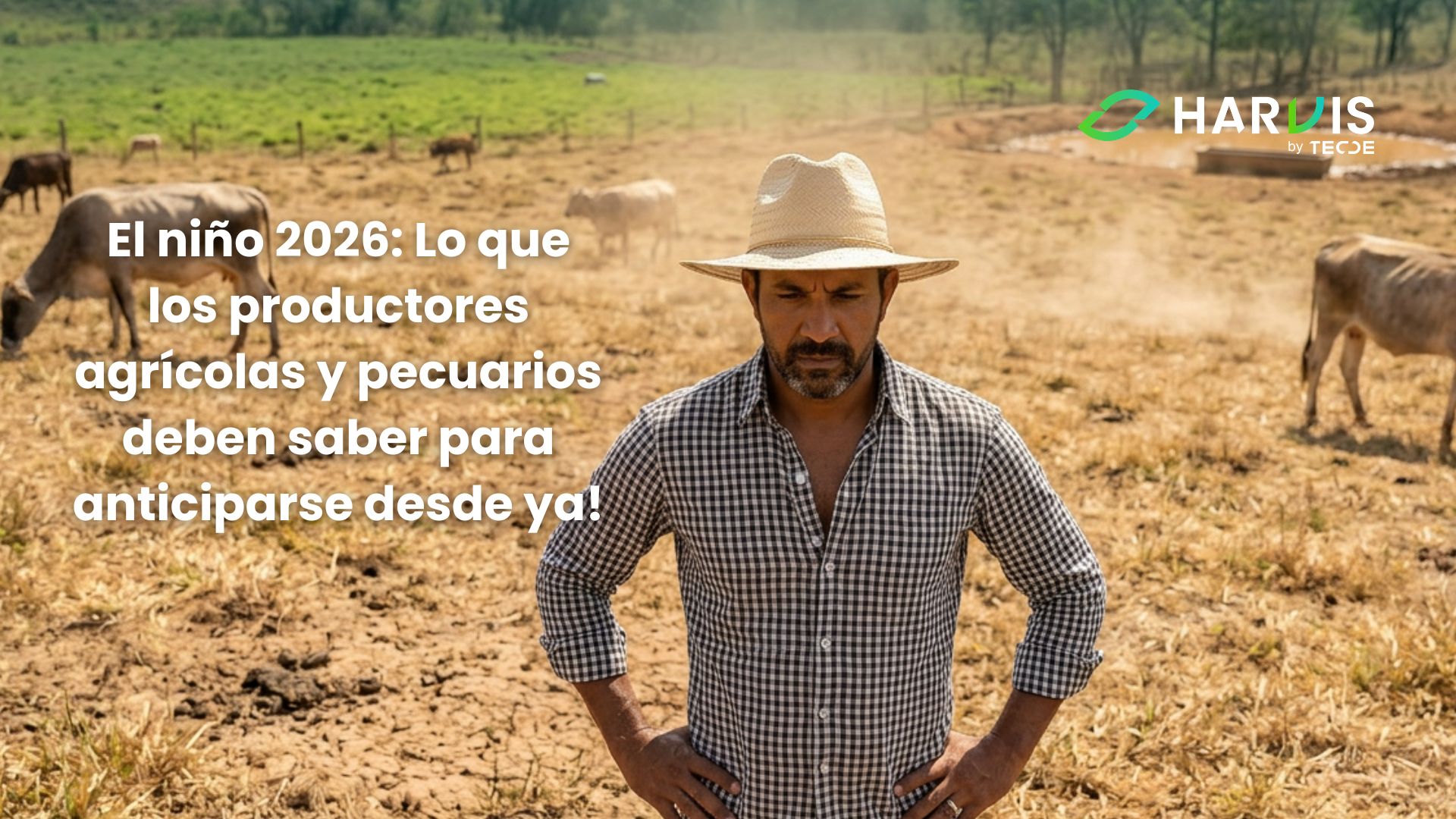
For years, I have focused my work on understanding in detail all the variables that impact agricultural and livestock production, with climate being one of the parameters I pay the most attention to due to the way its dynamics shape agricultural and livestock production in Colombia, my home country, throughout Latin America, and the world. Climate is not a minor issue, and that’s why I will focus on analyzing its impact considering that we are located in a region characterized as one of the main food supplies for the world, bearing a great responsibility for global food security. When climatic phenomena intensify, as occurs in extreme events like El Niño or La Niña, climate ceases to be just another factor and becomes a direct risk that generates a significant impact, as it disrupts production cycles, affects quality, reduces yields, and puts pressure on the stability of the food system.
Today, as I write these lines in April, we are experiencing the last remnants of a weak La Niña that is slowly dissipating, but still leaves its mark in the form of intense rains and floods in several regions of Colombia. This can be considered the closing of a cycle, but let’s remember that our planet is a living and changing organism that constantly closes and opens cycles, and that is why what comes next as a new cycle is, indeed, what motivates me to write today.
Although the Ministry of Environment has not yet officially reported the El Niño phenomenon, it has indicated: “Although we are not yet in a position to officially declare an El Niño phenomenon, it is responsible to inform the public that we already have scientific evidence confirming a growing warming of the Pacific Ocean.
These signals are an early warning for the country, allowing us to anticipate, activate institutional preparation, and work with regions to reduce risks and protect communities. However, according to the NOAA Climate Prediction Center, it is estimated that between June and August, the chances of El Niño arriving increase to 62%, and according to estimates, it will not be a short visit: models suggest it could persist until the end of 2026.
Now, I’m not telling you this to scare you, but rather because I firmly believe that an informed producer is a producer who can manage adverse conditions and does not react at the end when it’s time to put out the fire. In this context, anticipating is not optional: The decisions you make in the coming months regarding management, nutrition, water, and planning will define how your productive year will end.
But before delving into the impact of the El Niño phenomenon and how to anticipate it to make better decisions, it’s worth taking a moment to explain simply what El Niño really means and why it is a condition that demands our full attention in agro systems:
When we talk about El Niño , we refer to an abnormal warming of the waters of the Pacific Ocean. This may sound distant, but that change in the ocean alters the behavior of the atmosphere and ultimately modifies the climate in regions like Colombia. In practice, this translates into less rain, higher temperatures, and prolonged dry periods.
Why should we care?
Because that change directly impacts what happens on our farms:
- The soil loses moisture more quickly.
- Plants experience stress, reduce their development, and enter survival mode.
- The availability and quality of pasture decreases.
- Water, which is a limited resource, definitely becomes a limiting factor.
El Niño is not just a climatic phenomenon; it is a factor that changes the rules of production. That’s why it demands attention: it is the precursor to a series of complex conditions that we cannot stop. At this point, it’s no longer about whether it will impact or not because it is highly likely, but rather how prepared we are when it does.
Continuing with my thoughts on the subject, I am convinced that the transition from so much water in the first half of the year to drought conditions in the second is like asking the body to go from extreme cold to extreme heat without adaptation. Crops, just like us, need time to adjust.
Departments like La Guajira, Magdalena, Atlántico, Antioquia, Cundinamarca, and Huila are already being identified as critical areas where less rain and more heat will become the norm during the second half of the year. What worries me most is what European models are showing: October 2026 could mark the peak of the phenomenon. If these scenarios hold true, we would be facing one of the most intense heat waves recorded in Colombia. And this does not happen at just any time of the year.
October is a key month for Colombian agricultural production as it is when a large percentage of producers expect their main harvests:
- Coffee enters one of its most important productive phases in various regions of the country.
- Corn and rice should be consolidating their production.
- In Andean regions, crops like Hass avocado reach critical harvest moments. In other words, the possible peak of the phenomenon coincides directly with the moment when the effort of the entire year should translate into production.
I know that when you hear phrases like “the most intense heat wave” or even in some news reports it is mentioned as: “the super El Niño”, it’s normal to feel concerned, and it’s completely valid; as producers, we know firsthand what an intense and prolonged summer can cause in our production systems. Let me talk to you about something key to anticipate:
The vulnerability of crops
Diverse analyses from the Ministry of Environment and Sustainable Development of Colombia, along with entities in the agricultural sector, agree that certain production systems tend to be more sensitive during El Niño events. Among the most exposed, crops such as corn, rice, potatoes, cassava, vegetables, oil palm, panela cane, rubber, and fruit trees are often mentioned, mainly due to their high dependence on water availability and their sensitivity to temperature increases.
More than a static list, it’s important to understand that crops with high water demand or in critical stages coinciding with water deficits are the most vulnerable; additionally, various sector reports and technical analyses have documented a recurring behavior during these events: not only does water availability decrease, but pressures from pests and diseases increase, generating a double burden on production.
Now, when reviewing more specific studies, the impacts can be significant, but it’s important to interpret them in context. Research from the Alliance of Bioversity International and CIAT has shown that, during strong El Niño events, rice production in certain areas can be considerably reduced, especially in rainfed systems. However, figures such as reductions close to 80–90% are usually associated with extreme scenarios or very localized conditions, not necessarily national averages.
What is consistent in the evidence is that irrigation requirements increase in contexts of higher temperatures and lower precipitation, where productivity can fall significantly if there is no infrastructure or proper water management. Prices tend to be pressured upwards when there are relevant regional impacts on supply, leading us to conclude that the impact is not uniform, but significant enough to affect both production and markets.
In the case of coffee, analyses from entities like the National Federation of Coffee Growers of Colombia have shown that the effects depend heavily on the region and the phenological moment. In some areas, water deficits can affect flowering and fruit filling. In others, a reduction in rainfall can even favor certain stages if there is enough accumulated moisture; this explains why not all the country behaves the same, even within the same crop.
For corn and rice, organizations like the Food and Agriculture Organization of the United Nations have warned that production cycles coinciding with the second half of the year tend to be more sensitive in El Niño scenarios, especially in rain-dependent systems. In Colombia, a significant portion of corn and rice production is concentrated in these windows, so an alteration in rainfall during these months can have relevant impacts on national supply.
Now, there’s something we cannot lose sight of, and that is the impact that is deeply regional:
- Orinoquía: rainfed systems (especially rice and corn) are highly sensitive to prolonged rainfall deficits.
- Andean Region: crops like potatoes, vegetables, and onions may face water stress combined with frost events in some areas.
- Caribbean and warm northern areas: the main limitation is usually the availability of water for irrigation, especially in rice and corn.
Finally, regarding the scale of risk, various estimates have indicated that millions of hectares in Colombia may be exposed to drought conditions during El Niño events; what’s important is not the exact number of affected hectares, but the magnitude of the message: we are talking about a potential large-scale impact that demands planning, not reaction.
If you work in livestock, you are likely already feeling the pressure; during drought events associated with El Niño, a reduction in the availability and quality of forage has been documented, along with an increase in thermal stress on livestock. This not only affects milk and meat production but also reproductive variables and the body condition of the animals.
According to historical analyses from entities like IDEAM and sector reports, events like those of 2015–2016 generated significant declines in livestock productivity, especially in systems dependent on pastures without irrigation or strategic supplementation. Moreover, the impact does not remain in the short term, as the degradation of pastures and the slower recovery of soils can extend the effects even after the rains return.
In cocoa, the risk is also high, especially in early stages; according to technical recommendations from the National Federation of Cocoa Growers, young plantations (less than 2–3 years) are particularly vulnerable to water deficits.
In these phases:
- The root system is still limited.
- The plant has a lower capacity to tolerate stress.
- Mortality may increase if moisture is not managed properly. More than an “absolute risk,” what the data shows is that a prolonged drought poorly managed can seriously compromise the establishment of the crop and delay its entry into production.
But there’s something important we cannot lose sight of: what differentiates a resilient producer from a vulnerable one is not the absence of problems, but their ability to anticipate them. Right there is where I want to contribute, not from empty promises, but from experience and field analysis, to help you make key decisions that allow you to prepare and face the most critical moments of the phenomenon through a series of strategies that I consider fundamental to anticipate now:
Strategies to Anticipate the El Niño Phenomenon
1. 💧 Water Management and Governance as One of the Most Critical Priorities
- Review, repair, and optimize existing irrigation systems.
- Implement efficient irrigation as much as possible: drip or micro-sprinkling where feasible.
- Build or improve reservoirs, jagüeyes, or storage systems.
- Prioritize irrigation in critical stages of the crop and in areas of higher radiation, not uniformly.
- Establish community agreements with neighbors for the shared and efficient use of water sources.
- Harvest rainwater on a large scale: Beyond conventional tanks, the "Sowing Water" strategy through the adaptation of jagüeyes with geomembranes and roof collection systems allows for massive storage volumes during the last rains before the phenomenon, guaranteeing autonomy of up to 90 days.
- FAO studies show that improving irrigation efficiency can significantly reduce productive losses in drought scenarios.
2. 🌾 Soil Management
- Maintain vegetative covers or mulch to conserve moisture, using noble weeds or low-growing cover crops that do not compete for nutrients but protect the soil.
- Increase organic matter to improve water retention, using residues from previous harvests or straw on the base of the plants. This acts as a thermal insulator that prevents rapid evaporation of water and keeps root temperature stable.
- Reduce intensive operations that expose the soil.
- The application of efficient microorganisms and mycorrhizae at the roots helps plants explore a larger volume of soil in search of residual water. It is a strategy of "underground security" that should be applied before the soil compacts due to heat.
- A well-structured soil can retain up to 20–30% more available water, according to agronomic literature.
3. 🐄 Forage Strategy - Livestock
- Establish forage banks (silage, hay) in advance.
- Adjust animal load according to projected availability.
- Anticipating is preparing the animal's metabolism: The use of multinutritional blocks and chelated minerals months before the drought improves the body condition of livestock, allowing them to better withstand pasture shortages without collapsing the milk and/or meat production curve.
- In past events, systems that planned reserves managed to reduce productive losses and mortality compared to reactive systems.
4. 🌳 Microclimate Management:
While regional climate is something we cannot control, the conditions of temperature, humidity, and light in the immediate environment of the plant or animal (microclimate) is a space where we do have decision power.
- Implement shade in coffee, cocoa, and fruit trees through a shade architecture with agroforestry arrangements.
- In livestock, a silvopastoral system with scattered trees in pastures can reduce ambient temperature by 3°C to 5°C compared to an open pasture.
- Protect young plants.
- The dry and warm wind of El Niño accelerates plant transpiration and soil dehydration. Establishing live fences with native species of different heights breaks the wind speed and creates a "pocket" of cooler, more humid air within the lot, which can reduce water loss by evapotranspiration by up to 20%.
- Shade systems can reduce soil and plant temperature and improve moisture retention. While regional climate is something we cannot control, the conditions of temperature, humidity, and light in the immediate environment of the plant or animal (microclimate) is a space where we do have decision power.
5. 📅 Adjustments in Productive Planning
- Evaluate advancing or delaying sowing according to forecasts.
- Avoid having critical phases coincide with stress peaks.
- Diversify crops or cycles when feasible.
- This does not eliminate risk but redistributes it and reduces exposure.
6. 🤝 Collective Risk Management
- Share infrastructure when possible.
- Stay connected with local technical assistance.
7. 📡 Information as a Productive Tool
- Follow IDEAM bulletins.
- Check alerts from the Ministry of Agriculture and Rural Development of Colombia.
- Adjust decisions based on updated information, not assumptions.
- Of course, use Harvis; you will receive alerts and based on the knowledge of your production system, you will have precise technical support according to the conditions of your farm, as it can measure indices such as NDVI (Normalized Difference Vegetation Index). Through satellite images, you can detect which areas of your farm are starting to suffer from water stress before it becomes visible to the human eye, allowing you to focus irrigation where it is most needed.
To close... There’s something important to say, and that is we are not starting from scratch.
Institutions, guilds, and producers have already faced similar events; today there are contingency plans under construction and accumulated learning in the different segments that make up the agricultural and livestock sector.
El Niño 2026 is not just a climate challenge; it is a call to technical excellence. The difference between success and loss this year will not be determined by the thermometer, but by our capacity for anticipation; we are not facing an unknown phenomenon, but one that has already tested us and from which we have always emerged stronger. I will continue to closely monitor every update, model, and forecast issued by meteorological authorities to bring you real-time information.
This is a path we will walk together, adjusting the sails as the wind blows. Stay alert, stay prepared, and above all, stay connected.
Consulted References
- NOAA Climate Prediction Center - ENSO Forecast: https://www.cpc.ncep.noaa.gov/products/analysismonitoring/ensoadvisory/ensodisc_Sp.shtml
- Infobae - "When will the El Niño phenomenon begin in Colombia 2026": https://www.infobae.com/colombia/2026/04/07/cuando-comenzara-en-colombia-el-fenomeno-del-nino-2026-podria-ser-la-ola-de-calor-mas-fuerte-desde-que-se-tienen-registros/
- Diario del Huila - "El Niño 2026 could bring the strongest heat wave": https://diariodelhuila.com/el-nino-2026-podria-traer-la-ola-de-calor-mas-fuerte-en-la-historia-reciente-de-colombia/
- El Colombiano - "Super El Niño phenomenon 2026: Colombia forecast": https://www.elcolombiano.com/medio-ambiente/super-fenomeno-de-el-nino-2026-pronostico-colombia-LM35289662
- El Tiempo - "Warnings for possible super El Niño in Colombia": https://www.eltiempo.com/amp/economia/sectores/alertan-por-posible-super-el-nino-en-colombia-y-crecen-riesgos-de-racionamiento-de-energia-ademas-de-impacto-en-los-alimentos-e-inflacion-3546053
- Agronegocios - "The crops most affected by El Niño": https://www.agronegocios.co/agricultura/los-cultivos-mas-afectados-por-el-nino-3768297
- Bloomberg Línea - "El Niño phenomenon: how it impacts crops in Latam": https://www.bloomberglinea.com/2024/02/14/fenomeno-de-el-nino-asi-golpea-a-los-cultivos-los-precios-y-la-alimentacion-en-latam/
- Alliance Bioversity International - CIAT - "The El Niño phenomenon and its effects on the global rice market": https://alliancebioversityciat.org/publications-data/el-fenomeno-de-el-nino-y-los-efectos-en-el-mercado-mundial-del-arroz
- El Colombiano - "Rice, cereals, fruits, and livestock, the most affected by El Niño": https://www.elcolombiano.com/negocios/agro/arroz-cereales-frutas-y-ganado-los-mas-afectados-ante-un-fenomeno-del-nino-KD21110965
- IDEAM. "Probable development of El Niño in the second half of 2026 activates early warning in the country": https://www.ideam.gov.co/sala-de-prensa/noticia/probable-desarrollo-de-el-nino-en-el-segundo-semestre-de-2026-activa-alerta-temprana-en-el-pais