

The complete portfolio of sustainable certifications that open premium international markets.
In previous editions of our editorial, we have been exploring in detail a series of certifications of great importance for farmers and producers who have their sights set on international markets. In this sense, we have had the opportunity to delve into ICA and GlobalG.A.P. Certifications, which aim to guarantee the quality and traceability of the agricultural products we export. Today, it is time to address Rainforest Alliance and other certifications such as ORGANIC (USDA, EU), JAS, FAIRTRADE, SMETA, or BASC, which not only open doors to demanding international markets but also position producers as leaders in sustainability and social responsibility. These certifications go beyond technical compliance, defining themselves as a declaration of commitment to the planet, communities, and the future of agriculture.
🐸 Rainforest Alliance: “A certification for sustainable agriculture”
Rainforest Alliance represents one of the most recognized global standards for sustainable agriculture, helping farmers produce better, adapt to climate change, increase productivity, and reduce costs.
It is a certification that guarantees that agricultural products are produced through the development of various practices that focus on:
🌎 Protecting biodiversity and ecosystems.
🧑🌾 Improving rural livelihoods.
👩⚖️ Promoting human rights.
🌦️ Helping rural communities adapt to climate change.
Currently, Rainforest Alliance is based on the 2020 Certification Program that defines the long-term vision for the future of agriculture supported by 7 fundamental principles:
📈1. Principle: Integrated Management “A well-documented system is the foundation of sustainability”
This principle requires that farms and companies have a documented management system, where all key processes are clear and supported by evidence. This implies strategic planning with measurable objectives, monitoring of progress, identification and assessment of risks that encompass areas such as social, environmental, and economic, as well as mapping key stakeholders such as suppliers, communities, and authorities.
🕵️2. Principle: Traceability “Knowing the origin of productions is mandatory”
Through traceability, the aim is to ensure that each certified product can be traced from its origin on the farm to the final consumer.
To achieve this, the key requirement is to comply with regulations such as the EUDR (EU Deforestation Regulation), which prohibits the importation of agricultural products from areas where deforestation occurred for this purpose since 2020. To comply with this requirement, it is necessary to have complete records of production, processing, transportation, and sales, as well as the use of geolocation of production areas through polygons, maps, and/or satellite data.
Operators must submit an electronic DDD (Due Diligence Declaration) that includes key product data, such as the geolocation of lots and legal and environmental verification. This regulation came into effect on June 29, 2023, with application for large operators starting January 1, 2026, and for small businesses in June of the following year.
This standard is demanding, so companies that do not comply with the EUDR could face fines, legal sanctions, and lose access to the EU market.
🌱3. Principle: Conservation of natural resources: "The farm must be a refuge for biodiversity"
Considering this principle, the protection of ecosystems and biodiversity is required, thereby ensuring the responsible management of resources such as soil, water, and forests. This implies a prohibition on destroying protected natural areas, conserving biological corridors, practices that prevent soil erosion, and contamination of water sources.
💰4. Principle: Income and shared responsibility: "Sustainability also means paying fair prices"
This principle ensures that producers receive fair payments and that a culture of transparency exists in the product value chain. This implies the payment of a sustainability differential by buyers, strengthens cooperatives, defines clear prices, and formalizes contracts, which favors the economic stability of producers and promotes a long-term commercial relationship.
According to Fairtrade Insights: “60% of global buyers prefer suppliers that demonstrate fair pricing.”
🚜 5. Principle: Sustainable agriculture: "Produce more with fewer resources"
It is based on the implementation of sustainable agricultural practices that increase productivity without compromising the environment. This involves mandatory agronomic practices such as MIRFE (Integrated Management of Irrigation and Fertilization), MIPE (Integrated Management of Pests and Diseases), crop diversification, reforestation, vegetative covers for water retention, and hosting beneficial microbiota and adaptation to climate change.
🫂6. Principle: Social well-being: “Dignified work for farm workers”
Guarantees respect for the human and labor rights of workers, requiring the prohibition of child and forced labor, safe conditions where the use of PPE (Personal Protective Equipment) is guaranteed in farm activities, training of various kinds: technical, safety, new methodologies, etc., freedom of association, and fair pay where wages are equal to or exceed the legal minimum wage.
🌍 7. Principle: Environmental protection: "Reducing the ecological footprint is non-negotiable"
Focuses on mitigating the environmental impact of agricultural production, allowing for the reduction of GHG (Greenhouse Gas) emissions, energy efficiency, responsible management of hazardous waste, and recycling, which aligns with global climate goals and compliance with sustainability requirements of supermarket chains and international brands that ensure compliance with this principle.
🏕️ Farm certification for individual producers:
Requires the implementation of robust management systems focused on continuous improvement, traceability, conservation, sustainable agricultural practices, social well-being, and environmental protection.
🧑🌾👩🌾 Certification for groups of producers:
Designed for cooperatives or associations of small producers, up to 2000 members.
📋Chain of custody:
Designed for exporters, processors, and traders handling certified products. This certificate is mandatory for companies that use the Rainforest Alliance seal on their packaging.
🏭 Certificate for multiple companies (Multi-site):
Applies to companies that have multiple farms under the same legal entity.

🚀 Steps to Get Certified in Rainforest Alliance 2020
1. Self-diagnosis:
It is an internal evaluation where the producer, farm, or group of producers reviews whether they meet the requirements of the Rainforest Alliance Sustainable Agriculture Standard . For this, it is recommended:
✔︎ Conduct a review of social criteria, such as labor conditions, no child labor, gender equity, and workplace safety.
✔︎ Evaluate environmental criteria, such as biodiversity conservation, responsible use of agrochemicals, water management, and forest protection.
✔︎ Verify productive and traceability criteria, such as input control, records, and documentation.
2. Training:
Involves training for staff and producers on the practices required by the standard on topics such as:
✔︎Good Agricultural Practices (GAP).
✔︎Sustainable soil and water management.
✔︎Integrated pest control.
✔︎Protocols for data recording (traceability).
✔︎Training in labor rights and occupational health.
In this sense, it is not enough to just comply; it must also be demonstrated that all workers and responsible parties know and apply the requirements.
3. Audit:
It is the formal evaluation conducted by an authorized certification body (CB – Certification Body) that verifies in the field and in records whether all criteria are met by requesting an approved certification body, reviewing documentation prior to the field visit, and conducting an inspection visit where staff are interviewed, facilities are analyzed, records and agricultural practices are reviewed, culminating in a detailed report of findings and, if applicable, a correction plan.
2. Maintenance:
Annual audits + reports of continuous improvement: Certification is not for life. It must be maintained by meeting the standards year after year through:
✔︎ Annual audits (in some cases biannual for small producers).
✔︎Continuous improvement plans to resolve non-conformities and update practices.
✔︎Periodic reports on sustainability, use of agrochemicals, labor conditions, and traceability.
Objective: To ensure that sustainable practices are maintained over time and that the farm/project remains eligible to export with the Rainforest Alliance seal.
🌐 Other Key Certifications for Export
🌾 USDA Organic
What does it certify? Organic production according to US standards Target markets: United States and countries with equivalence agreements Key benefits:
✔︎ Direct access to the US organic market (over $50 billion annually).
✔︎ Premium prices of 20-40% over conventional products.
✔︎ Recognition in international markets.
🍃 EU Organic (European Organic Certification)
What does it certify? Organic production according to European Regulation 834/2007 Target markets: European Union (27 countries) Key benefits:
✔︎ Access to 450 million European consumers.
✔︎ Significant premium prices.
✔︎ Globally recognized logo.
🌸 JAS Organic (Japan)
What does it certify? Organic agriculture according to Japanese standards Target markets: Japan Key benefits:
✔︎ Access to the Japanese organic market (one of the most demanding and profitable).
✔︎ High premium prices.
✔︎ Loyalty of Japanese consumers.
⚖️ Fairtrade (Fair Trade)
What does it certify? Fair trade and community development Target markets: Europe, North America, Australia Key benefits:
✔︎ Guaranteed minimum price + social premium.
✔︎ Long-term contracts.
✔︎ Support for community development.
💎 UTZ (Now part of Rainforest Alliance)
What did it certify? Sustainable agriculture (merged with Rainforest Alliance in 2018) Transition: UTZ certificates are being migrated to the Rainforest Alliance 2020 system.
🌐BASC
Certifies that companies including producers, packers, exporters, and transporters have management systems that prevent illicit activities such as drug trafficking, smuggling, money laundering, or terrorism in the logistics chain.
📃 SMETA and BRCGS: Ethics and Food Safety Are Key (For suppliers of large chains)
SMETA (Ethical Audits)
✔︎ Verifies labor rights (no forced labor).
✔︎ Required by Walmart, Tesco, and Unilever.
BRCGS (Food Safety)
✔︎ Mandatory for exporting to the UK and Australia.
✔︎ Focused on traceability and quality control.
🚀 Certification Strategy: Which to Choose?
📊 Market Decision Matrix
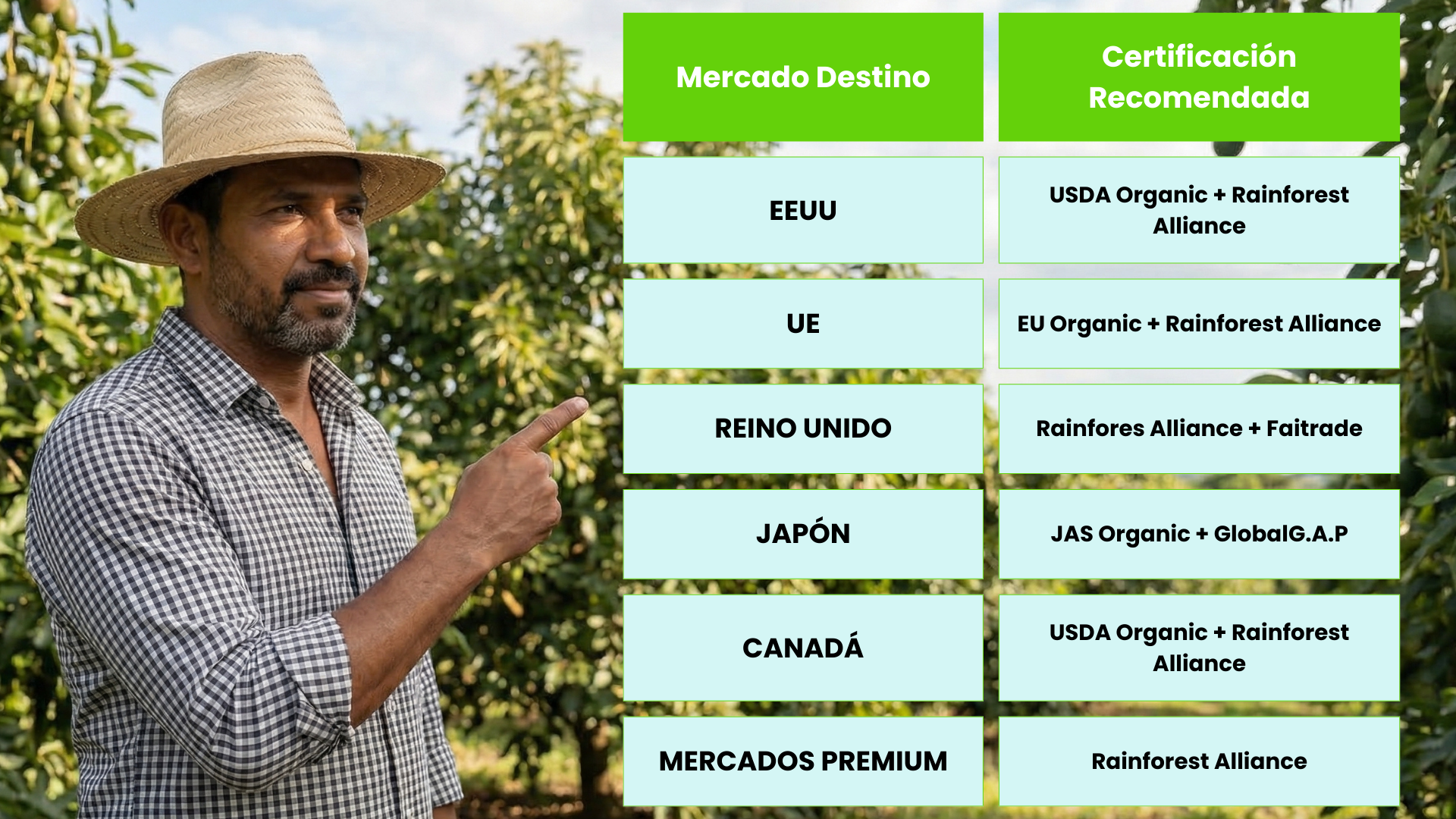
💡 Competitive benefits of the certification portfolio
📈Commercial benefits
✔︎Access to premium markets: Over 150+ countries recognize these certifications.
✔︎Higher prices: 15-40% over conventional prices depending on certification.
✔︎Long-term contracts: Greater commercial security.
✔︎Reduction of rejections: Anticipated compliance with regulations.
🌱 Operational benefits
✔︎Resource efficiency: Less use of external inputs.
✔︎Improved productivity: Rainforest Alliance helps increase productivity and reduce costs.
✔︎Risk management: Better preparation for climate change.
✔︎Innovation: Access to new technologies and practices.
🏆 Strategic benefits
✔︎Competitive differentiation: Unique positioning in the market.
✔︎Attraction of investment: Sustainable funds prioritize certified producers.
✔︎Brand reputation: Association with sustainability and quality.
✔︎Regulatory preparedness: Anticipated compliance with regulations such as EUDR.
💬 Multiple certification is not just a commercial strategy; it is an investment in the future of agriculture. Each seal represents a commitment to excellence, sustainability, and global responsibility that distinguishes industry leaders.
With this edition, we conclude our journey through the different certifications recognized worldwide for exports. In our next installment, we will address a topic that certifications require: the MRLs (Maximum Residue Limits) in export products.
Harvis integrates traceability, georeferencing, records, and reports so that the evidence is always ready.
Join Our Agricultural Community! 🌱
Are you passionate about the field and want to stay one step ahead?
In our space, we not only share valuable information but also build a support network for producers in Colombia and Latin America. Here you will find:
🔹 Practical solutions to your daily challenges.
🔹 Key topics to boost your agricultural business.
🔹 Experts and colleagues willing to share knowledge.
Let’s create a space for knowledge and joint participation.
Share your experiences with certifications, the challenges you have faced, and tips for other producers to have more tools for their certification processes.
REFERENCES CONSULTED
Through the following links, you can access the document and download the requirements: by October 2025, a new version 1.4 will be available, and through the following access links, you can find:
Sustainable agriculture standard for Rainforest Alliance - Requirements for farms.
https://knowledge.rainforest-alliance.org/docs/es/rainforest-alliance-sustainable-agriculture-standard-farm-requirements
Sustainable agriculture standard for Rainforest Alliance - Supply chain requirements:
https://knowledge.rainforest-alliance.org/docs/es/rainforest-alliance-sustainable-agriculture-standard-supply-chain-requirements
https://knowledge.rainforest-alliance.org/docs/guidance-h-integrated-pest-management
https://knowledge.rainforest-alliance.org/docs/guidance-j-soil-fertility-and-conservation
Rainforest certification modalities
https://www.rainforest-alliance.org/es/business-es/certificacion/como-obtener-la-certificacion-rainforest-alliance-una-guia-para-los-agricultores/