

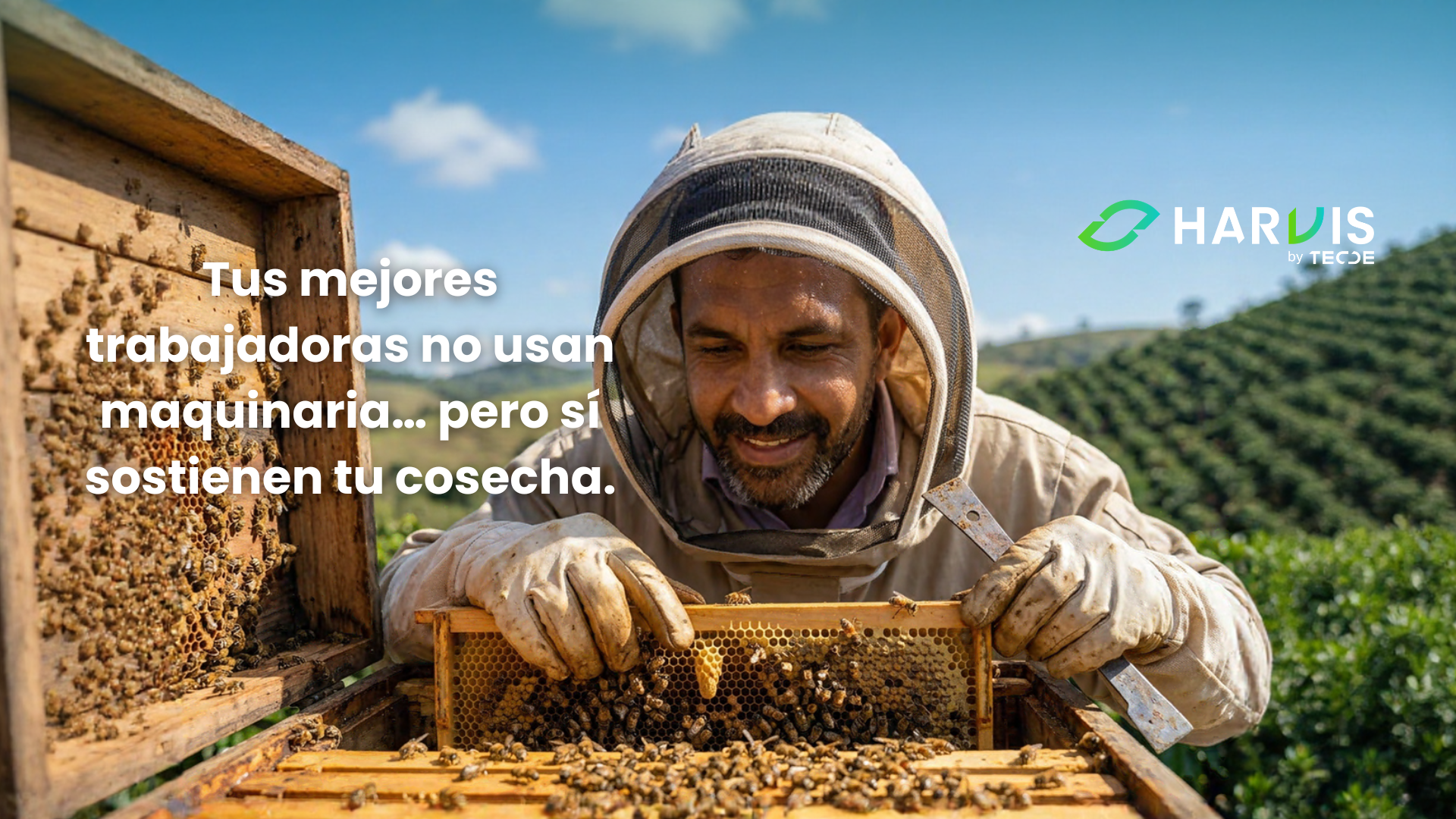
"Often, in agricultural management, we focus all our attention on measuring and optimizing inputs such as fertilizers, fungicides, herbicides, or the use of machinery and labor. We analyze costs per hectare, project yields, and adjust strategies always seeking to improve the efficiency of the production system. However, this detailed approach often leaves in the background a key factor that we do not always quantify with the same rigor: the fundamental role of pollinators in the productivity and sustainability of our crops."
However, within this detailed analysis, there is a key component of the production system that is often completely left out of the equation. It is a natural service that directly affects critical variables such as fruit set, the number of fruits per plant, and consequently, yields per hectare.
Its impact is tangible in productivity and in the quality of the harvest, but it is rarely measured, managed, or incorporated into decision-making. Not because it lacks importance, but because its constant presence and apparent availability have led to it being perceived as something guaranteed. This perception has led to the undervaluation of the real support it provides to production systems and the improvement opportunities it represents when managed intentionally.

Pollination can represent a significant difference in crop productivity, translating into higher yields per hectare, better fruit set, and greater uniformity in production.
According to the FAO, 71 of the 100 crops that provide 90% of the world's food are pollinated by animals. In Latin America, a region that hosts one of the greatest biodiversities of pollinators on the planet, this service is essential for crops that represent billions of dollars in exports: coffee, avocado, cocoa, berries, citrus. In Colombia specifically, where we have over 1,000 species of native bees, this free service is silently working in our fields. Or at least, it should be.
Let’s talk about numbers we are not seeing…
Let’s review some recent data that should be in any serious agricultural productivity analysis. According to research published in the scientific journal Ecology, experiments conducted over four years where flowers were deliberately isolated from contact with pollinators showed technically revealing results: seed production decreased by 50%, pollinator species decreased by 27%, and floral species decreased by 23%. These are not hypothetical scenarios; they are direct measurements of the cost of losing this ecosystem service.
In Colombia, the figures also demand attention: according to Professor Andre Riveros, a pollinator expert from the Faculty of Natural Sciences at the University of Rosario, up to 40% of beehives are lost annually in various regions of the country. If we translate this to any other productive asset, it would be unacceptable, as no operation could sustain a 40% loss of its production infrastructure year after year without collapsing. However, when it comes to pollinators, that loss is assumed as part of the landscape.
International data reinforces the trend; research from the United States Department of Agriculture (USDA) and scientists from Washington State University (WSU) projected that by 2025, losses of between 60% and 70% of commercial honeybee colonies were expected. These numbers represent direct pressure on crops that critically depend on pollination: almonds, avocados, berries, citrus. Crops that, coincidentally, represent some of the highest value export products for countries like Colombia.
Let’s analyze the fundamental paradox of our current management system; a study led by researchers from the Faculty of Exact and Natural Sciences at the University of Buenos Aires (FCEyN-UBA), the Faculty of Agronomy at the University of Buenos Aires (FAUBA), and the National Institute of Agricultural Technology (INTA) of Argentina, published in 2025 in the scientific journal One Earth, installed beehives in real agricultural plots and monitored the bees before and after the application of agrochemicals. The findings are quite revealing: exposure to agrochemicals generates genetic, sensory, and behavioral damage in honeybees that weakens the entire colony.
The documented effects include alterations in genes linked to brain functions that ultimately affect individual behavior and reduce foraging efficiency. Exposed bees show sensory failures, difficulties in learning and communication, and disorientation. In practical terms, this means that each application of certain chemicals reduces our pollinators' ability to do the work we need them to do.
Glyphosate presents a particular challenge: Teacher Jorge Zavala, a researcher at FAUBA and CONICET, mentions that this herbicide does not repel bees, unlike other products. Bees come into contact with the product and transport it directly to the hive, contaminating the stored pollen and nectar. Neonicotinoids, on the other hand, affect the central nervous system of insects, specifically damaging the brain regions where learning and memory are processed.
Recent studies also document alterations in the intestinal flora of bees, compromising their nutrition and immunity. The equation does not add up: we apply inputs to protect crops that depend on organisms that those same inputs are deteriorating. 33% of agricultural crops depend on pollination to maintain yields, but our management practices are systematically reducing the available pollination capacity.
The impact of the decline of pollinators on different sectors of Colombian agriculture.
Each Colombian production system has its own relationship with pollinators, and the loss of this service manifests in specific ways in each one.
In coffee, bees can increase yield by up to 20% and improve grain quality; adequate pollination results in more uniform and better-filled grains, factors that directly impact classification and selling price. In avocado crops, the most recent evidence is compelling: according to a research program on assisted pollination implemented by Ubees on a Hass avocado farm in Antioquia during 2024-2025, a 39% increase in production was reported after introducing 30 beehives in 8.9 hectares, with the farm moving from conventional yields to 13.9 tons per hectare, producing a total of 123.5 tons.
In crops such as tomato, goldenberry, and blackberry, inadequate pollination translates into smaller, deformed fruits, with shorter post-harvest life and lower commercial value. In citrus, the quality of the fruit, its size, and its juice content are directly related to the effectiveness of pollination. For export crops like berries, where price is directly linked to size and quality, poor pollination represents a direct loss of income.
The problem is that this loss of productivity is rarely diagnosed correctly. There is no soil analysis that shows "pollinator deficiency." What is observed are symptoms: yields below projections, fruits that do not meet quality specifications, seasons that do not reach targets. And the typical response is to intensify other inputs, increase fertilization, adjust phytosanitary management, when in many cases the limiting factor lies in a deteriorated ecosystem service.
The recovery data that does work
But let’s also analyze the evidence of what happens when favorable management strategies for pollinators are implemented. The numbers show that the investment has measurable and significant returns.
The case documented by Ubees in Antioquia is instructive: 30 beehives in 8.9 hectares generated a 39% increase in production. If we calculate the value of that additional 39% in a high-value crop like Hass avocado for export, the return on investment in pollination service is substantial; we are not talking about marginal improvements of 3% or 5%, but increases that completely transform the economic equation of the operation.
Biodiversity programs implemented in Latin America show consistent results. According to reports from 2025, the Pollinator Operation program benefits more than 50,000 hectares in Mexico, 7,000 in Costa Rica, 48,000 in Chile, and 5,000 in Colombia. In Argentina, Uruguay, and Paraguay, the Multifunctional Landscapes program has impacted 88,000 hectares. Producers participating in these programs document not only better pollination but also better biological pest control, indicating that restoring biodiversity generates multiple ecosystem services.
Research also shows that agricultural operations that ensure greater abundance and richness of pollinators achieve higher production compared to those that only rely on domesticated pollinators. According to Anna Traveset, a researcher at the Spanish National Research Council (CSIC), greater diversity of pollinators not only increases fruit production but also improves nutritional quality, size, weight, firmness, coloration, and ripening time of foods.
Practical implementation strategies
The operational question is how to translate this information into concrete actions that generate measurable results. Here I describe a series of strategies that have shown documented effectiveness.
- 🐝 Adjustment in the application calendar: Reducing or eliminating agrochemical applications during flowering is the measure with the greatest immediate impact. If applications are necessary, scheduling them during times of low pollinator activity (early in the morning or at sunset) significantly reduces exposure. This change does not require additional investment, just an adjustment in the scheduling of activities.
- 🐝 Floral margins and biological corridors: Designating strips of 3 to 4 meters along the edges of plots for native species that bloom at different times of the year creates feeding and refuge habitat for pollinators. The "loss" of cultivable area is compensated by the increase in productivity in the central area of the crop due to better pollination. Recommended species include marigolds, salvias, wild sunflowers, and other native plants with low establishment costs.
- 🐝 Pollination services: For high-value crops where pollination is a limiting factor, renting beehives during flowering represents an investment with measurable returns. The calculation is direct: cost of pollination service versus value of the increase in production. In the documented case of avocado, a 39% increase in production more than justifies the investment in beehives.
- 🐝 Strategic reduction of toxic agrochemicals for pollinators: Reviewing the products used and identifying less toxic alternatives for bees. In Colombia, there are technical guides that classify agrochemicals according to their toxicity to pollinators. Replacing highly toxic products with lower-impact alternatives maintains crop protection while reducing harm to pollinators.
- 🐝 Monitoring pollinator populations: Implementing basic observations of pollinator activity during flowering provides data to assess whether pollination is a limiting factor. There are now monitoring technologies with connected beehives that allow real-time tracking, although even systematic manual observations generate valuable information for decision-making.
The long-term economic perspective
Let’s analyze this from an asset management perspective. Pollinators represent natural infrastructure that generates valuable services without significant maintenance costs. The deterioration of this asset represents a loss of productive capacity that must be compensated with greater investments in other inputs or accepted as a reduction in yields.
Intensive agriculture has operated under the assumption that ecosystem services are unlimited and replaceable with technology. Recent evidence questions this assumption. There is no artificial pollination technology that can replicate the service of millions of bees working simultaneously per hectare at no cost. Assisted pollination technologies with drones or manual pollen application are viable in very specific high-value crops but do not scale for most production systems.
Therefore, conserving pollinator populations is not an optional environmental consideration; it is basic management of productive infrastructure. Systems that maintain healthy populations of pollinators have measurable competitive advantages over those that have degraded this service.
Emerging technologies and institutional support
The sector is developing tools that facilitate the integration of pollinator management into commercial operations. There are now beehives equipped with sensors that monitor colony health, foraging activity (the activity of worker bees when they leave the hive to collect nectar, pollen, propolis, and water), and pollination efficiency. These technologies allow quantification of the pollination service and optimization of hive distribution in the crop.
Several countries in Latin America, including Colombia, have government initiatives for pollinator conservation. In Colombia, the Colombian Pollinator Initiative, led by the Ministry of Environment and Sustainable Development since 2021, defines conservation and sustainable use actions both in natural ecosystems and in transformed landscapes. The Ministry of Agriculture, through Law 2193 of 2022, created mechanisms to promote and develop beekeeping in Colombia.
Regional programs like Poli-LAC (Regional action to improve the protection of pollinator insects and pollination services in Latin America and the Caribbean), which includes Brazil, Costa Rica, Mexico, Paraguay, and Peru, are developing integrated assessment frameworks to reduce the decline of pollinators through mitigation strategies. In Peru, the Ministry of the Environment (MINAM), in partnership with the Pollinator Technical Group and the Ministry of Agrarian Development and Irrigation (MIDAGRI), activated in 2026 the Annual Operational Plan for pollinator conservation. These initiatives offer technical resources and, in some cases, financial support for implementing pollinator-friendly practices.
The data we should be measuring
If we accept that pollinators are productive infrastructure, then we should measure them as we measure other assets. Some basic metrics that should be integrated into monitoring systems are:
Observations of pollinator activity during flowering, recording visit frequency and species diversity. Percentage of flower set, comparing plots with different pollinator availability. Fruit quality in terms of size, uniformity, and commercial characteristics related to pollination. Presence and diversity of favorable habitat for pollinators in the operation.
These data generate information to assess whether pollination is a limiting factor and whether the interventions implemented are generating results. What is not measured is not managed, and currently, most operations are not measuring this service.
An investment that pays for itself
Let’s review a basic economic equation; the costs of implementing pollinator-friendly practices include adjustments in the application calendar (minimum marginal cost), establishment of floral margins (opportunity cost of 3-4 meters of edge), and eventually renting beehives for high-value crops (variable depending on crop and region).
The measurable benefits include documented increases of up to 39% in yield, improvement in fruit quality that impacts selling price, potential reduction in the need for other inputs due to better overall crop health, and improved resilience of the production system.
For high-value crops like avocado, citrus, berries, specialty coffee, the equation clearly favors investment in pollinator management. For lower-margin crops, low-cost strategies like application adjustments and floral margins generate positive returns without significant investments.
The way forward
The available information indicates that integrating pollinator management into agricultural operations is not a niche option for organic agriculture or alternative systems. It is a productivity optimization strategy applicable to conventional commercial systems seeking to maximize yields and profitability.
The data shows that operations that have implemented these practices achieve measurable results. Technology and technical knowledge are available. Institutions are developing support programs. The limiting variable is the management decision: to recognize that pollinators are productive infrastructure that requires intentional management.
Colombia has significant advantages to capitalize on this: over 1,000 species of native bees, a diversity of crops that depend on pollination, and climates that allow flowering and pollinator activity for much of the year. But these advantages only translate into productivity if actively managed.
The question is not whether we can afford to invest in pollinator management. The question is whether we can afford to continue operating without optimizing this service that generates thousands of pesos in value per hectare.
Consulted References 📚
- Ecoportal (April 2026). "For decades we have contributed to the disappearance of bees, and a study has just demonstrated how the absence of pollinators impacts ecosystems". https://www.ecoportal.net/tecnologia/desaparicion-abejas-peligro/
- National Geographic in Spanish (April 2025). "Earth Day 2025: why the extinction of bees could trigger chaos on the planet". https://www.nationalgeographicla.com/animales/2025/04/dia-de-la-tierra-2025-por-que-la-extincion-de-las-abejas-podria-desencadenar-un-caos-en-el-planeta
- La República Perú (March 2025). "Ecological crisis in the US: 70% of honeybee colonies could disappear, affecting crops". https://larepublica.pe/mundo/2025/03/27/crisis-ecologica-en-eeuu-el-70-de-las-colonias-de-abejas-meliferas-podrian-desaparecer-afectando-cultivos-lrtmusv-2005101
- Infobae Colombia (May 2025). "Colombia, a beekeeping power in the world: more than 40% are lost annually and the country has over 1,000 species of bees". https://www.infobae.com/colombia/2025/05/25/colombia-una-potencia-colmenera-en-el-mundo-se-pierden-mas-del-40-anualmente-y-el-pais-tiene-mas-de-1000-especies-de-abejas/
- Ubees (April 2026). "How UBEES increased avocado yields by 39%". https://ubees.com/es/como-ubees-aumento-los-rendimientos-de-aguacate-en-un-39/
- Universidad Javeriana Pesquisa (July 2025). "Bees, pollination, and responsible management in Colombia". https://www.javeriana.edu.co/pesquisa/abejas-y-manejo-responsable/
- El Diario Web (June 2025). "An Argentine study reveals how agrochemicals affect bee colonies". https://www.eldiarioweb.com/2025/06/un-estudio-argentino-revela-como-los-agroquimicos-afectan-a-las-colmenas-de-abejas/
- Sudoeste BA (June 2025). "Pollination at risk: bees lose key abilities due to agrochemicals". https://www.sudoesteba.com/2025-06-04/la-polinizacion-en-riesgo-las-abejas-pierden-capacidades-clave-por-los-agroquimicos-12258/
- Sustainable Economy (October 2025). "COP30: 5 innovative solutions to boost regenerative agriculture and global food security". https://economiasustentable.com/noticias/cop30-cinco-soluciones-innovadoras-para-impulsar-la-agricultura-regenerativa-y-la-seguridad-alimentaria-global
- BASF Colombia (February 2026). "Regenerative agriculture: transforming the future of the field with strategic allies". https://agriculture.basf.com/mx/es/contenidos-de-agricultura/agricultura-regenerativa-para-un-futuro-agricola-sustentable
- BASF Colombia (November 2025). "Plant Health and Pollinators: The Best Kept Secret of Your Harvest". https://agriculture.basf.com/co/es/contenidos-de-agricultura/sanidad-vegetal-y-polinizadores0
- Be Origen (October 2025). "Pollination: key to life and agriculture". https://beorigen.com/2025/10/27/polinizacion-clave-para-la-vida-y-la-agricultura/
- Spanish National Research Council - CSIC (April 2025). "The extinction of pollinators puts biodiversity and our health at risk". https://www.csic.es/es/actualidad-del-csic/la-extincion-de-los-polinizadores-pone-en-riesgo-la-biodiversidad-y-nuestra-salud
- Ecoticias (March 2026). "Pollinator Day 2026: why protecting bees and butterflies is vital". https://www.ecoticias.com/naturaleza/dia-de-los-polinizadores-2026-importancia-abejas