

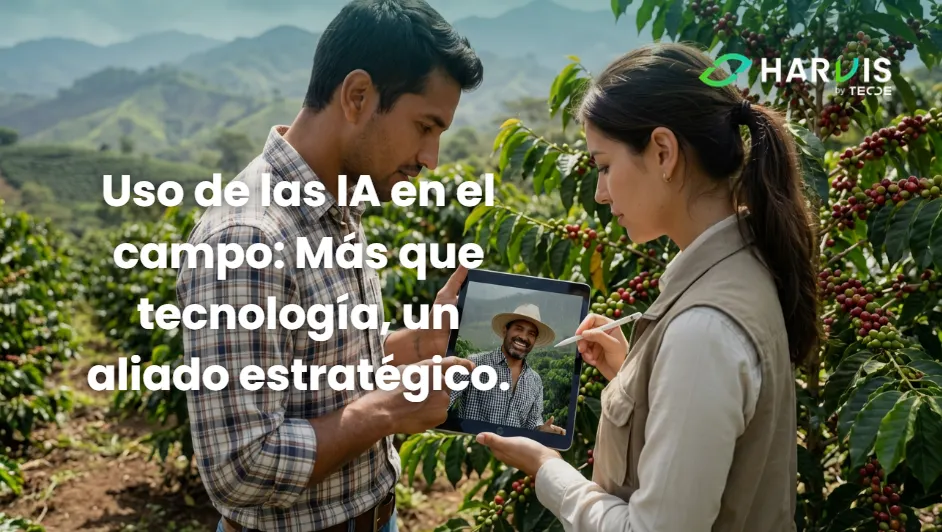
Every hectare produces data every day, but how to turn it into concrete decisions?
The field is an inexhaustible source of information. When leveraged with the right tools and mechanisms, that information transforms into an incredible source of data with enormous potential. Well-managed, this data becomes a strategic ally, capable of providing the clarity needed to make more precise, timely, and effective decisions.
Talking about artificial intelligence in agriculture may sound like science fiction until you discover how a small sensor underground can alert you several days in advance about the water stress that will affect your crops, or how a device in the middle of the field measures air humidity in real-time to adjust and make key decisions that will be relevant for good Integrated Pest and Disease Management. The real power lies in processing: turning scattered data into information that reveals crop behavior, detecting early pest appearances, and anticipating scenarios that previously relied solely on intuition. AI does not come to replace the farmer's experience but to enhance it, as it analyzes signals invisible to the human eye, connects climate, historical, and biological patterns, and delivers quick, precise, and, most importantly, preventive responses.
How to get started? AI is not just for large corporations; today, a producer with a smartphone and access to agricultural platforms like HARVIS from Tecde.AI can monitor their fields and collect information.

You don't need to invest in expensive equipment from day one. Just record the basic variables: rainfall, temperatures, yields per plot. Over time, those raw numbers turn into patterns. AI learns from your farm, your practices, your successes, and failures. The result is a tool that alerts you to risks, suggests optimal times for planting, performing cultural activities, better understanding the population dynamics of pests in your crop, or even helps you reduce input use without sacrificing productivity.
The benefit is enormous: scheduling fertilization at the right moment, detecting anomalies before they turn into losses, understanding which part of the plot is performing better and why. It's as if the producer had an advisor that never sleeps, analyzing every detail. AI not only brings efficiency but also peace of mind: knowing that decisions are based on data and not on hunches. And in a world where the margin for error is costly, that difference is worth its weight in gold.
Countries like Brazil and Argentina have been using these technologies for years to compete in global markets. Colombia, with its climatic diversity and its way of farming, has even more to gain. The key is to lose the fear and take the first step: AI comes to enhance the instinct of those who are daily focused on producing with information that was previously impossible to obtain and, above all, process.
At Tecde.AI, we love creating communities through discussions and forums; this way, we can understand which topics generate the most questions among our users.
If you have any questions and want to delve deeper into a specific topic, write to us and subscribe.