

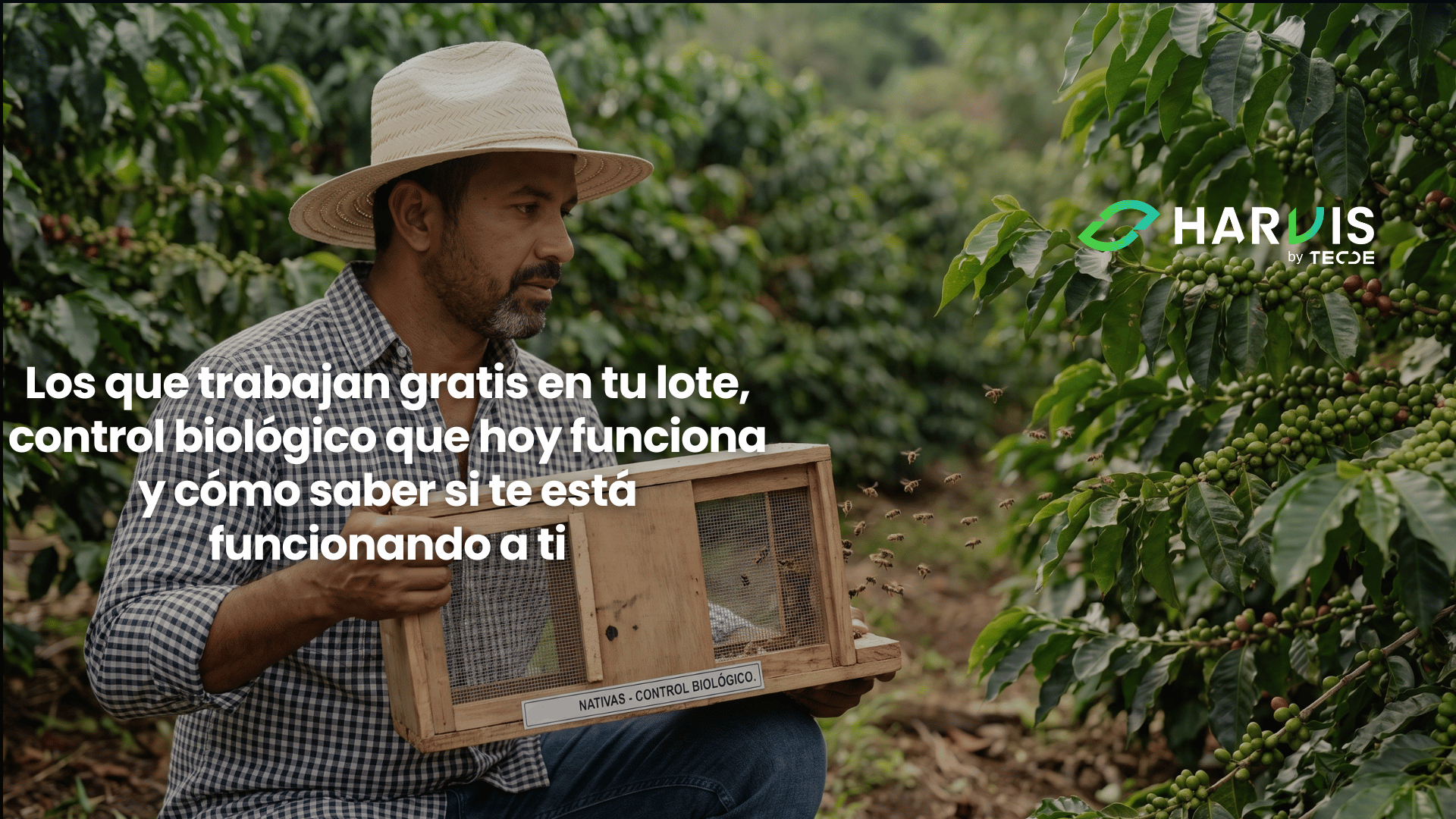
The box arrives at the farm at noon, in the truck bed, after three hours of travel under the sun on an unpaved road. Someone unloads it, leaves it in the house corridor while lunch is served, and by mid-afternoon, two workers go out to release the contents, walking through the lot where they always walk, opening the packets every certain number of steps according to the judgment of the person in front. A month later, no one can say if it worked, and the conclusion left on the farm is that biological control did not work.
This season has already shown biological control working with numbers. The pest blog reported a program that combined mapping of hotspots, targeted release of parasitoids, and application of the fungus by threshold, with infestation dropping from 3.3 to 1.7 percent and a 26 percent increase in net income per hectare; the Hass blog showed predatory mites containing pest mites without the producer paying anything for them, until a broad-spectrum spray broke the balance. What is lacking is not more catalogs of agents, but the operational layer that decides whether those results are repeated on your farm or not.
It is worth entering with the right expectation. Well-executed biological control does not deliver spectacular blows nor does it replace a chemical program overnight; it maintains populations below the threshold over time and reduces the number of necessary interventions. Measured this way, it works; measured as if it were a shock insecticide, it will always disappoint.
What Arrives in the Box Is Not Always What You Paid For
The first point of failure in biological control is not in the field; it is in logistics, and it is the one that is least audited.
Products based on entomopathogenic fungi, which are the most widespread, entirely depend on the conidia arriving alive. Of about 171 commercial products inventoried, the vast majority are distributed between two species, Beauveria bassiana and Metarhizium anisopliae, each holding about 34 percent of the market, and sector reviews consistently identify the same bottlenecks: maintaining viability during storage and transport, limited shelf life, and sensitivity to environmental factors after application.
With living organisms, the situation is even more fragile. An adult parasitoid has a short life expectancy and a narrow temperature tolerance, so the hours the box spent in a hot truck bed cannot be recovered with any release technique.
From this arise three concrete demands that you can put in writing to any supplier before the first purchase. Request the quality control certificate of the batch with production date, concentration, and percentage of viability or emergence, not the generic technical data sheet of the product. Ask for the transport conditions and temperature, and agree on a delivery time that allows you to release or apply on the same day. And request the specific release protocol of the agent, with density per hectare and number of points, because as we will see shortly, that data changes the result more than any other variable. Keep the idea of the percentage of viability in mind, as it comes back at the end when we set up the verification exercise.
The Spraying Next Week Decides the Outcome of Today’s Release
A study that exposed adult parasitoids to residues of twenty-five commonly used insecticides in citrus and classified them according to the methodology of the international organization that standardizes these tests found that only 20 percent were harmless, 12 percent slightly harmful, another 12 percent moderately harmful, and 56 percent frankly harmful. In farm terms, if you choose a product at random from the shelf, you have more than a 50 percent chance of buying something that kills the control agents you just released or that were already working for free on your farm.
There is also a level of damage that does not appear in the count of dead. Evaluations of sublethal effects on the citrus psyllid parasitoid show that doses that do not kill the adult alter its behavior, reproduction, and development, so a product classified as low toxicity can still reduce parasitism to irrelevant levels. A count of corpses does not capture that effect, and that is why labels that rely solely on acute mortality underestimate the problem.
The operational rule that emerges does not require giving up chemical control; it requires organizing it. Before scheduling a release, review what you applied in the past weeks and how long the residue of those molecules lasts, because releasing over an active residue is throwing the entire box away. And before choosing the product for the next application, look at the selectivity classification available for that active ingredient and prefer the most selective among those that solve your problem, even if it costs a bit more. The price difference between a selective product and a broad-spectrum one is often much less than the cost of rebuilding the population of natural enemies on a farm.
As we already addressed in our blog Your Best Workers Don’t Use Machinery, which you can read here, broad-spectrum products incur a cost that does not appear in the quote and is paid in pollination and in services that the producer is not accounting for; biological control is the exact other side of that same account, because the organisms that control your pests and those that pollinate you share sensitivity to the same molecules and disappear together with the same spraying.
Density and Radius: The Part That Decides If the Release Was Money Thrown Away
If there is one piece of data from this season that is worth keeping, it is from a study that evaluated density and dispersal radius of the citrus psyllid parasitoid in commercial orchards, because it shows that the same number of wasps can yield opposite results depending on how they are distributed.
The numbers are compelling. At a radius of 7.5 meters from the release point, a density of 3,200 wasps per hectare achieved a parasitism of 74.1 percent. The same density, measured at 15 meters from the point, fell to 30.7 percent. And below 800 wasps per hectare, with release radii greater than 15 meters, no parasitism was recorded. The protocol that the authors recommend is 3,200 wasps per hectare distributed in 56 equidistant points, that is, about 57 wasps per point.
What those three data points say together is that the most expensive error of a release is not buying too little; it is distributing poorly. A farm that buys the correct amount but releases it in eight convenient points along the path is producing islands of control surrounded by untreated lot, and the average of the hectare does not resemble the average of the release point at all. That is exactly the scene at the beginning of this blog, two workers opening packets where they always walk.
The second reading relates to the minimum scale. Below a certain density, the agent simply does not find a host often enough to establish itself, so a small release made to test usually fails for reasons that have nothing to do with the quality of the agent. If you are going to do a test, do it in a small area with the full density, never in a large area with reduced density.
There is also national production of this parasitoid, with public protocols for mass rearing, quality control, transport, and field release developed by the country's agricultural research institution, which reports high levels of efficacy in prolonged free exposure. It is the type of tool that is already available and is poorly utilized when the release logistics do not support it.
How to Know If the Release Worked

What Already Lives on Your Farm and Doesn’t Charge You
Buying organisms is the visible route of biological control and is not the most profitable. The other route consists of conserving and feeding the natural enemies that are already on your farm, and its advantage is that it has no recurring purchase cost.
Augmentative biological control has grown significantly in recent decades, increasing from about 4.35 million hectares treated around the year 2000 to 31.4 million in 2018 and nearly 62 million in 2024, with Latin America as the region with the largest area in the world under this practice in open fields. This growth coexists with a quieter and cheaper line of work, that of conservation control, which has been accumulating evidence on habitat management for twenty-five years.
The most studied tool in that line is flower strips within or around the crop. A recent meta-analysis found that flower strips increase the abundance of natural enemies by 48 percent, and that strips planted with at least two species of flowers reach 70 percent more natural enemies compared to lots without strips, with the effect growing as the diversity of the mix increases. The groups that respond the most are generalist predators that also feed on pollen and nectar, such as ladybugs, lacewings, hoverflies, and predatory bugs, which consume aphids, thrips, and mites.
There is a condition that decides the outcome and that is worth clarifying before planting anything. What matters is not the quantity of flowers but access to pollen and nectar, so open and shallow flowers work, while ornamental closed corolla flowers do not, and a mix of several species with staggered flowering is much more effective than a single species that blooms for two weeks and then ends. The other determining factor is outside the property, because the effect of these practices interacts with the semi-natural habitat of the surroundings and performs differently in a landscape with remaining vegetation than in one that is completely clean.
What the Meta-Analysis Says and Is Almost Never Cited
The same meta-analysis that reports the 48 and 70 percent increase in natural enemies found that the effect on pest populations was much more variable and did not turn out to be statistically significant. Translated, planting the strip confidently increases the number of natural enemies, but does not guarantee that this will result in less damage in the adjacent crop. The evidence of spillover from the strip to the lot is also variable.
This does not invalidate the practice; it places it. It means that the flower strip is a medium-term investment whose return depends on the landscape, the crop, the pest, and how aggressive the rest of the health program is, and that a producer who plants it expecting to reduce applications in the first campaign will likely be disappointed. It also means that the component that most consistently pays off is not the strip alone, but the combination of conserving habitat and stopping the killing of what that habitat supports, which brings us back to the selectivity section above.
The same caution applies to entomopathogenic fungi, which this season has already put numbers on. The realistic ceiling of accumulated mortality reported by serious trials is far from what advertising promises, and that ceiling is only reached when the application time, protection against radiation, and repetitions are respected. A well-used biological agent is a tool for sustained reduction, not rescue.
Half a Hectare, a Flowered Strip, and a Weekly Count
The exercise to know if this works on your farm costs little and fits within a campaign.
Choose a lot and divide it into two comparable parts, with similar soil, age, and variety. One part will receive the complete biological intervention and the other will remain with your usual management, and it is essential that the control part exists, because without it any result can be attributed to the weather.
Before intervening anything, count for two or three weeks in both parts, with the same sampling unit and on the same day. You need two numbers in each, the pest and the natural enemies, because the signal of biological control appears first in the relationship between the two and only later in the damage. For the enemies, a standardized review of leaves and shoots per tree is sufficient, always the same amount and the same person.
On the treated part, plant a strip of at least two species of open flowers with staggered flowering, and if you are going to do a release, do it with the full recommended density and distributed in the number of points of the protocol, even if that forces you to reduce the area of the trial to half a hectare. Note the date, the product batch, the quality certificate, and the declared percentage of viability, which is the data that was pending at the beginning of this blog and that you will need when comparing suppliers next year.
Biological control is sold as a product and behaves as a system, and that confusion explains most of the failures attributed to it. What arrives in the box is just an input whose performance depends on the temperature at which it traveled, the residue it found upon arrival, how it was distributed in the lot, and what the producer sprays three weeks later. When those four conditions are organized, the tool works with measurable numbers and documented economic returns; when not, the farm concludes that biological control does not work and returns to a program that costs more.
During the rest of the campaign, maintain the weekly count and record all the chemical applications you make in either part, with product and date. At the end, you will be able to answer three questions that you cannot today: whether the relationship between pest and natural enemies moved, whether the damage moved, and how many applications you saved in the treated part. Multiply those saved applications by their cost and compare them against what you spent on the strip and on the release. That number is the only one that should decide whether you repeat.
Buying the Insect Is Not Buying Control
What you can do starting Monday fits into five decisions. Demand from the supplier the quality certificate of the batch with date, concentration, and viability, and agree on a delivery time that allows you to release or apply on the same day, because hot transport ruins the product before it touches the lot. Review the selectivity of the active ingredient before buying it and prefer the most selective among those that solve your problem, keeping in mind that more than half of commonly used products turned out to be harmful to parasitoids in standardized tests. Release with the full density and with the number of points from the protocol, even if you have to reduce the area, since the same number of wasps yielded 74 percent parasitism at seven and a half meters and only 31 percent at fifteen. Plant the flower strip with at least two species of open flowers and staggered flowering, knowing that the increase in natural enemies is well documented and that the reduction of damage is not guaranteed. And always leave a control area with prior and subsequent counting, because without it you will not be able to demonstrate anything, not even to yourself. The producer who finishes the campaign with that comparison made knows how much each peso he put into biological control yielded; the one who did not will continue deciding based on the price of the box.
Do you want to keep a record of the before and after of each release, the certificate of each batch that enters, and the applications you made in the same window? Write to us via WhatsApp or schedule a demo, and we will show you how Harvis organizes your monitoring and your tasks so that by the end of the campaign, the comparison is made.
Consulted References
- Development of mycoinsecticides, advances in formulation, regulatory challenges and market trends for entomopathogenic fungi. PMC. https://www.ncbi.nlm.nih.gov/pmc/articles/PMC12843292/
- Entomopathogenic fungi and their relevance in sustainable agriculture, a review. Cogent Food and Agriculture, Taylor and Francis. https://www.tandfonline.com/doi/full/10.1080/23311932.2023.2180857
- Conservation biological control using selective insecticides, a valuable tool for IPM. Biological Control, ScienceDirect. https://www.sciencedirect.com/science/article/pii/S1049964418302470
- Lethal and sublethal effects of insecticides used on citrus on the ectoparasitoid Tamarixia radiata. PLOS One. https://journals.plos.org/plosone/article?id=10.1371/journal.pone.0132128
- Density and dispersal radius of Tamarixia radiata for control of Diaphorina citri in citrus groves. (2023). Neotropical Entomology, Springer. https://pubmed.ncbi.nlm.nih.gov/37369981/
- Corporación Colombiana de Investigación Agropecuaria, Agrosavia. Protocolo de cría y liberación de Tamarixia radiata (Waterston) (Hymenoptera, Eulophidae). Editorial Agrosavia. https://editorial.agrosavia.co/index.php/publicaciones/catalog/book/13
- Recent advancements toward augmentative biological control in pest-resilient cropping systems. (2026). Frontiers in Agronomy. https://www.frontiersin.org/journals/agronomy/articles/10.3389/fagro.2026.1824199/full
- Mapping conservation biological control and IPM research (2000-2025), a bibliometric analysis of natural enemies and habitat management. (2025). Insects, MDPI. https://doi.org/10.3390/insects17050447
- Highly diverse flower strips promote natural enemies more in annual field crops, a review and meta-analysis. Agriculture, Ecosystems and Environment, ScienceDirect. https://www.sciencedirect.com/science/article/pii/S0167880924005309
- Interaction effects of farm-scale management of natural enemy resources and the surrounding seminatural habitat on insect biological control. (2025). Insects, MDPI. https://doi.org/10.3390/insects16030286
- Perennial flower strips increase pollinator and natural enemy abundance but have limited effects on pest control in adjacent crops. Agriculture, Ecosystems and Environment, ScienceDirect. https://www.sciencedirect.com/science/article/pii/S0167880925005572
- Augmentative biological control of invertebrate pests in Australasia, experiences from down under. (2025). Biological Control, ScienceDirect. https://www.sciencedirect.com/science/article/pii/S1049964425002051
- Validation of a sustainable pest management program to control coffee berry borer. (2026). Insects, MDPI. https://doi.org/10.3390/insects17020181
- Efficacy of Beauveria bassiana strain GHA spray applications against coffee berry borer Hypothenemus hampei. Biological Control, ScienceDirect. https://www.sciencedirect.com/science/article/abs/pii/S1049964421000578
- UC Statewide IPM Program, University of California. Selectivity of Insecticides and Miticides, Citrus. https://ipm.ucanr.edu/agriculture/citrus/selectivity-of-insecticides-and-miticides/
- Integrated biological control strategies for citrus rust mites, distribution, impact on mandarin quality, and the efficacy of Amblyseius largoensis. (2024). PMC. https://pmc.ncbi.nlm.nih.gov/articles/PMC11594963/
- Photoprotection of Beauveria bassiana, testing simple formulations for control of the coffee berry borer. International Journal of Pest Management, Taylor and Francis. https://www.tandfonline.com/doi/abs/10.1080/096708700415490