

In previous blogs, we talked about why fertilizer prices are rising and that you don't control them; Latin America imports most of its nitrogen, phosphorus, and potassium, and any shake-up in the international market ends up on your bill. It's a costly and, for now, unavoidable dependency on purchased inputs.
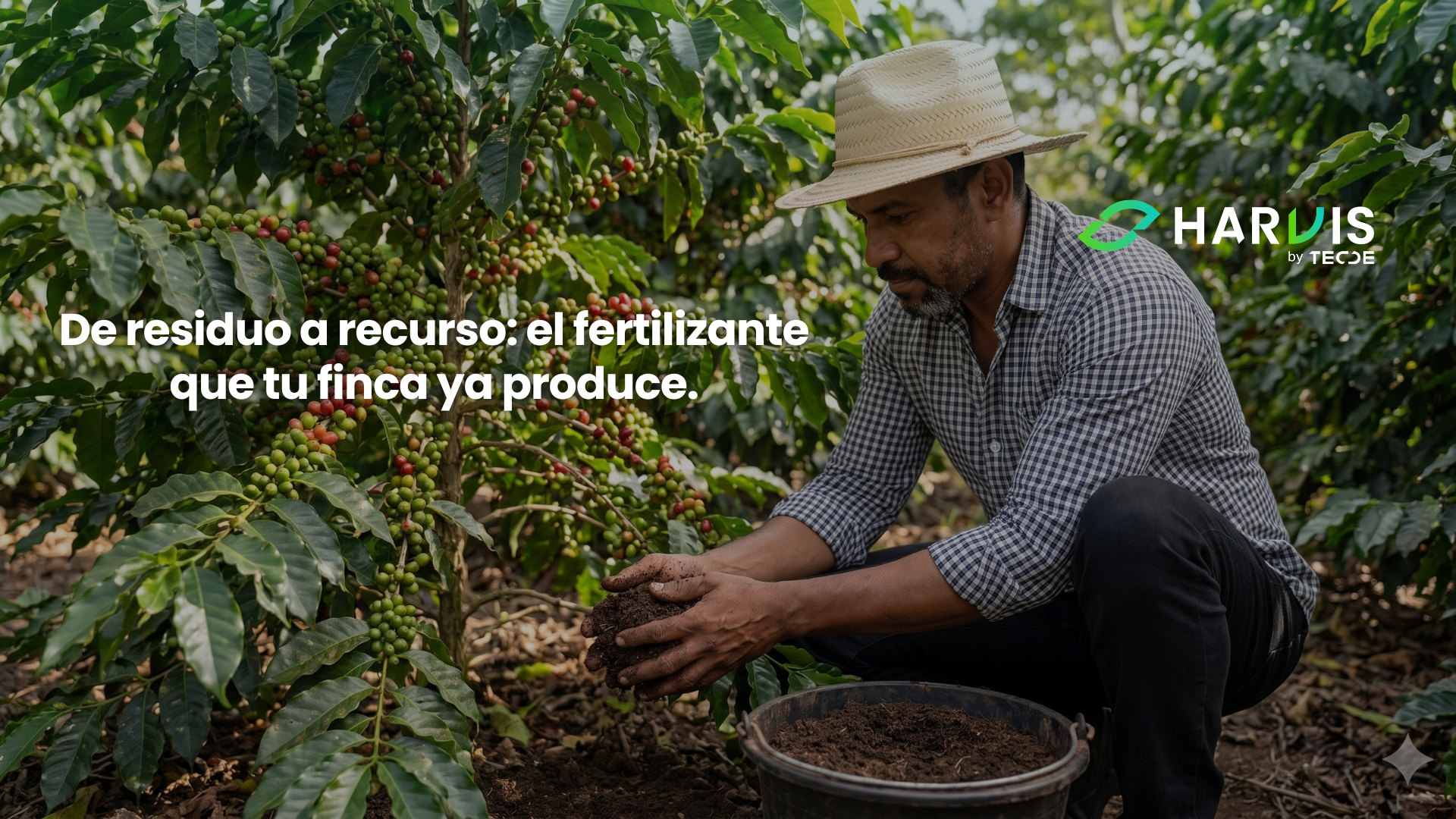
But it is important to look at the fact that while you pay for nutrients that come from the other side of the world, your own farm is producing nutrients every day, and in most cases, you are throwing them away. Manure from livestock, crop residues, the coffee pulp left after processing, all of that contains nitrogen, phosphorus, potassium, calcium, and micronutrients, and they are the same ones you buy; the difference is that these do not arrive on a truck, they are already in your lot. And when you leave them piled up rotting, burn them, or allow the rain to wash them away into a stream, you are not throwing away garbage; you are throwing away fertilizer that you already paid for with your harvest.
To this economic reason, a second one is added: the market and regulation now expect it; national circular economy strategies in the region have set concrete goals for the utilization of residual biomass, and certifications that open premium markets value, and sometimes require, nutrient recycling on the farm. Recovering your waste has ceased to be just a good environmental practice; it is also savings, access to the market, and resilience against expensive inputs. Let's see what you really have on hand, how to turn it into something your crop can use, and how much it is worth.
The Hidden Fertilizer in What You Throw Away
Let's start by understanding that your waste is not inert matter; it is concentrated nutrients with real agronomic value, although its content varies greatly depending on the source.
Manure is the clearest case, and its composition depends on the animal. Cattle manure tends to be rich in nitrogen (around 2.3%), while poultry and goat manure concentrate more phosphorus and potassium (close to 2.1–2.5%). The differences are not just in quantity but in behavior; chicken manure is very rich in nitrogen (3.5–4.5%) but has a narrow carbon:nitrogen ratio, which makes it decompose quickly and prone to losing nitrogen through leaching if not managed well; on the other hand, sheep manure, with a more balanced carbon:nitrogen ratio, releases its nutrients more gradually, and knowing these differences allows you to use each type of manure at the right time and for the right crop, instead of applying them all equally.
But the most revealing example for our region is coffee pulp. When you process coffee, the pulp represents about 40% of the weight of the fruit, meaning almost half of what you harvest is left as waste. The concentrations of phosphorus, calcium, and potassium are higher in the pulp than in the coffee bean you sell. So you extract the bean and with it a part of the nutrients from your soil, but if you throw away the pulp, you are discarding a material that is even more concentrated in potassium and phosphorus than your coffee plants need. The pulp is not the leftover of the business; it is a fertilizer that comes with every harvest. Additionally, considering that Cenicafé has identified pulp as the waste from processing that most contaminates water sources when poorly managed, it is so rich in organic matter and nutrients that, in the river, it becomes a problem, but in your soil, it is a solution.
The same goes for crop residues in general, such as stems, leaves, banana stalks, and straw. Although their nutrient concentration is lower, their volume is enormous, and they return significant amounts of potassium and organic matter to the soil. Field studies show that returning straw and green manures to the soil can increase available potassium by up to 47%. Together, what your farm discards each cycle is, in reality, a recoverable fraction of the nutrients that your harvest took away.
From the Pile That Rot to the Compost That Nourishes
Now, there is a warning; you cannot simply throw fresh manure or freshly extracted pulp at the base of your plants, as doing so is counterproductive since fresh organic matter can burn roots, compete with the crop for nitrogen while microorganisms process it, and carry pathogens. Raw waste is a liability, and composted waste is an asset.
Composting is a controlled decomposition; you provide microorganisms with the conditions to transform the waste into a stable, clean material with available nutrients. The three keys are a good carbon:nitrogen ratio (ideally between 25 and 30 to 1) achieved by mixing carbon-rich materials, such as straw, with nitrogen-rich ones, such as manure, sufficient moisture, and enough air. Coffee pulp, with its natural carbon:nitrogen ratio close to that range, is almost an ideal raw material for composting.
Recently, science has provided a valuable improvement; inoculating the compost with microorganisms (strains of Bacillus, yeasts, and others) not only accelerates the process but retains more nutrients in the final product. Controlled studies show that microbial inoculation increased the total nitrogen retained by nearly 9% and raised the soluble phosphorus available, in addition to shortening times. In the case of coffee pulp, a well-managed process with microorganisms can reduce the composting time from the traditional 150 days to about 40. And using certain additives during the process reduces losses of gases like ammonia and nitrous oxide, meaning more nutrients stay in your compost instead of going into the air.
It is wise to be realistic about the scale because many get frustrated there. The pulp produced by a coffee farm typically only covers about a third of the planted area. This is not a failure; it is the reason why composting works better as a system that combines sources: pulp, available manure, crop residues, and complements mineral fertilization instead of trying to replace it entirely. Compost does not eliminate the bag; it reduces how many bags you need to buy. And that reduction, in a year of expensive inputs, is exactly where the profit lies.
How much mineral fertilizer could you stop buying by using what your farm already produces? The answer depends on what waste you have, what it contains, and what your crop needs. Harvis crosses that data to tell you lot by lot. Talk to our team →

How Much Is It Really Worth
But then we come to the question that defines whether this is worth your time and effort: how much money does it represent? Let's be honest because there is a lot of exaggerated promise here.
First, what field evidence supports, a recent case with sugarcane residues in the region reports that compost made on the farm allows for the substitution of up to 30% of chemical fertilizer, a decision explicitly motivated by rising prices and dependency on imported inputs. It is not 100%, but 30% fewer bags purchased is a huge relief for any budget.
Second, compost not only saves but can equal or improve your yield when well combined with minerals. Trials confirm it; substituting 50% of mineral nitrogen with composted manure increased yield by 12% to 15% in a grain crop; and a combination of compost with mineral fertilizer in a 25:75 ratio raised wheat yield by 42% compared to the control, also recording the highest total absorption of nitrogen, phosphorus, and potassium of all treatments. The reason is that compost provides something that the bag does not have: organic matter and microbial life that improve the assimilation of all nutrients, both from the compost and from the mineral fertilizer you continue to apply.
Third, compost has its own market value. A documented operation that produced 1,440 tons of compost per year recorded a production cost of around USD 93,000 and generated revenues of about USD 329,000. This is a case of production at scale for sale, not that of a small or medium producer, but it illustrates a point that does apply: the material you are throwing away has real economic value; at the scale of your farm, that value translates mainly into fertilizer you stop buying. The FAO, in its composting manual for Latin America, proposes precisely that calculation of comparing the market value of the mineral fertilizer that compost replaces, urea, single superphosphate, potassium chloride, against what it costs you to produce it, using reference field doses of 7 to 10 tons of compost per hectare.
Finally, all of this adds to the value that does not appear on the bill but does in your future; regional circular economy goals aim to increase the utilization of residual biomass by 20% in the coming years, composting is officially recognized as a legitimate form of waste utilization, and organic production regulations recognize biofertilizers and inoculants as valid inputs for certification; recycling your nutrients aligns you with markets that pay more for sustainable products. It is a saving today and access to better markets tomorrow.
Knowing Exactly How Much You Can Replace
The practical problem that separates good intention from good decision is that compost, unlike the bag, does not come with a label showing its analysis. Its nutrient content varies depending on the materials you used, the manure you mixed, the degree of maturity; So, how many kilos of urea can you subtract this cycle because your compost already provides them? How much potassium are you adding with that pulp, and when will it be available? Applying blindly leads to costly mistakes like falling short and not taking advantage of the savings.
With data sent to me by producers and by crossing the nutritional contribution of your composted waste with your crop's extraction curve and your soil analysis, I can tell you how many units of nitrogen, phosphorus, and potassium you are incorporating with your compost, and therefore how many kilos of mineral fertilizer you can subtract from your plan without sacrificing yield. It is not an eye estimate; it is a balance that starts from what your farm produces and what your crop needs.
Something decisive is that compost is slow-releasing; it does not deliver all its nutrients in the first cycle but feeds the soil over time. Being able to model what fraction is available for the current harvest and what fraction is building your soil's reserve for the following cycles allows you not to pay twice for the same nutrient or fall short waiting for something that has not yet been released. The result is that every ton of compost you produce translates into a concrete number of bags you do not have to buy, and in the peace of mind of knowing that you are not unbalancing your soil in the attempt. Nutrient recycling only pays if you measure it; the rest is guessing.
Stop Paying for What Your Farm Gives Away
The mindset shift proposed by this blog is simple but powerful: stop seeing manure, pulp, and crop residues as a disposal problem, and start seeing them as the nutrient bank that your farm already possesses. In a context of expensive and imported inputs, the cheapest fertilizer is not the one on sale at the distributor; it is the one you do not have to buy because you recovered it from what you were going to throw away.
This is not about becoming 100% organic overnight, nor promising yourself that you will never buy a bag again. It is about something more realistic and more profitable: trying to recover the fraction of nutrients that your own harvest left on your farm, turning it into quality compost, and subtracting those kilos from your fertilizer bill each cycle while improving your soil and aligning with markets that reward sustainability.
As we already addressed in our blog Circular Economy in Livestock: Closing the Cycle to Produce More with Less, which you can read here, the waste of a productive system is the raw material of another, and closing that cycle is one of the most profitable and sustainable decisions a producer can make. With the nutrition of your crops, that cycle starts with something as everyday as what you are currently letting go to waste.
You don’t have to calculate this alone. I can help you integrate the contribution of your waste, the needs of your crop, and the conditions of your soil to tell you exactly how much mineral fertilizer you can replace, lot by lot, without risking your harvest.
References consulted
- Shrivastava, V., and Laasri, I. (2025). Nutrient Recovery Strategies and Agronomic Performance in Circular Farming: A Comprehensive Review. Sustainability, 6(3), 80. https://www.mdpi.com/2504-3129/6/3/80
- Cao, R., Huang, Y., Li, R., Li, K., Ren, Z., and Wu, J. (2024). Regulation of nitrogen transformation and microbial community by inoculation during livestock manure composting. Environmental Microbiology Reports. https://pmc.ncbi.nlm.nih.gov/articles/PMC10994714/
- Wang, L., Li, Y., and Li, X. (2024). Microbe-aided thermophilic composting accelerates manure fermentation. Frontiers in Microbiology. https://www.frontiersin.org/journals/microbiology/articles/10.3389/fmicb.2024.1472922/full
- Effects of combined application of pig manure composts with chemical fertilizer on winter wheat yield and soil biological characteristics. (2025). (Article in PMC12615480). https://www.ncbi.nlm.nih.gov/pmc/articles/PMC12615480/
- Zhang, H., Chen, L., Wang, Y., Xu, M., Qiu, W., Liu, W., ... and Yi, J. (2025). Straw and Green Manure Return Can Improve Soil Fertility and Rice Yield in Long-Term Cultivation Paddy Fields. Plants, 14(13), 1967. https://www.ncbi.nlm.nih.gov/pmc/articles/PMC12251679/
- Xing, Y., Xie, Y., and Wang, X. (2025). Enhancing soil health through balanced fertilization: a pathway to sustainable agriculture and food security. Frontiers in Microbiology, 16, 1536524. https://www.frontiersin.org/journals/microbiology/articles/10.3389/fmicb.2025.1536524/full
- Noor, R. S., Shah, A. N., Tahir, M. B., Umair, M., Nawaz, M., Ali, A., ... and Assiri, M. A. (2024). Recent Trends and Advances in Additive-Mediated Composting Technology for Agricultural Waste Resources. ACS Omega, 9(10), 11210-11226. https://pubs.acs.org/doi/10.1021/acsomega.3c06516
- Peeva, G. (2026). Phosphorus Recovery from Wastewater in the Circular Economy: Focus on Struvite Crystallization. MDPI, 6(2), 32. https://www.mdpi.com/2673-8783/6/2/32
- Cuéllar, J.A. (2018). Composting Coffee Pulp by Incorporating Microorganisms. National Open and Distance University (UNAD). https://repository.unad.edu.co/bitstream/handle/10596/49524/jacuellarpa.pdf
- Fernández, Y., Sotto, K. D., and Vargas, L. A. (2020). Environmental impacts of coffee production and sustainable utilization of generated waste. Revista Producción + Limpia, 15(1), 93-110. SciELO Colombia. http://www.scielo.org.co/scielo.php?script=sci_arttext&pid=S1909-04552020000100093
- Integrated Nutrient Management for Regenerative Coffee Farming. (2024). ResearchGate. https://www.researchgate.net/publication/382316796
- FAO, Regional Office for Latin America and the Caribbean. (2013). Composting Manual for Farmers: Experiences in Latin America. ISBN 978-92-5-307844-8. https://www.fao.org/4/i3388s/i3388s.pdf
- Sarmiento, A., et al. (2015). Production costs of compost derived from waste of an establishment. Revista Conexagro, 5(1). https://revista.jdc.edu.co/index.php/conexagro/article/download/519/566
- Prensa Libre. (2026). Compost produced from sugarcane residues replaces up to 30% of chemical fertilizer. https://www.prensalibre.com/economia/compost-producido-con-residuos-de-cana-de-azucar-sustituye-hasta-un-30-del-fertilizante-quimico/
- Ministry of Environment and Sustainable Development. (2018). National Circular Economy Strategy. Government of Colombia. https://www.funcionpublica.gov.co/eva/gestornormativo/norma.php?i=260496
- Ministry of Economic Development. (2002). Decree 1713 of 2002. Government of Colombia. https://www.mincit.gov.co/ministerio/normograma-sig/procesos-de-apoyo/gestion-de-recursos-fisicos/decretos/decreto-1713-de-2002.aspx
- Ministry of Agriculture and Rural Development. (n.d.). Regulation for Organic Agricultural Production. Government of Colombia. https://www.minagricultura.gov.co/tramites-servicios/Documents/ReglamentoparalaproduccionOrganica.pdf