

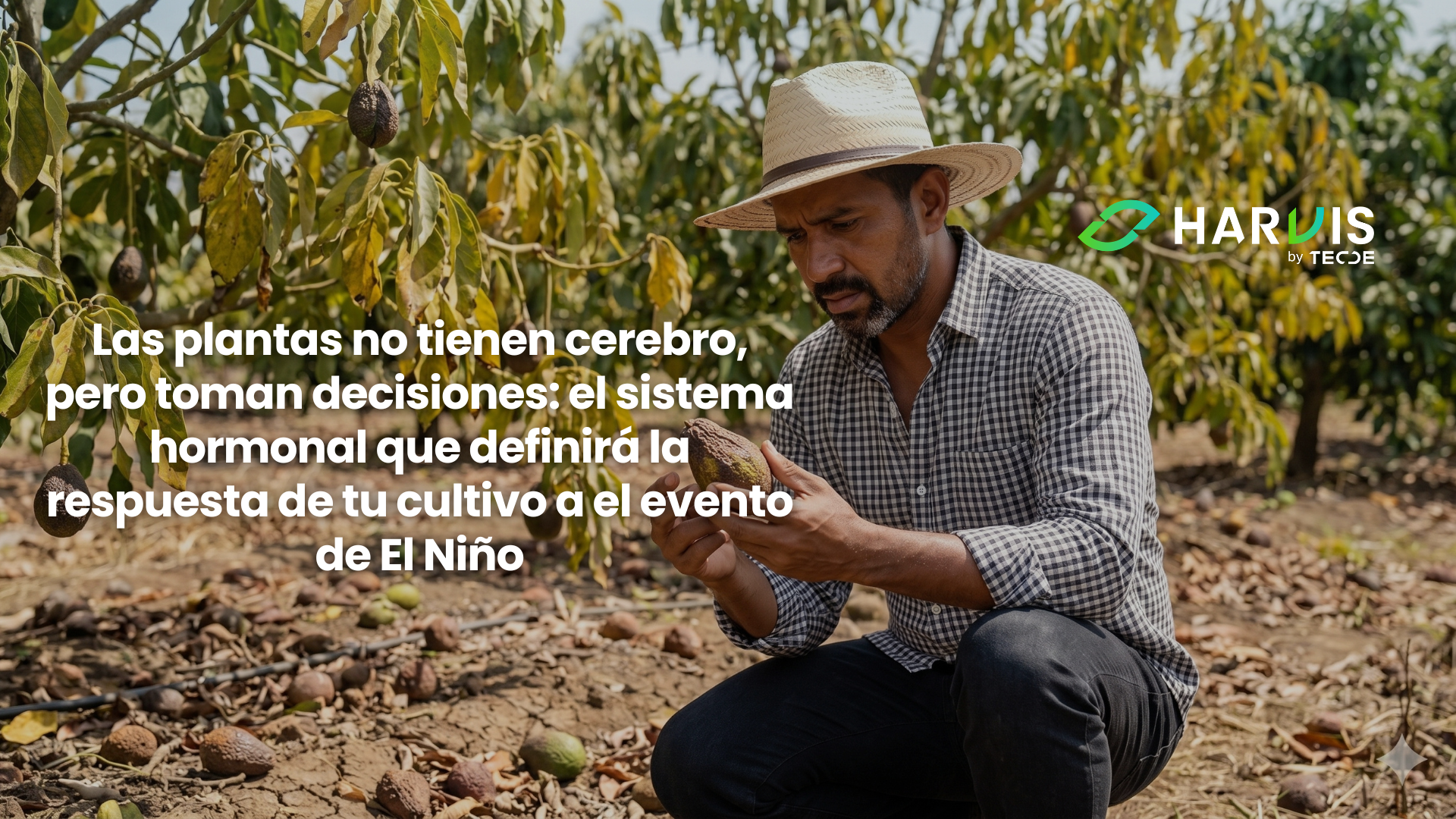
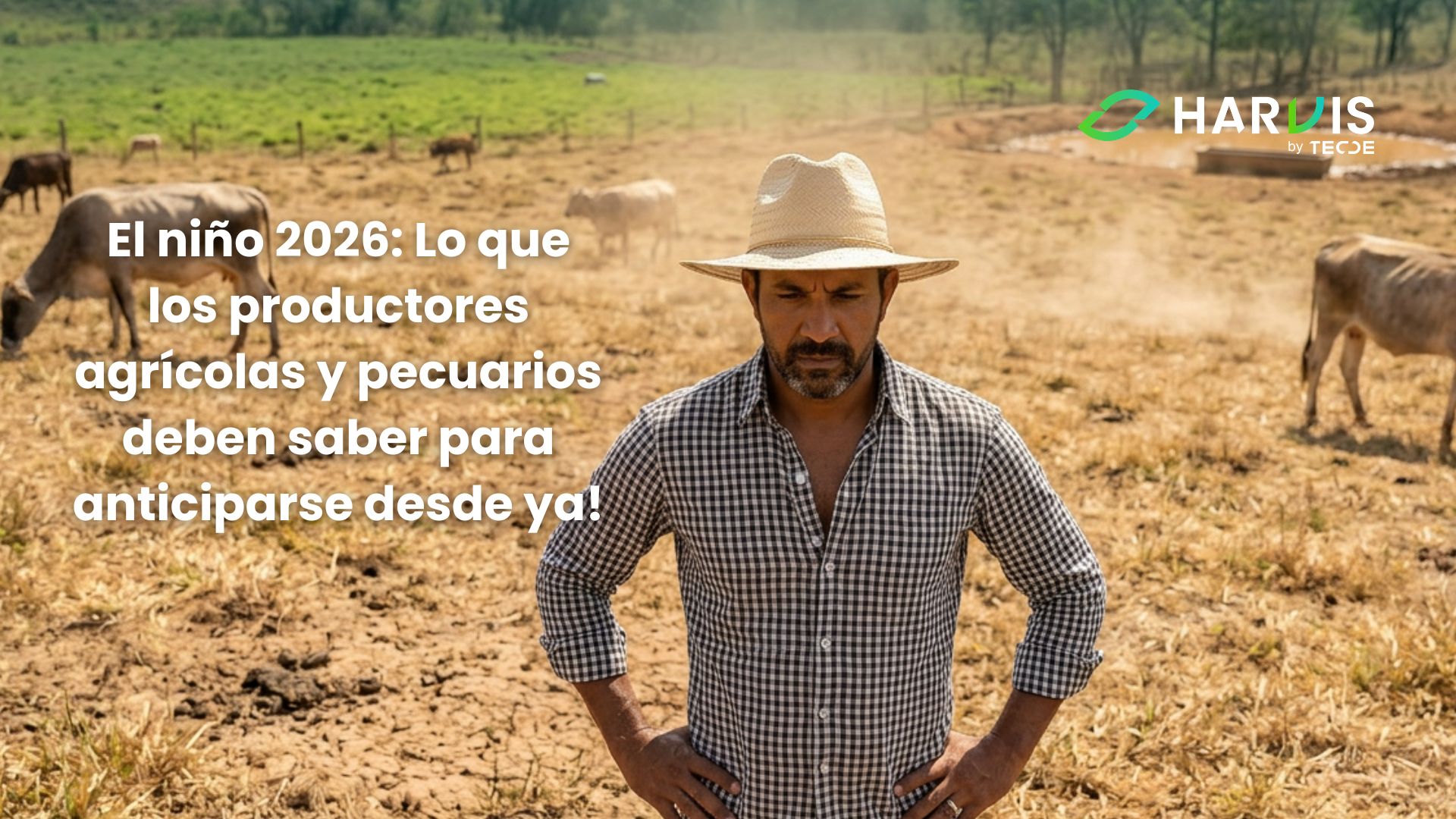
The forecasts from the World Meteorological Organization have raised the probability of the El Niño event consolidating and remaining active until the end of 2026 to nearly 90%, which could be one of the most intense events recorded. For much of the agricultural production areas in northern South America, this translates into a scenario of less rain, drier soils, heat waves, and greater thermal stress on crops. Therefore, the concern should no longer be whether it will arrive or not, but how prepared your crop will be when it does.
Your crop has a system to face that stress; it is not a system you can see at first glance, but it is as real as the roots or leaves. Plants do not have brains or a nervous system, but they perceive their environment and make decisions such as closing stomata to avoid losing water, slowing growth to save energy, maturing faster, and dropping fruits they cannot support. All these decisions are directed by a small group of chemical messengers called plant hormones or phytohormones.
In this and the following blogs, we will explore this system in detail, what hormones are, how minor elements like zinc, molybdenum, copper, and boron are keys that activate them, and how all this connects with the physiological processes that determine your harvest. We start with the fundamental understanding of the hormonal language of your crops, just when an extreme climatic event is about to test it.
What Are Plant Hormones and Why Do They Determine Your Harvest?
A plant hormone is, essentially, a chemical messenger. It is a substance that the plant produces in tiny amounts, measured in millionths, and that travels from one tissue to another carrying an order such as grow here, stop there, open, close, mature, drop. They are not nutrients; they do not feed the plant as their job is to coordinate and tell each part of the plant what to do and when to do it, in response to both its internal development program and environmental signals.
One way to see it is, if nutrients are the building materials of your crop, hormones are the blueprints and work orders. You can have all the bricks in the world—nitrogen, phosphorus, potassium—but if the orders do not arrive correctly, the construction goes wrong. A perfectly nourished plant but with its hormonal system altered grows crooked, flowers out of time, does not set fruits, or collapses under the first stress.
The remarkable thing is that this system works without a control center; there is no brain giving orders. Instead, different hormones are produced in different places, interact with each other, sometimes collaborating, sometimes opposing, and from that dynamic balance emerges the "decision" of the plant. When you understand that balance, you understand why your crop does what it does. And when an event like El Niño comes, understanding that balance is what allows you to anticipate rather than react when it is too late.
There are five major families of plant hormones. A simple way to organize them is to divide them into two groups based on their main role: those that promote growth and those that manage stress and maturity.
Growth Hormones: Auxins, Gibberellins, and Cytokinins
These three families are, broadly speaking, the "accelerator" of your crop. They promote development, cell division, and expansion. When conditions are good with enough water and appropriate temperature, they are the ones in charge.
Auxins are the hormones of direction and growth. The main one is called indole-3-acetic acid (IAA), and its job is one of the broadest in the entire plant; it directs cell elongation, governs apical dominance, which is why the main bud grows more than the lateral ones, and why pruning activates the side branches, and it is responsible for the formation and development of roots. When a root grows downward seeking water, or a shoot leans toward the light, auxins are directing that movement. In a drought scenario, their role in root growth is key as good root exploration allows the plant to seek the scarce water.
Gibberellins are the hormones of stretching and awakening. Their most visible function is to promote stem elongation and tissue expansion, but they are also responsible for breaking seed dormancy and activating germination, and they participate in flowering and fruit growth. They are, to a large extent, what makes a plant "stretch" and occupy space. Under stress, their levels tend to drop because the plant, sensing that conditions are becoming difficult, stops investing in stretching.
Cytokinins are the hormones of division and youth. They promote cell division (hence their name), stimulate the formation of new shoots, and, above all, delay leaf aging, keeping them green and active for longer. Where there are cytokinins, there is young and productive tissue. But an important fact is that cytokinins are antagonists of abscisic acid, the stress hormone. When one rises, the other falls. It is the first indication of how the hormonal system shifts from "growth mode" to "defense mode."
Stress and Maturity Hormones: Abscisic Acid and Ethylene
If the previous three are the accelerator, these two are the brake and emergency system of your crop. And they are precisely the protagonists of any stress event like El Niño.
Abscisic acid (ABA) is the master hormone of the drought response. It is the substance that decides whether your crop survives a water deficit; when the plant perceives that it lacks water, it triggers the production of ABA, and this hormone orders an immediate and decisive action: close the stomata, those microscopic pores in the leaves through which water is lost, to halt moisture loss. Additionally, ABA induces dormancy, slows growth, and prepares the plant to withstand. It is a cautionary hormone that sacrifices growth for survival. In coffee, this stomatal closure mechanism mediated by ABA accumulation is the central component of its response to drought. In avocado, something equivalent occurs; under water stress, the plant overexpresses the genes linked to the ABA response. Without sufficient and timely ABA, a plant literally does not know how to turn off the water tap when it needs it most.
Ethylene is the hormone of maturity and farewell, and it has the particularity of being a gas. It is the hormone that triggers fruit ripening, accelerates tissue aging (senescence), and orders abscission, that is, the dropping of leaves, flowers, and fruits. Ethylene is also produced in response to stress and injuries, making this its dangerous side during El Niño, as under severe water and thermal stress, an excess of ethylene can order the plant to drop flowers and fruits prematurely, that small fruit drop that frustrates the producer so much and is often attributed only to "lack of water," when in reality it is a hormonal decision of the plant to rid itself of a load it cannot support.
The key point is that under an event like El Niño, the hormonal balance of your crop shifts from "growth mode" to "defense mode." ABA rises, ethylene may rise, and auxins, gibberellins, and cytokinins drop. This is adaptive—the plant is protecting itself—but it has a direct cost on your harvest: closed stomata mean less photosynthesis and smaller fruits; high ethylene means fruit that falls. Understanding this mode shift is the first step to accompany it rather than suffer it.
Do you know if your crops have what they need to activate their hormonal response when drought arrives? That preparation is defined before stress, not during. Harvis analyzes the conditions of each plot to help you anticipate El Niño. Talk to our team →

The Invisible Link: How Minor Elements Ignite Hormones
The question is, where does the plant get these hormones? Well, it does not absorb them from the soil nor do they come in a bag. The plant manufactures them through biochemical reactions. And like any biochemical reaction, these manufacturing pathways need catalysts or enzymes, which in many cases only work if they have a specific micronutrient at their center.
Currently, science has demonstrated this, and it is more direct than it seems; zinc is necessary to produce auxin, activating the enzyme that produces tryptophan, which is the precursor from which the plant synthesizes IAA. Without sufficient zinc, auxin levels drop, and that is why zinc deficiency appears as slow growth and small leaves, which are essentially symptoms of deficient auxin. Molybdenum is even more decisive for what is to come; the final step in the synthesis of abscisic acid depends on an enzyme called aldehyde oxidase, which necessarily needs a molybdenum cofactor to function. And copper is a structural component of the receptor that allows the plant to "hear" ethylene; thus, without copper, that receptor cannot detect the hormone.
Pause for a moment to consider what this means in the face of El Niño. A plant deficient in molybdenum cannot properly produce the abscisic acid it needs to close its stomata when drought arrives. It does not matter how much water it lacks or how strong its instinct to protect itself is: if it lacks the micronutrient that ignites that hormone, its defense response arrives weak or late. The same applies to zinc and auxin, or copper and ethylene. Minor elements are not a secondary nutritional detail; they can be considered the keys that ignite your crop's decision-making system.
El Niño and the Hormonal Context: How to Prepare for Real
With all of the above clear, let’s address the practical question that matters: in the face of one of the strongest El Niños announced, what can be done at the hormonal level?
The temptation is to think that the solution is to apply hormones directly, spraying ABA to force stomatal closure, or cytokinins to keep the crop green. There are commercial products based on hormones and biostimulants, and they can have a place. But it is wise to understand their limits; the application of exogenous hormones is not a magic switch. It is extremely sensitive to dosage, timing, and crop stage, and if misapplied, it can be counterproductive; an incorrect hormone or an inadequate dose can cause more harm than good, for example, causing the drop of fruits you were trying to conserve. It is not something to improvise; it requires technical support.
The most reliable and fundamental strategy is another: ensuring that your crop can produce and properly regulate its own hormones. And that largely depends on having the available micronutrients that ignite them. Arriving at a drought event with adequate levels of zinc, molybdenum, copper, and boron is what guarantees that the plant can mount its defense hormonal response when it needs to. It is the difference between giving your crop the tools to defend itself or waiting to rescue it when it is already in crisis. This preparation is preventive; it is done before the peak of stress arrives, not during.
This is complemented by agronomic practices that reduce the intensity of the stress the plant has to face, such as conserving soil moisture with covers and organic matter, maintaining or establishing shade in coffee plantations, irrigating, even if only partially, a partial irrigation helps, and avoiding adding other stresses during the critical window, such as severe pruning or transplanting. A counterintuitive but important point is that under severe drought, it is not the time to over-fertilize; applying large doses of fertilizer to dry soil concentrates salts and exacerbates stress, and a plant in "defense mode" cannot utilize that nutrient anyway.
Finally, there is the part that is in your hands every day: recognizing stress symptoms in time and acting. The plant's hormonal response begins long before damage is visible; the first signs are subtle, even almost imperceptible, such as slow growth, leaves losing their shine, slight wilting during the hottest hours that recovers in the evening. If you wait for obvious signs like curled or folded leaves, wilting that does not recover overnight, yellowing of old leaves, premature dropping of flowers and fruits, new shoots halted, the crop has already been in hormonal crisis for some time. The practical rule is that at the first sign of stress, the action is agronomic and preventive: conserve moisture, reduce other stresses, ensure basic nutrition, do not wait to react when the fruit is already on the ground.
Which Lots Are Hormonal Unprepared?
During an El Niño event, the lots that collapse first are not always the driest. They are often the ones that reached stress with a hidden deficiency of micronutrients that left their hormonal system impaired, lots low in molybdenum whose ABA response arrives weak, or low in zinc with poor root growth to seek water.
This pattern is practically impossible to see at first glance because hormonal deficiency does not manifest until stress puts it to the test, and by then it is too late. This is where technology does what field observation cannot. With Harvis, you can cross the micronutrient status of each lot with the El Niño weather forecast and the phenological stage of the crop to indicate, before symptoms appear, which lots are unprepared for the approaching stress. It is not about waiting to see the crop wilt; it is about identifying in advance where the hormonal machinery will fail and correcting the nutritional base in time.
As we have already addressed in our blog El Niño 2026: How to Prepare Your Crop for the Upcoming Climatic Phenomenon, which you can read here, anticipating this event is the only strategy that truly protects production. This season adds a new layer to that preparation; it is not enough to manage water and shade; it is necessary to ensure that your crop's hormonal system has everything it needs to make the right decisions before stress arrives.
Your crop already knows how to defend itself from El Niño. Your job is to give it, in time, the tools to do so.
Prepare your crop's defense system before El Niño arrives. Write to us on WhatsApp and receive technical assistance to ensure that your lots arrive at stress with everything they need to respond. Talk to us and receive a demonstration of Harvis →
Consulted References
- Schroeder, J. I., et al. (2022). Plant hormone regulation of abiotic stress responses. Nature Reviews Molecular Cell Biology, 23. https://www.nature.com/articles/s41580-022-00479-6
- Jardim-Messeder, D., de Souza-Vieira, Y., and Sachetto-Martins, G. (2025). Dressed Up to the Nines: The Interplay of Phytohormones Signaling and Redox Metabolism During Plant Response to Drought. Antioxidants / MDPI. https://pmc.ncbi.nlm.nih.gov/articles/PMC11768152/
- Zhao, W., Chen, X., Wang, J., Cheng, Z., Ma, X., Zheng, Q., Xu, Z., and Zhang, F. (2025). Emerging Mechanisms of Plant Responses to Abiotic Stress. Plants / MDPI. https://pmc.ncbi.nlm.nih.gov/articles/PMC12655730/
- Finkelstein, R. (2013). Abscisic Acid Synthesis and Response. The Arabidopsis Book. https://pmc.ncbi.nlm.nih.gov/articles/PMC3833200/
- Castillo-González, J., Ojeda-Barrios, D., Hernández-Rodríguez, A., González-Franco, A. C., Robles-Hernández, L., and López-Ochoa, G. R. (2018). Zinc metalloenzymes in plants. Idesia / Redalyc. https://www.redalyc.org/journal/339/33957240004/html/
- Dluhosch, D., Kersten, L. S., Minges, A., Schott-Verdugo, S., Gohlke, H., and Groth, G. (2025). Molecular mechanism and structural models of protein-mediated copper transfer to the Arabidopsis thaliana ethylene receptor ETR1. Scientific Reports, Nature. https://www.nature.com/articles/s41598-025-19915-6
- Jing, H., Wilkinson, E. G., Sageman-Furnas, K., and Strader, L. C. (2023). Auxin and abiotic stress responses. Journal of Experimental Botany. https://pmc.ncbi.nlm.nih.gov/articles/PMC10690732/
- Silva, P. C. da, Ribeiro Junior, W. Q., Ramos, M. L. G., Rocha, O. C., Veiga, A. D., et al. (2022). Physiological Changes of Arabica Coffee under Different Intensities and Durations of Water Stress in the Brazilian Cerrado. Plants. https://pmc.ncbi.nlm.nih.gov/articles/PMC9460576/
- Lopez-Merino, J. E., Huaman, E., Condori-Apfata, J. A., and Oliva-Cruz, M. (2026). Physiological and Biochemical Analysis of Coffea arabica Cultivars Subjected to Water Stress. Stresses / MDPI. https://doi.org/10.3390/stresses6010002
- Moreno-Ortega, G., Zumaquero, A., Matas, A., and Olivier, N. A. (2021). Physiological and Molecular Responses of 'Dusa' Avocado Rootstock to Water Stress: Insights for Drought Adaptation. Plants / MDPI. https://www.ncbi.nlm.nih.gov/pmc/articles/PMC8537572/
- Agrolatam. (2026). How Will El Niño 2026 Impact Agriculture and Food?. https://www.agrolatam.com/agricultura-latam/el-nino-2026-impacto-agricultura-sequias-lluvias-extremas/
- IFRC / Red Cross. (2026). "El Niño" 2026: How Do We Prepare for Its Effects in Latin America and the Caribbean?. https://www.ifrc.org/es/articulo/el-nino-2026-como-nos-preparamos-para-sus-efectos-en-america-latina-y-el-caribe
- Lu, Y., Li, Y., Zhang, J., Xiao, Y., Yue, Y., Duan, L., Zhang, M., and Li, Z. (2013). Overexpression of Arabidopsis Molybdenum Cofactor Sulfurase Gene Confers Drought Tolerance in Maize. PLoS One / PMC. https://www.ncbi.nlm.nih.gov/pmc/articles/PMC3542365/
- BID. (2026). El Niño 2026-2027: How to Better Prepare in Latin America and the Caribbean. Inter-American Development Bank. https://www.iadb.org/es/blog/naturaleza-clima-y-riesgo-de-desastres/el-nino-2026-2027-como-prepararse-mejor-en-america-latina-y-el-caribe